
hol·i·day /ˈhäləˌdā/
Origin: Old English, hāligdæg, meaning “holy day”
Why do we do the things we do?
In our search for truth, it is good to question every tradition we have come to accept as normal in our society, lest we fall short of the will of God and see the proverbial writing on the wall:
Mene mene tekel uparsin
(You have been weighed in the balance and found wanting)
Daniel 5:25
In this exposition we will examine the historical record to see what theologians and historians wrote about the holiday season. We will observe both ancient and more modern sources in order to rightly divide the truth regarding the origins of the holidays billions of people have come to know and love. Let us do this so that we may prove the perfect, acceptable will of God.
I beseech you therefore, brethren, by the mercies of God, that you present your bodies a living sacrifice, holy, acceptable to God, which is your reasonable service. And do not be conformed to this world, but be transformed by the renewing of your mind, that you may prove what is that good and acceptable and perfect will of God. Romans 12:1-2
At the same time, we will examine some of the arguments people use to justify the celebration of the holiday season to see if they hold up to scrutiny. Let us test all things as Paul tells us to in 1 Thessalonians 5:21:
Test all things; hold fast what is good. Abstain from every form of evil.
Puritans like William Prynne, Increase Mather, Cotton Mather, Richard Baxter and Thomas Mocket refused to celebrate Christmas and wanted nothing to do with it, not only because of the typically loose behavior that accompanied the winter celebrations, but because they saw no biblical or spiritual reason to participate in them. In 1647, Parliament outlawed Christmas in England. In 1659 it was banned in Massachusetts until 1681 when England changed their minds and forced them to relax the law.
For millennia, the winter solstice has repeatedly been associated with idolatry and sexual immorality, often taking the form of heavy drinking, obnoxious revelries and lewd behavior, but also religious rituals. This was largely due to pagan beliefs about that particular time of year. Lucian, a mid-2nd century Roman writer, writes (in the first person voice as the Roman god, Saturn), “During My week the serious is barred; no business allowed. Drinking, noise and games and dice, appointing of kings and feasting of slaves, singing naked, clapping of frenzied hands, an occasional ducking of corked faces in icy water—such are the functions over which I preside.”
The Romans and the Greeks considered the time leading up to the winter solstice a holiday season. This occasion for celebration has persisted throughout the world for over 3 millennia with a religious emphasis on the interplay of light and dark.
All throughout the late Roman Empire and Medieval Europe the holiday season was largely considered a pagan festival and was shunned by many churches (we will cover examples later). Yet, some still adopted them with the intention of Christianization. From the 2nd century through to the 19th there was not a consensus that Christmas is even a Christian holiday, despite it bearing the name of Christ. There were times when the Roman church tried to clean up the holidays and associate them with Christian themes, yet it didn’t really catch on at first. Centuries later, at the end of the Renaissance, the holiday season started seeing a resurgence of popularity, but it was not a Christian resurgence. It was secular and pagan in nature. It carried the same elements of drunkenness and pleasure-seeking that the Roman holidays did. In the 19th century there were considerable efforts made to clean up the holidays and create an image, a feeling and a spirit that was more family/community oriented. This holiday season carried the added benefit of increased commerce at a time when people tended to spend less, though one might argue commercialism was the primary reason for the revival of these holidays, particularly, Christmas and to a lesser extent, Thanksgiving.
There were many failed attempts to clean up these ancient pagan winter festivals, known primarily in the Roman Empire by the names Saturnalia and Brumalia. These ancient days of “Brumae” eventually transformed into the modern Holiday Season which encompasses Thanksgiving, Christmas and New Year’s Day. Winter festivals have a written history as far back as the 7th century BC in the ancient near east (probably much further back in Egypt) to the Roman Empire in the 4th century AD, where Christ’s nativity was declared as being the true reason for the season. In spite of this declaration the pagan spirit persisted even through Justinian’s ban of the holidays in the 6th century. People insisted on celebrating these festivals the way they had been for centuries, regardless of what the church or emperor would say, all the way through to the 11th century, where the Eastern Byzantine Empire, known for its religious orthodoxy (especially Constantinople), held fast to these traditions. It is no surprise that Constantine’s prized city kept these customs alive, especially considering the corruptions that occurred in the church during his reign in the 4th century. Most Christians are taught that Constantine was a hero-type figure, who helped to make Christianity the official religion of the Roman Empire. What really occurred under his watchful eye was a twisting of the Gospel truth, the rise of Dominion Theology, encouragement towards the syncretization of religions by rebranding pagan holidays and temples as Christian, a suppression of the nature and identity of Yahshua and the merging of the church with the State. Constantine and the Council of Nicea are subjects worthy of their own in-depth study. For now, though, let’s look at Christmas in its more modern form. From there we can trace it back to see what can be learned of its history. Let’s do this to answer the first question that opened this book: “Why do we do the things we do?” In order to remain open to a truth you may not want to hear consider first the following verse in prayer before we move on:
Search me, O God, and know my heart: try me, and know my thoughts: And see if there be any wicked way in me, and lead me in the way everlasting. Psalms 139:23-24
The Modern Resurgence of Christmas
Let us begin our journey back through time with the words of a well-known, 19th century preacher, Charles Spurgeon.
We have no superstitious regard for times and seasons. Certainly, we do not believe in the present ecclesiastical arrangement called Christmas. First because we do not believe in any mass at all, but abhor it, whether it be sung in Latin or in English: Secondly, because we find no scriptural warrant whatever for observing any day as the birthday of the Savior; and consequently, its observance is a superstition, because not of divine authority. Superstition has fixed most positively the day of our Savior’s birth, although there is no possibility of discovering when it occurred… It was not till the middle of the third century that any part of the church celebrated the birth of our Lord; and it was not till long after the western Church had set the example, that the eastern adopted it. Because the day is not known… Probably the fact is that the “holy” days were arranged to fit in with the heathen festivals. We venture to assert that if there be any day in the year of which we may be pretty sure that it was not the day on which our Savior was born it is the 25th of December… I will neither justify nor condemn… Regarding not the day, let us give God thanks for the gift of His dear Son.” —C. H. Spurgeon Dec. 24, 1871 (Spurgeon, Metropolitan Tabernacle Pulpit)
Spurgeon simplified and condensed a lot of information in this statement. Clearly, he knew a good deal of the history behind the Holiday Season. His sermon pointed not only to the incarnation but to the death on the cross, for it was not the incarnation alone that saved us. The shed blood on the cross is the focus in the epistles of the apostles. Rarely was birth even mentioned. It was what Christ accomplished on the cross that completed and fulfilled the good news of the Gospel. In this sermon he didn’t condemn meditating on the incarnation of Christ, but he certainly criticized the typical traditions that people had come to depend on in order to enjoy Christmas. In an earlier sermon in 1856, he said, “…though I have no respect to the religious observance of the day, yet I love it as a family institution…” He was preaching at a time when Europe and North America were experiencing a massive resurgence of the Christmas holiday and I’m sure this is what prompted his exhortation as well as his obvious apprehension towards the “holiday.”
With a fervent admonition from such a well-respected minister as Charles Spurgeon, should we not perform our due diligence by testing his claims about Christmas? Shouldn’t we use our Spirit-given discernment to determine if what he is saying is the truth? If we find the evidence is compelling, or even convicting, then we must face the decision to cease celebrating these “holy days.” The fact is there is nothing holy about them because they are not God-ordained, and they have nothing to do with the Gospel of Yahshua Christ except what man has assigned to them. I can say without reservation it is a shame that most Christians have decided to ignore or reinterpret the parts of the Bible they don’t agree with and accept a half-hearted, watered-down version of the Gospel. Let us embrace it wholly, not shying from the cross of Christ, which is the focal point of His life on earth in Scripture.
What scares the Dickens out of you?
 In 1843, Charles Dickens published his famous novella, A Christmas Carol in Prose, Being a Ghost Story of Christmas, known in short as A Christmas Carol. It immediately became an overnight success. A critic named Margaret Oliphant wrote the faintest praise of all her contemporary critics, characterizing Dickens’s book as “the apotheosis of turkey and plum pudding,” and admitted that “it moved us all in those days as if it had been a new gospel.” (Wikipedia, WV Gazette-Mail, Lithub). Despite there being nothing Christian about the story it made its way into the hands and homes of many Christians, nonetheless. Although the purported inspiration of the story was Dickens’ disgust towards child labor and the brutality of the burgeoning Industrial Revolution, the real appeal was the surface morality of being jolly and generous during the Christmas season, as well as shunning those who oppose the Christmas spirit. In a way, Ebenezer Scrooge was not only a representative of the cold business class but a caricature of those pesky Puritan types who rained on everyone’s parade. Ironically, the very Industrial Revolution Dickens’ was railing against helped him to capitalize on his own work, making him filthy rich. His book created a marketing frenzy promoting a new level of mass consumerism that never existed in such a wide-reaching capacity before.
If we are addressing the irony of Dickens then let us also note that Ebenezer is ironically a name from the Bible, seen in 1 Samuel 7:12. The Hebrew name means, “stone of help.” The Bible says that the Israelites came against the Philistines in battle near a city called Ebenezer. They were participating in idolatry at that time and thought that if they brought the Ark of the Covenant into the camp surely Yahweh would give them victory like He had done before. The Philistines defeated them, and Israel suffered great loss, including the ark, which was carried off by the enemy. After they realized they lost because of their idolatry they repented. The next time they went against the Philistines Yahweh gave them victory. You see, we cannot be idolaters and expect God to help us. We gain victory by remaining pure and holy. If we become complacent and undiscerning, falling into compromise and idolatry, we can’t expect God to stand up for us. The scariest thing about this account is that the Israelites didn’t even know they were sinning until they were defeated! How could this be possible? They knew what Yahweh commanded them. Surely, they would know if they were committing a grave sin. Evidently, they did not, and it wasn’t the first time they were ignorant to such an extent. They fell into idolatry over and over, which led God’s hand to teach them many hard lessons.
The takeaway for Christians is that we cannot put Christ in something that He was not in to begin with, just as the Israelites cannot attempt to bring the ark to a losing battle thinking God is in that ark. The ark is a symbol of a pure heart with God’s law written within, but they did not have pure hearts. The Ebenezer “stone” that helped them (being a foreshadowing of Christ - see Psalm 118:22, Isaiah 28:16, Matthew 16:18, Acts 4:11, Ephesians 2:20…) came after they repented of their idolatry.
Therefore you are no longer strangers and foreigners, but fellow citizens with the saints and members of God’s household, built on the foundation of the apostles and prophets, with Christ Yahshua Himself as the cornerstone. In Him the whole building is fitted together and grows into a holy temple in the Lord.
Ephesians 2:19-21
Many stories in entertainment victimize the wicked and demonize the righteous. You see the same pattern in many movies these days. The whole hero vs. villain theme is usually inverted in subtle, but sometimes overt ways. Ebeneezer is one of those figures. He abhors Christmas. Dickens associates him with something else that is deplorable in order to make him look evil, that is greed. The moral is a fallacy meant to convey how people who hate Christmas are greedy. Nice way to guilt and shame people through pop culture into a particular behavior.
At some point in his life Dickens became a Unitarian, a denomination that rejects the Trinity and the divine nature of Christ. Unitarians also reject the doctrine of Original Sin and instead adopt a Humanist approach to spirituality, placing an emphasis on using reason in order to understand the Bible. These tenants eventually led to their universal acceptance of all people, including liberal Christians, Buddhists, Jews and neo-pagans. Humanism is the basis of humanitarianism and the justification of works-based faith for many Christians. They think that charity of any kind is of Christ when it is the other way around. Christ will lead you to proper charity.
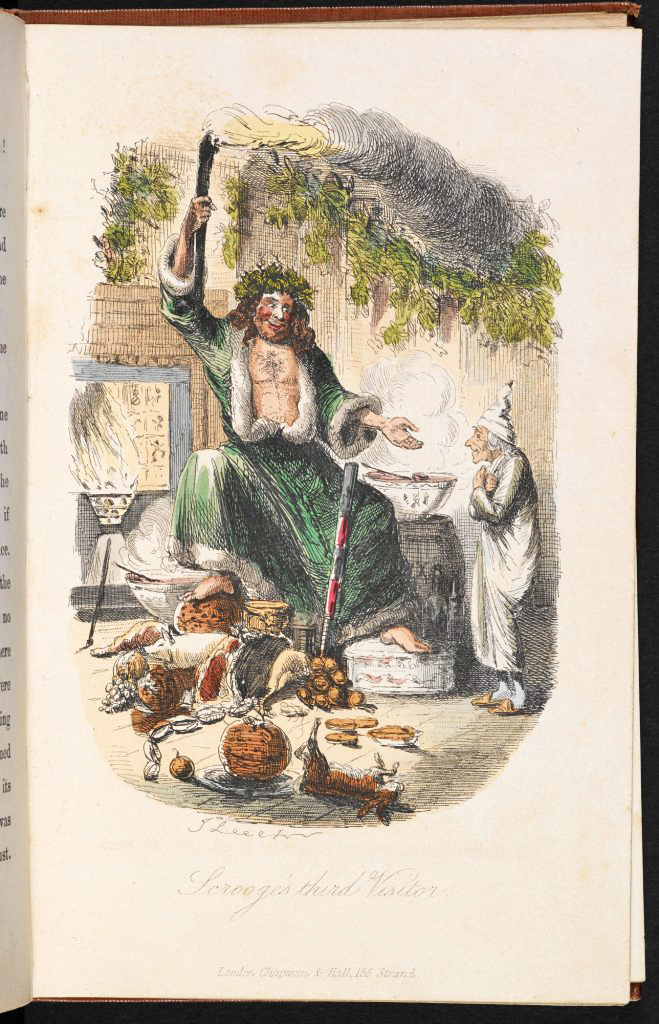 Because of Dickens’ beliefs it is no wonder that Ebenezer, the stone that helps, takes on a form that merely looks like the author’s own conception of Christ in the story. You see, Scrooge became more “Christ-like” by being scared out of his wits by ghosts of his past. These ghosts persuaded him to become nice, generous and caring instead of greedy and grumbling. While these might be commendable traits this is a very watered-down summation of Christ’s teachings and an obvious attempt to use Christmas as a crutch for this message. Repentance is not enough to save you. It is making Christ Lord over your life that saves you. In this tale it is not God or Christ leading Scrooge to repentance. It is pagan, worldly ideas, myths and legends which inspire his so-called morality.
It is no wonder it is the iconic tale that defined Christmas, a holiday that was, from its Christianized inception, aimed to unite disparate groups of people in a common harmony, much like Constantine did to unite the Roman Empire. A Christmas Carol doesn’t really have Christ in it, but it does have other elements of spirituality, elements that are clearly pagan in nature. For example, it wasn’t Christ that inspired Scrooge to change. It was the ghosts of Christmas past, present and yet to come. The Ghost of Christmas Present is a perfect depiction of the Germanic Holly King, complete with symbols of firelight, life and abundance in the midst of winter’s desolation (see illustration). Similarly, the Ghost of Christmas Present bore a striking, purposeful resemblance to the Grim Reaper, who is the personification of Death. The Grim Reaper has his origins in the symbolism of Cronos/Saturn, who was an unpleasant, elderly man carrying a scythe and ruling over time. Father Time also shares in the same roots and is closely associated with the old year transitioning to the new year. It was the fear of death and leaving behind a legacy of selfishness that finally made Scrooge decide to be more selfless. That’s Humanism, not Christianity. Many Christians have a narrow view of paganism. Pagans have morals too. They don’t all go around conducting sexual rituals and child sacrifices. Many pagans would be considered very moral, humanitarian people. So, what then, separates Christian morality from pagan? Remember, Satan comes disguised as an angel of light (2 Corinthians 11:14). He is trying to look like Christ, who is the light and life of the world. He wants to deceive you into thinking you are behaving according to God’s will when really, it is his will that you are doing.
Woe to those who call evil good and good evil, who put darkness for light and light for darkness, who put bitter for sweet and sweet for bitter. Isaiah 5:20
If Dickens understood the name Ebeneezer then perhaps the “Stone of help,” who is Christ, would have a place in his story. If so, it would have been a much different telling, but then again, it probably wouldn’t have inspired the following generations to adopt “morally acceptable” pagan traditions. I doubt he would have written the book at all if that were the case, because the true Gospel is not a popular message.
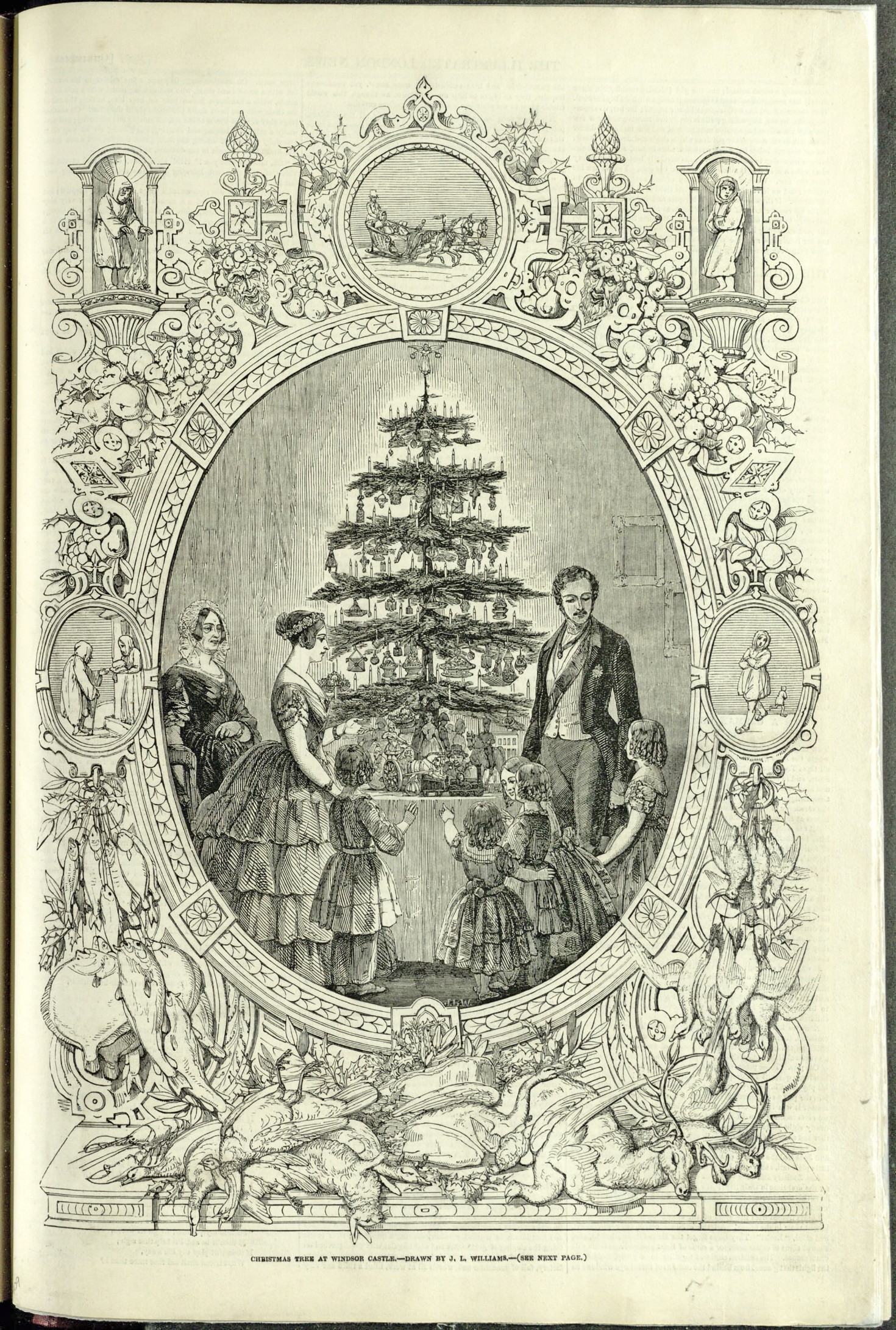 It is interesting to me that Queen Victoria was a lover of Dickens’ writings. In 1848, an engraving was published in in the Illustrated London News of a Christmas tree in Windsor Castle surrounded by Queen Victoria, Prince Albert, their servants and several children (see illustration). This was a depiction of an event that actually occurred. Prince Albert brought an evergreen, called a Tannenbaum, into the castle as part of his German heritage. This cover story’s image, along with Dickens’ story, inspired people in both Europe and America to begin reviving and reinventing the image and spirit of Christmas, filtering out centuries of licentiousness, leaving the relics of things deemed good and worthy of practice by the judgment of men, not God. Within 10 years Christmas trees were a standard tradition in homes all across the western world.
If you think a Christmas tree is nothing more than just a decoration, recall the popular carol, “O, Christmas Tree” which is a 19th century adaptation of a 16th century German folk song titled “Auch Tannenbaum” which had nothing to do with Christianity. The lyrics of the 19th century song say pretty much the same thing as the 16th, but with more words.
O Tannenbaum, O Tannenbaum, How faithfully you blossom! Through summer’s heat and winter’s chill, Your leaves are green and blooming still. O Tannenbaum, O Tannenbaum, How faithfully you blossom!
O Tannenbaum, O Tannenbaum, With what delight I see you! When winter days are dark and drear, You bring us hope for all the year. O Tannenbaum, O Tannenbaum, With what delight I see you!
The royal tannenbaum as seen in Illustrated London News, 1848
O Tannenbaum, O Tannenbaum, You bear a joyful message: That faith and hope shall ever bloom, To bring us light in winter’s gloom. O Tannenbaum, O Tannenbaum, You bear a joyful message
Have you ever noticed that they are singing to a tree? They are looking to a tree as a symbol of constancy and faithfulness, not to Christ as their source of these things. Oh, but it’s ridiculous to say it’s idolatry, right? Well, isn’t it ridiculous to sing to a tree? The thing is brought indoors as a symbol of life in the dead of winter, just as it has been done by the traditions of men for thousands of years. We’ll examine this in more detail later.
It was not long before Christians started trying to make Christmas about Christ, but Spurgeon was arguing that it was not a Christian cause, that we should ignore the holiday and be separate from the world. His Puritan counterparts from the 16th century would wholeheartedly agree. Sure, the Puritans were often very legalistic, but at least they had a desire for purity and godliness. I feel the same way about such religious movements as the Anabaptists, Amish and Mennonites (even if these various groups have compromised a lot over the last few generations). Unfortunately, most people that decide to abandon the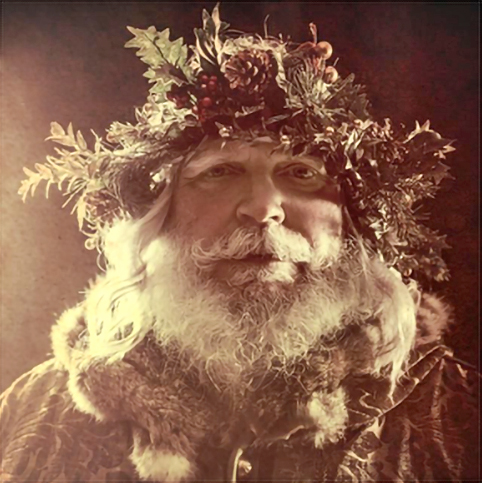 legalism of these denominations only wind up blanketly calling any form of religious confrontation legalism. It’s a shame because purity doesn’t have to be legalistic, and many times those who are being called pharisees are being called such by the pharisees of a “new-and-improved” version of Christianity. They are legalistic about not being legalistic.
The Holly King is an ancient Germanic/Celtic/Norse personification of wintertime, which inspired the modern Father Christmas. Compare the likenesses of the Holly King to the depiction of the Ghost of Christmas Present in Dickens’ A Christmas Carol. Holly King and Oak KingThe Ghost of Christmas Present
Charity
The “spirit of Christmas,” which stories like A Christmas Carol promote, mean to suggest that through philanthropy one can gain a happy, fulfilling life. Donations to charity skyrocket at this time of year. It is easy for a Christian to justify “getting in the Christmas spirit” because it is supposedly Christ-like to give to those in need, but are you getting into the spirit of Christmas or is it getting into you? If the definition of being Christ-like is charity to everyone and if Christ was a humanitarian, why did He walk by the crippled man at the temple knowing He could heal Him? Surely, He saw this man, who was lame from birth and was brought to the temple daily to beg for alms. Why did He wait and let Peter heal him?
Now Peter and John went up together to the temple at the hour of prayer, the ninth hour. And a certain man lame from his mother’s womb was carried, whom they laid daily at the gate of the temple which is called Beautiful, to ask alms from those who entered the temple; who, seeing Peter and John about to go into the temple, asked for alms. And fixing his eyes on him, with John, Peter said, “Look at us.” So he gave them his attention, expecting to receive something from them. Then Peter said, “Silver and gold I do not have, but what I do have I give you: In the name of Yahshua Christ of Nazareth, rise up and walk.” Acts 3:1–6
Yahshua went to the temple often and surely would have seen this man. Why didn’t He heal him? Why, being full of the grace of God and wise beyond His years as a child, did He restrict His ministry to only three years when He could have been preaching the Gospel and healing everyone He came across His whole life? The answer is simple. Christ only ever did the will of the Father. If it was not God’s will that He heal, then He did not heal.
Now as Yahshua passed by, He saw a man who was blind from birth. And His disciples asked Him, saying, “Rabbi, who sinned, this man or his parents, that he was born blind?”
Yahshua answered, “Neither this man nor his parents sinned, but that the works of God should be revealed in him.” John 9:1–5
God appointed a time for this man to be healed, just as He did for the crippled man at the pool of Bethesda in John 5. This man went there often to get healed, but someone always beat him to it, because only the first person in the pool that day could get healed. Would you think it cruel of God to allow this man to constantly get outrun by more capable men? Clearly, He had a plan for him, so who are we to rail against God? Would we, seeing this injustice and by the works of our own hands, try to heal this man not knowing God’s plan for him? That might not be pleasing to God because there was a greater glory revealed by this man being healed on that specific day. Yahshua explains why He healed Him when He did:
“My Father has been working until now, and I have been working… the Son can do nothing of Himself, but what He sees the Father do; for whatever He does, the Son also does in like manner… For as the Father raises the dead and gives life to them, even so the Son gives life to whom He will. For the Father judges no one, but has committed all judgment to the Son… For as the Father has life in Himself, so He has granted the Son to have life in Himself, and has given Him authority to execute judgment… I can of Myself do nothing. As I hear, I judge; and My judgment is righteous, because I do not seek My own will but the will of the Father who sent Me. John 5:19–30
This passage is rich in wisdom. The Son always seeks to do the will of the Father, and because of this the Father has granted the Son the ability to exercise His own judgment and will, because it is perfectly in line with the Father’s will. This is because the Father has taught His Son well and He is His perfect representative. The Son judged the right time to heal these men because He knew the will of the Father. Just as He could see that the blind man was not blind due to sin, He saw that there was a time and place for His Father’s glory to be shown in his healing. He followed the Spirit. It was that very day when the event got written into history for us to read.
So, in light of this reality, which is called Sabbath rest, are Christians always supposed to be charitable? Do you get a reward for giving regardless of when or to whom you are giving? I suppose the real question is, can we make charity into an idol? We can take anything good and turn it into an idol by the works of our own hands. How? The Spirit of Babylon is the worship of humanity above God. Humanitarianism is an idea people fall in love with because it fits their own view of morality. People forget that God’s morality is not their morality. When humanitarianism takes precedence over God, you have become an idolater. Remember, Yahshua reduced the 10 Commandments to 2, saying the first is, “Love the Lord your God with all your heart, mind, soul and strength…” and the second being, “Love your neighbor as yourself.” The second cannot become the first. When it does you can expect judgment to come sooner or later.
I will utter My judgments against them concerning all their wickedness,
Because they have forsaken Me, burned incense to other gods,
And worshiped the works of their own hands.
Jeremiah 1:16
Over and over in the Bible we see idolatry being defined as worshiping the works of one’s own hands. We will be looking at more examples of this in the pages to come. Essentially, if your charity and humanitarianism is the works of your own hands, not being led by the Spirit, it is worthless to God. However, if your charity is the work of God, driven by His Spirit, then it is commendable in His sight. Knowing the difference is knowing when God is speaking to you and when you are following the dictates of the world, which often try to imitate God. We are exhorted to know the difference.
Like newborn babies, crave pure spiritual milk, so that by it you may grow up in your salvation.
1 Peter 2:2
But solid food belongs to those who are of full age, that is, those who by reason of use have their senses exercised (trained) to discern both good and evil.
Hebrews 5:14For this reason, since the day we heard about you, we have not stopped praying for you and asking God to fill you with the knowledge of His will in all spiritual wisdom and understanding, so that you may walk in a manner worthy of the Lord and may please Him in every way: bearing fruit in every good work, growing in the knowledge of God.
Colossians 1:9-10
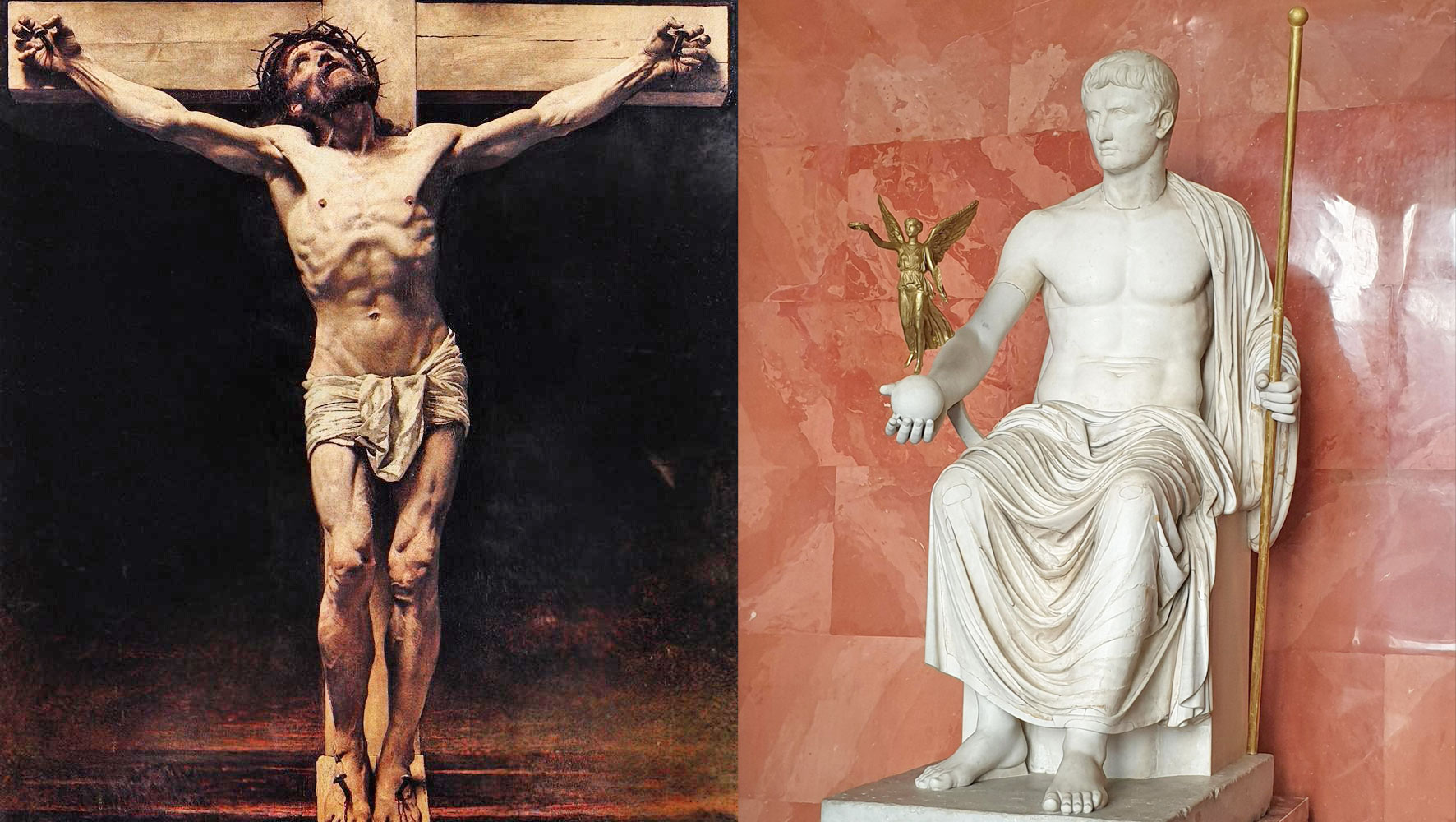
Christian Vs. Roman Evangelism
What better place to learn how to discern purity vs harlotry than an examination of the Greek behind the word “gospel?” This will definitively reveal the difference between Christian evangelism and Roman evangelism, since evangelism is not a concept isolated to Christianity.
In John 19 the Jews are pressing Pilate, the Roman prefect in Judea, to crucify Yahshua. When Pilot resists them the Jews threaten him with the possibility of taking the matter to Caesar. Why would Caesar even hear them on this matter? Let’s look at what the Bible says.
The Jews answered him, “We have a law, and according to our law He ought to die, because He made Himself the Son of God.” Therefore, when Pilate heard that saying, he was the more afraid, and went again into the Praetorium, and said to Jesus, “Where are You from?” But Jesus gave him no answer. Then Pilate said to Him, “Are You not speaking to me? Do You not know that I have power to crucify You, and power to release You?” Yahshua answered, “You could have no power at all against Me unless it had been given you from above. Therefore the one who delivered Me to you has the greater sin.”
From then on Pilate sought to release Him, but the Jews cried out, saying, “If you let this Man go, you are not Caesar’s friend. Whoever makes himself a king speaks against Caesar.”
When Pilate therefore heard that saying, he brought Jesus out and sat down in the judgment seat in a place that is called The Pavement, but in Hebrew, Gabbatha. Now it was the Preparation Day of the Passover, and about the sixth hour. And he said to the Jews, “Behold your King!”
But they cried out, “Away with Him, away with Him! Crucify Him!”
Pilate said to them, “Shall I crucify your King?”
The chief priests answered, “We have no king but Caesar!”
Then he delivered Him to them to be crucified. Then they took Jesus and led Him away.
John 19:7–16
There’s a lot going on here which history along with the Bible clarifies.
Then the whole multitude of them arose and led Him to Pilate. And they began to accuse Him, saying, “We found this fellow perverting the nation, and forbidding to pay taxes to Caesar, saying that He Himself is Christ, a King.”
Luke 23:1–2
In the Roman culture, the term “Christ” was perceived as a threat to Caesar’s kingship. Christos is the Greek version of the Hebrew word, “mashiach,” meaning Messiah. The Romans believed that Caesar was a divinely appointed King and Savior, the Lord and son of the divine, who brings good news from Heaven of salvation for all, the same terminology used by Christians. The Priene Inscription (9 BC) about Augustus declares this.
The Romans attributed deity to Caesar and placed him on the level of a demi-god, a long-standing tradition after the deification of Alexander the Great. They literally worshiped Caesar as a mediator to their gods. Do you see why Pilot reacted to the threat of the Jews by letting them have their way rather than having the situation escalated to Caesar?
What is even more striking about this scene is the Jews confessed Caesar to be their king, rejecting Yahshua. For the entire time of the Roman occupation in Israel the Jews largely rejected the Romans and were quite troublesome to them from time to time because they didn’t want to recognize Caesar as king. For them to declare this publicly was a big deal. They declared their allegiance before God and men to Caesar, rejecting the King God sent to them. In essence (and maybe they didn’t fully realize this) they chose their Messiah. This was the beginning of the end for the Temple of Jerusalem. Remember, Yahshua prophesied twice about the falling of Jerusalem:
For days will come upon you when your enemies will build an embankment around you, surround you and close you in on every side, and level you, and your children within you, to the ground; and they will not leave in you one stone upon another, because you did not know the time of your visitation.”
Luke 19:43–44Then as He went out of the temple, one of His disciples said to Him, “Teacher, see what manner of stones and what buildings are here!”
And Jesus answered and said to him, “Do you see these great buildings? Not one stone shall be left upon another, that shall not be thrown down.”
Mark 13:1–2
In December of 2019 I was researching the word “gospel’s” in Mark 8:35 when I ran across something particularly appropriate for the time of year. I wasn’t looking for it, but I stumbled on information that connected some of the pagan traditions I had heard of but didn’t quite understand how they connected historically to Christmas. Let’s read the verse for context.
For whoever desires to save his life will lose it, but whoever loses his life for My sake and the gospel’s will save it. For what will it profit a man if he gains the whole world, and loses his own soul?
Mark 8:35–36
I noticed the Greek word translated as “gospel’s” is the word “evangeliou” (εὐαγγελίου). This is what caught my attention. The gospel is evangelism. I had to look further into the meaning and history of evangelism, which is the etymological extension of the word angel. The Theological Dictionary of the New Testament says (parenthetical translations and definitions added for clarity):
εὐαγγέλιον (euaggelion or good news) in the imperial cult. This is the most important usage for our purpose. Note must be taken of what is said concerning the θεῖος ἄνθρωπος (Theos anthropos or God man → 712), τύχη (tyche or governing deity, usually Fortuna) and σωτηρία (soteria or salvation). The emperor unites all these in his own person. This is what gives εὐαγγέλιον (good news) its significance and power. The ruler is divine by nature. His power extends to men, to animals, to the earth and to the sea. Nature belongs to him; wind and waves are subject to him. He works miracles and heals men. He is the saviour of the world who also redeems individuals from their difficulties (→ σωτήρ or soter, meaning savior). Τύχη (Tyche) is linked up with his person; he is himself τύχη. He has appeared on earth as a deity in human form. He is the protective god of the state. His appearance is the cause of good fortune to the whole kingdom. Extraordinary signs accompany the course of his life. They proclaim the birth of the ruler of the world. A comet appears at his accession, and at his death signs in heaven declare his assumption into the ranks of the gods. Because the emperor is more than a common man, his ordinances are glad messages and his commands are sacred writings. What he says is a divine act and implies good and salvation for men. He proclaims εὐαγγέλια through his appearance, and these εὐαγγέλια treat of him (→ 713). The first evangelium is the news of his birth: ἦρξεν δὲ τῶι κόσμωι τῶν διʼ αὐτὸν εὐανγελι[ων ἡ γενέθλιος] τοῦ θεοῦ. “The birthday of the god was for the world the beginning of the joyful messages which have gone forth because of him.” Other εὐαγγέλια follow, e.g., the news of his coming of age and esp. his accession: ἐπεὶ γν[ώ]στ[ης ἐγενόμην τοῦ] εὐαγγελ[ίο]υ περὶ τοῦ ἀνηγορεῦσθαι Καίσαρα τὸν τοῦ θεοφιλεστάτου κυρίον ἡμῶν … Joy and rejoicing come with the news. Humanity, sighing under a heaven burden of guilt, wistfully longs for peace. Doom is feared because the gods have withdrawn from earth. Then suddenly there rings out the news that the σωτήρ (savior) is born, that he has mounted the throne, that a new era dawns for the whole world. This εὐαγγέλιον (evangelion) is celebrated with offerings and yearly festivals. All cherished hopes are exceeded. The world has taken on a new appearance. The imperial cult and the Bible share the view that accession to the throne, which introduces a new era and brings peace to the world, is a gospel for men. We can explain this only by supposing a common source. This is generally oriental. To the many messages, however, the NT opposes the one Gospel, to the many accessions the one proclamation of the → βασιλεία τοῦ θεοῦ (Kingdom of God). The NT (New Testament) speaks the language of its day. It is a popular and realistic proclamation. It knows human waiting for and hope of the εὐαγγέλια, and it replies with the εὐαγγέλιον, but with an evangel of which some might be ashamed, since it is a σκάνδαλον (skandalon or stumbling block – referring to the message Yahshua preached) (Mt. 11:5 f.; R. 1:16; 1 C. 1:17, 23; 2 Tm. 1:8; Mk. 8:35). The Gospel means for men σωτηρία (soteria or salvation), but σωτηρία through → μετάνοια (metanoia or repentance) and judgment (→ 728 f., 732). For many this Gospel may be ironical when they hear it (cf. Ac. 17:32). But it is real joy; for penitence brings joy, and judgment grace and salvation. Caesar and Christ, the emperor on the throne and the despised rabbi on the cross, confront one another. Both are evangel to men. They have much in common. But they belong to different worlds.
In reading this (without my added commentary) one might feel like this perfectly justifies celebrating Christ’s birth. After all He is the One who was born, proclaimed by men and miracles, brought the Good News, ushered in the foundation stone of His spiritual kingdom… I mean the description of how the Roman culture honored Caesar is spot on with the coming of Christ. Why not simply apply it to Christ and give credit where credit is due? Ah, but here is the line that brings it all into focus, the best line, saved for last:
“But they belong to different worlds.”
This is the kicker of this entire exposition. The Christian gospel is not the same as the Roman gospel. In fact, it is polar opposite, even if it has similar concepts. It goes on to say:
“For many this Gospel may be ironical when they hear it (cf. Ac. 17:32). But it is real joy; for penitence brings joy, and judgment grace and salvation.”
Why would good news be ironic? Because it doesn’t sound like good news to those who don’t like the message. Can you see how it would be easy for churches to syncretize with the Roman gospel seeing that there are so many similarities to the messaging found in Scripture? It would only be by misunderstanding that someone would do such a thing, though. That or a desire for the world above Christ.
Note that the birth of the emperor in the Roman culture, was marked by yearly celebrations. These celebrations occurred in the Winter, as is seen in ancient Roman writings and on their calendars.
Christ’s Birthday
Perhaps Yahshua’s birthday was never recorded by the apostles for a good reason. We aren’t supposed to worship like the heathen do—in this case, the Roman traditions associated with the worship of the Caesar. Christ’s birth was not calculated or even celebrated until centuries after His death. Early apostolic fathers criticized bishops who were pushing so hard to make this a yearly celebration. There were several theories as to the day but no consensus. Why? Because no one knew the day. Then by necessity they would have to make it up.
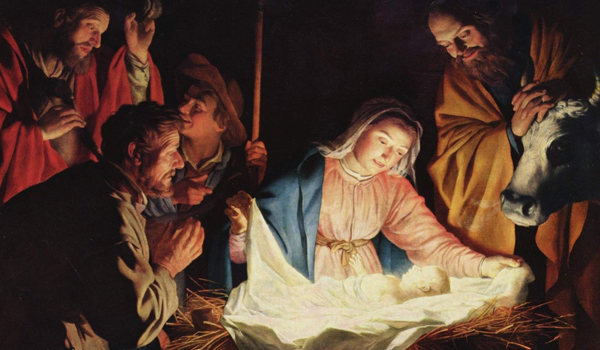 The earliest attempts to calculate Yahshua’s birthday were based on assumptions and superstitions. One common superstition used to calculate His birthday comes from a Jewish tradition which teaches that a prophet is born and dies on the same day. Another fallacy contrived by Hippolytus of Rome in the 3rd century says that Yahshua was conceived on March 25th so He must have been born on December 25th. Interestingly enough, Hippolytus also incorrectly calculated His second advent to 500AD. This certainly doesn’t lend him credibility in regard to Christ’s birthday. Besides, all reasonable evidence points to Christ being born in the Spring or Fall. I’d still like to know, though, why an unbiblical celebration would be such a priority to contrive anyway? Let’s look at some of the hoops people jump through to arrive at a date.
“There are those who have calculated not only the year of our Lord’s birth, but also the day. They say that it took place in the twenty-eighth year of Augustus, on the twenty-fifth day of Pachon [May 20] … Others say that He was born on the twenty-fourth or twenty-fifth day of Pharmuthi [April 19 or 20].” Clement of Alexandria (c. 195)
In the fourth century, a tract falsely attributed to John Chrysostom called The solstices and equinoxes, the conception and birth of Jesus and John the Baptist (II), says:
“But Our Lord, too, is born in the month of December … the eight before the calends of January [25 December] …, But they call it the ‘Birthday of the Unconquered’. Who indeed is so unconquered as Our Lord …? Or, if they say that it is the birthday of the Sun, He is the Sun of Justice.”
We can see here that the writer of this tract is attempting to detract away from the pagan association of the winter holiday and instead point towards Christ, using a metaphor from the Bible as support for his statement. Notice the implication is that pagans were first using this symbolism and the argument is a response to that. One such justification some Christians hold supporting the Christianization of The Birthday of the Unconquerable Sun is that the Bible uses the metaphor of the sun to refer to the Son of God:
But to you who fear My name the Sun of Righteousness shall arise with healing in His wings; and you shall go out and grow fat like stall-fed calves. Malachi 4:2
I hardly see this as a justification for converting a pagan holiday to a Christian one. Just because a metaphor is used in the Bible doesn’t mean we are permitted to use it in the justification of our traditions.
Besides not having any evidence in Scripture of people celebrating birthdays annually, according to Origen, many early Christians appeared to have an aversion to celebrating birthdays because of the importance placed on the birthday of the Caesar in association with the birthdays of Roman gods.
“…of all the holy people in the Scriptures, no one is recorded to have kept a feast or held a great banquet on his birthday. It is only sinners (like Pharaoh and Herod) who make great rejoicings over the day on which they were born into this world below.” (Origen, in Levit., Hom. VIII, in Migne P.G., XII, 495)
Let’s get this straight, birthdays aren’t necessarily bad, yet I have heard it said that because Psalm 90:12 says, “So teach us to number our days, that we may gain a heart of wisdom,” we are actually encouraged in the Bible to celebrate birthdays. That’s not really the case. Look at the context of the Psalm. It is about Yahweh’s anger and wrath, and the fear of Him. This same sentiment is echoed in Psalm 39:4 placing emphasis on the fear of the wrath of God:
Yahweh, make me to know my end, and what is the measure of my days, that I may know how frail I am. Psalm 39:4
This numbering of days is specifically to remind us of the majesty and glory of God through a heart of humble repentance. This is the opposite of the Roman concept of life, which is to “eat, drink and be merry! For tomorrow we die!” Remember what Paul said in response to Christians of his day teaching there is no resurrection of the dead:
I affirm, by the boasting in you which I have in Christ Jesus our Lord, I die daily. If, in the manner of men, I have fought with beasts at Ephesus, what advantage is it to me? If the dead do not rise, “Let us eat and drink, for tomorrow we die!” 1 Corinthians 15:31–32
Paul is telling us not to live for today but for the resurrection to come. Our celebration is in taking up our cross and living in service to our Lord, Yahshua. I can see why early Christians would have wanted to be set apart from such elated celebrations. I can see why they wouldn’t want their lives to be perceived as corrupted by pagan practices. Preachers and writers like Spurgeon and Tertullian were pointing to this very idea. The Roman midwinter festivals which gave rise to the Holiday Season as we know it are not in honor of Christ because they are in the manner of men.
Just to be clear, I don’t discourage anyone from being thankful of the years God has given them, nor to refrain from celebrating their birthday with friends and family, but just remember what you are celebrating. It is another day God has given you. Does it really matter if the day happens to be on the anniversary of your birth? My personal conviction is that I don’t care either way whether anyone remembers my birthday or not so long as they remember what Yahshua told them to remember, that is, the breaking of His body and the spilling His blood for us. That is something we should do every day. Recall Spurgeon’s words, “Regarding not the day, let us give God thanks for the gift of His dear Son.” Yahshua never told us to remember the day He was born, nor any day in particular but the day of the Lord. We also count the number of our years, not for the sake of the flesh, but in thankfulness towards God for atoning for our sins and doing His good works in us. No ceremony, ritual or tradition will suffice for that but what God has ordained. What He ordained is above days or seasons or years. Let us honor Him in like fashion.
If the emperor’s gospel is celebrated with yearly festivals does that mean Christ’s Gospel should too? If these two gospels belong to different worlds then why should those who are “little Christs,” that is, “Christians,” mimic that of the world? As Paul says in Hebrews 11:13, we are “strangers and pilgrims on the earth.”
“The kingdom [domain] of God does not come with observation; nor will they say, ‘See here!’ or ‘See there!’ For indeed, the kingdom of God is within you.” Luke 17:20-22
This made no sense to most Romans because they were altogether focused on the tangible domain of this world, which they believed Caesar was the anointed ruler over. Tacitus describes why the Romans hated Christians.
“Therefore, first those were seized who admitted their faith, and then, using the information they provided, a vast multitude were convicted, not so much for the crime of burning the city, but for hatred of the human race.” -Tacitus, The Annals (c. 116 CE)
It’s interesting that some things never change. Those who proclaim the love of God and the rejection of the world are invariably labeled as “haters” by unbelievers, and even worse, by those who are believers. How much has humanism infiltrated and changed the Gospel so that it will avoid this label? Do you fear being called a hater because you proclaim FIRST the love of God? Is the love of God separable from His chastening if “He whom He loves He also chastens” (Hebrews 12:6)? So those who speak hard truths in exhortation are evil because they are not creating “peace and security.” Is this not the mind of the Romans, who persecuted Christians for being haters of the human race?
The Romans took it to the extreme by framing Christians for crimes they likely did not commit (at least, not true Christians). So too is the present condition of humanity placing blame on Christianity for hatred of the human race and crimes against humanity, for standing up for biblical principles and godly behavior. Perhaps it is rightly so, for many who call themselves Christians have given the title a bad rap by following the world first and Christ second, if at all.
The Christian Gospel is polar opposite of the Roman gospel, even if it contains similar symbolism. Why is it despised so by the world? Because the world’s gospel is focused on the world. The Christian Gospel is focused on Christ. The two cannot be mixed and maintain purity. The Gospel tells us we are strangers and pilgrims on the earth (Hebrews 11:13), citizens of a heavenly kingdom (Philippians 3:20). It is a rejection of the world (James 4:4), and so it is a rejection of humanism. Humanists would say that if you reject humanism then you must hate humans. This is the line of thinking that sparked the Roman persecutions of Christians. Rome may have been sacked and the Empire felled, but the spirit lives on to this day all around us as evidenced in the statues, art, customs and traditions our cultures have adopted.
The spirit of Rome (aka Babylon, aka Humanism) is alive and well, and it may have even found its way into your heart, believer or unbeliever. Much of what Christians do today is the result of tradition and the influence of other professing believers. If we limit our walk of faith to what we see others doing, too lazy and complacent to press on further, then we will surely fall short of God’s will for us. You must press on, demonstrating your love for God by exercising initiative in your pursuit of Him. While you do so ask Him to reveal everything that is not pleasing to Him—to open and close doors on your path to Him. He is faithful to lead you. Paul concurs with:
“Examine yourselves to see whether you are in the faith.” 2 Corinthians 13:5
Pagan Midwinter’s Festivals
The second century theologian Tertullian anticipates and heralds Spurgeon’s sentiment almost 1600 years earlier in the following excerpt from his book titled, On Idolatry. It’s a long, deep statement, so you may need to read it a couple of times to pick up on his wit. I have taken the liberty to copy excerpts from the work since copying the entire 3 chapters would be cumbersome to include, but I highly recommend you find and read it at your leisure if possible. Although he makes some great assertions, I must point out that his statement is not without some error. I have added a couple of notes in correcting these errors. You will find some error in all the early church father’s writings. For the sake of continuity, let’s not dwell on those errors, but rather focus on the topic at hand, which pertains to the holidays he is referring to.
CHAP. XII.—FURTHER ANSWERS TO THE PLEA, HOW AM I TO LIVE?
If you wish to be the Lord’s disciple, it is necessary you “take your cross, and follow the Lord:” your cross; that is, your own straits and tortures, or your body only, which is after the manner of a cross. Parents, wives, children, will have to be left behind, for God’s sake. Do you hesitate about arts, and trades, and about professions likewise, for the sake of children and parents? Even there was it demonstrated to us, that both “dear pledges,” and handicrafts, and trades, are to be quite left behind for the Lord’s sake; while James and John, called by the Lord, do leave quite behind both father and ship; while Matthew is roused up from the toll-booth; while even burying a father was too tardy a business for faith. None of them whom the Lord chose to Him said, “I have no means to live.” Faith fears not famine. It knows, likewise, that hunger is no less to be contemned by it for God’s sake, than every kind of death. It has learnt not to respect life; how much more food? [You ask] “How many have fulfilled these conditions?” But what with men is difficult, with God is easy. Let us, however, comfort ourselves about the gentleness and clemency of God in such wise, as not to indulge our “necessities” up to the point of affinities with idolatry, but to avoid even from afar every breath of it, as of a pestilence. [And this] not merely in the cases forementioned, but in the universal series of human superstition; whether appropriated to its gods, or to the defunct, or to kings, as pertaining to the selfsame unclean spirits, sometimes through sacrifices and priesthoods, sometimes through spectacles and the like, sometimes through holy-days.
CHAP. XIII.—OF THE OBSERVANCE OF DAYS CONNECTED WITH IDOLATRY
In this place must be handled the subject of holidays and other extraordinary solemnities, which we accord sometimes to our wantonness, sometimes to our timidity, in opposition to the common faith and Discipline. The first point, indeed, on which I shall join issue is this: whether a servant of God ought to share with the very nations themselves in matters of his kind, either in dress, or in food, or in any other kind of their gladness. “To rejoice with the rejoicing, and grieve with the grieving,” is said about brethren by the apostle when exhorting to unanimity. But, for these purposes, “There is nought of communion between light and darkness,” between life and death or else we rescind what is written, “The world shall rejoice, but ye shall grieve. If we rejoice with the world, there is reason to fear that with the world we shall grieve too. But when the world rejoices, let us grieve; and when the world afterward grieves, we shall rejoice.”
If you are not unknown to be a Christian, you are tempted, and you act as if you were not a Christian against your neighbour’s conscience; if, however, you shall be disguised withal, you are the slave of the temptation. At all events, whether in the latter or the former way, you are guilty of being “ashamed of God.” But “whosoever shall be ashamed of Me in the presence of men, of him will I too be ashamed,” says He, “in the presence of my Father who is in the heavens.”
CHAP. XIV.—OF BLASPHEMY. ONE OF ST. PAUL’S SAVINGS
But, however, the majority (of Christians) have by this time induced the belief in their mind that it is pardonable if at any time they do what the heathen do, for fear “the Name be blasphemed.” Now the blasphemy which must quite be shunned by us in every way is, I take it, this: If any of us lead a heathen into blasphemy with good cause, either by fraud, or by injury, or by contumely, or any other matter of worthy complaint, in which “the Name” is deservedly impugned, so that the Lord, too, be deservedly angry. Else, if of all blasphemy it has been said, “By your means My Name is blasphemed,” we all perish at once; since the whole circus, with no desert of ours, assails “the Name” with wicked suffrages. Let us cease (to be Christians) and it will not be blasphemed! On the contrary, while we are, let it be blasphemed: in the observance, not the overstepping, of discipline; while we are being approved, not while we are being reprobated. Oh blasphemy, bordering on martyrdom, which now attests me to be a Christian, while for that very account it detests me! The cursing of well-maintained Discipline is a blessing of the Name. “If,” says he, “I wished to please men, I should not be Christ’s servant.” But the same apostle elsewhere bids us take care to please all: “As I,” he says, “please all by all means.” No doubt he used to please them by celebrating the Saturnalia and New-year’s day! [Was it so] or was it by moderation and patience? by gravity, by kindness, by integrity? In like manner, when he is saying, “I have become all things to all, that I may gain all,” does he mean “to idolaters an idolater?” “to heathens a heathen?” “to the worldly worldly?” But albeit he does not prohibit us from having our conversation with idolaters and adulterers, and the other criminals, saying, “Otherwise ye would go out from the world,” of course he does not so slacken those reins of conversation that, since it is necessary for us both to live and to mingle with sinners, we may be able to sin with them too. Where there is the intercourse of life, which the apostle concedes, there is sinning, which no one permits. To live with heathens is lawful, to die with them is not. Let us live with all; let us be glad with them, out of community of nature, not of superstition. We are peers in soul, not in discipline; fellow-possessors of the world, not of error. Man does not possess the world as of yet. It has not been taken from the “ruler of this age,” who is Satan. See 2 Corinthians 4:4, 1 John 5:19, Ephesians 2:2. It is important to understand that Adam surrendered to the beast nature and the dominion given him was usurped by Satan for the duration of this entire age. Yahshua’s kingdom is a spiritual kingdom within His saints, yet the earth has been declared His for the age to come.. But if we have no right of communion in matters of this kind with strangers, how far more wicked to celebrate them among brethren! Who can maintain or defend this? The Holy Spirit upbraids the Jews with their holy-days. “Your Sabbaths, and new moons, and ceremonies,” says He, “My soul hateth.” By us, to whom Sabbaths are strange, and the new moons and festivals formerly beloved by God, the Saturnalia and New-year’s and Midwinter’s festivals Note the word for “Midwinter’s festivals” is Brumae in the Latin. We’ll come back to this later. and Matronalia are frequented—presents come and go—New-year’s gifts—games join their noise—banquets join their din! Oh better fidelity of the nations to their own sect, which claims no solemnity of the Christians for itself! Not the Lord’s day, not Pentecost, even it they had known them, would they have shared with us; for they would fear lest they should seem to be Christians. We are not apprehensive lest we seem to be heathens! If any indulgence is to be granted to the flesh, you have it. I will not say your own days, but more too; for to the heathens each festive day occurs but once annually: you have a festive day every eighth day were meeting on Sunday, the first day of the week and relating it, unscripturally, to the resurrection of Christ and of the church. This is a man-made tradition.]. Call out the individual solemnities of the nations, and set them out into a row, they will not be able to make up a Pentecost. Tertullian. On Idolatry, Chapter XIV, c. 190 AD
There is so much to break down here, but I will focus more on the last chapter above. First, Tertullian was warning Christians about leading heathens into blasphemy “with good cause” and by doing so were assailing the Name with “wicked suffrages.” This is our indicator that Christians were trying to win pagans into the fold by appealing to the Roman cultural practices they were accustomed to. Toward the end he tells them that they are not apprehensive to look like pagans, but pagans are apprehensive to look like Christians. He calls what Christians were doing (adopting the Brumae) worldly, idolatry and sin.
Similarly, Paul says in Galatians 4:8-11:
But then, indeed, when you did not know God, you served those which by nature are not gods. But now after you have known God, or rather are known by God, how is it that you turn again to the weak and beggarly elements, to which you desire again to be in bondage? You observe days and months and seasons and years. I am afraid for you, lest I have labored for you in vain.
In other words, these Anatolian Greeks served Grecco-Roman gods by observing days, months seasons and years before they became Christians, and now, after they have become Christians, they are adopting Jewish holy days, which Paul is equating to their former Grecco-Roman holidays, calling them both “weak and beggarly elements.” Paul is discouraging this sort of behavior, which is what Tertullian is reiterating in his own words. Evidently, in Tertullian’s day, Greek Christians were returning to some of their former pagan ways while trying to maintain their Christian identity.
Saturnalia and Brumalia
All the festivals called out by Tertullian were Roman pagan holidays. Saturnalia was celebrated at the end of December around the time of the Winter Solstice, somewhere between December 17th and 23rd, depending on which emperor was reigning at the time. Brumalia was the cumulative holiday season which started on November 24th and continued to the end of the week-long holiday of Saturnalia. Let’s recall what Lucian wrote between 125 AD and 180 AD in Saturnalia, from the perspective of the Greek god, Saturn:
Mine is a limited monarchy, you see. To begin with, it only lasts a week; that over, I am a private person, just a man in the street. Secondly, during my week the serious is barred; no business allowed. Drinking and being drunk, noise and games and dice, appointing of kings and feasting of slaves, singing naked, clapping of tremulous hands, an occasional ducking of corked faces in icy water,–such are the functions over which I preside. But the great things, wealth and gold and such, Zeus distributes as he will… this festive season, when ’tis lawful to be drunken, and slaves have license to revile their lords…
John Lydus wrote in De Mensibus (The Months), c. 550 AD:
The Romans customarily divided their citizenry into three [groups] and distinguished those who were suitable for arms, those [who were suitable] for farming, and those [who were suitable] for hunting; and the season of winter brings an end to these [pursuits]. For in it, neither do they arm themselves, nor do they practice farming, because of the season’s cold and the shortness of the days — and hence in the old days they named it bruma, meaning “short day.” And Brumalia means “winter festivals”; so at that time, until the Waxing of the Light, ceasing from work, the Romans would greet each other with words of good omen at night, saying in their ancestral tongue, “Vives annos” — that is, “Live for years.” And the farming people would slaughter pigs for the worship of Cronus and Demeter — and hence even now the “Pig-Slaughter” is observed in December. And the vine-dressers would sacrifice goats in honor of Dionysus — for the goat is an enemy of the vine; and they would skin them, fill the skin-bags with air and jump on them. And the civic officials would also [offer as] the firstfruits of the collected harvest wine and olive oil, grain and honey and as many [products] of trees as endure and are preserved — they would make loaves without water and they would bring [all] these things to the priests of the [Great] Mother. And this sort of custom is still observed even now [550AD]; and in November and December, until the “Waxing of the Light,” they bring [these] things to the priests. For the [custom] of greeting [people] by name at the Brumalia is rather recent; and, the truth [is], they call them “Cronian festivals” — and because of this the Church turns away from them. And they take place at night, because Cronus is in darkness, having been sent to Tartarus by Zeus — and they mysteriously signify the grain, from its being sown in the ground and thereafter not being seen. And this is quite true, as has been said: The attention to [these] things goes on at night, such that finally, in truth, the Brumalia are festivals of the subterranean daemones.
Is it a coincidence that the meat of choice for Christmas is a ham roast, a meat that is symbolically associated with a lack of discernment in the Bible? Swine do not “chew the cud.” They rightly divide, but they do not ruminate.
…as well as the pig; though it has a divided hoof, it does not chew the cud. It is unclean for you.
Deuteronomy 14:7
Do the descriptions by ancient writers not resemble the holiday season as we celebrate it today, ie; taking off of work, wishing people a happy new year, banquets, festivities, lighting up the night, etc? All these things are the types of spectacles Tertullian mentioned. Is this not a “flood of dissipation,” as Peter puts it?
Therefore, since Christ suffered for us in the flesh, arm yourselves also with the same mind, for he who has suffered in the flesh has ceased from sin, that he no longer should live the rest of his time in the flesh for the lusts of men, but for the will of God. For we have spent enough of our past lifetime in doing the will of the Gentiles—when we walked in lewdness (license of sensual abandon), lusts (impulsive craving), drunkenness, revelries (carousing, social binges), drinking parties, and abominable idolatries. In regard to these, they think it strange that you do not run with them in the same flood of dissipation (ἀνάχυσιν, anachysin – excessive outpouring), speaking evil of you.
1 Peter 4:1–4
You might not think you pour yourself out excessively during the holiday season, but do you eat too much? Spend a lot of time shopping? Say to everyone you see “Happy Thanksgiving,” “Merry Christmas” and “Happy New Year?” If you didn’t people would think you were rude—a scrooge.
Also note Cronos and Saturn were the same god to the Greeks and Romans. They were syncretized together because the Greeks believed that all other cultures worshiped the same gods as they did, only under different names. They made efforts to draw parallels wherever possible. For this reason, Saturnalia was also known as the Cronian Festivals.
Other Pagan Holidays
The winter solstice is very important in many pagan religions because it is the darkest day of the year. Paganism is often based on the concept of duality in constant flux, dark and light, male and female, abundance and scarcity, yin and yang if you will.
In ancient Egypt, the god Horus was associated with the Sun and his birthday was on the winter solstice. Plutarch writes:
Thus we shall attack the many boring people who find pleasure in associating the activities of these gods with the seasonal changes of the atmosphere or with the growths, sowing, and plowing of crops, and who say that Osiris is being buried when the corn is sown and hidden in the earth, and that he lives again and reappears when it begins to sprout. For this reason it is said that Isis, when she was aware of her being pregnant, put on a protective amulet on the sixth day of Phaophi, and at the winter solstice gave birth to Harpocrates (from the Egyptian title Hor-pa-khered, or Horus the Child), imperfect and prematurely born, amid plants that burgeoned and sprouted before their season … and they are said to celebrate the days of her confinement after the spring equinox. (On Isis and Osiris, 65 BC)
This celebration of the mother is the Matronalia spoken of by Tertullian. The child was celebrated in the winter as a symbol of life flourishing in the midst of death, and the mother was celebrated in the spring. It is the same today. Macrobius writes:
…at the winter solstice, the sun would seem to be a little childlike that which the Egyptians bring forth from a shrine on the appointed day, since the day is then at its shortest and the god is accordingly shown as a tiny infant. (Saturnalia, c. 431 AD)
Horus is the child of Isis. They are often seen together in images of mother and child. The statuette shown in the image here is from the 6th century BC.
A Harvard study in 2008 concluded that Egyptian temples were constructed with precise and purposeful alignments to the star Sirius, the winter solstice and the cardinal points (N, S, E, W). In comparing this with the religious practices of Egypt it is clear that much of the symbolism is the same in many other cultures when it comes to the winter solstice. Just before and during the Ptolemaic period (305-30 BC), Egypt syncretized greatly with the Grecco-Roman culture, and vice versa. This is due largely to the influence of priests who deified Alexander the Great. Many Roman emperors tried to model themselves after Alexander, drawing on his image to give them credibility and stature. It is partly because of his deification that the Romans carried on the tradition of deifying their emperors. He did something no one else had done before the Romans. He united a vast empire, the largest to their day, and they sought to replicate that glory. Carrying on the midwinter’s festivals, as had been a long-standing tradition, was an important part of unifying an empire. Along with that maintained an emphasis on the perpetual cycle of light and dark, crafting their mythology and culture around this very concept.
The idea of duality is also seen in the Germanic traditions of the Holly and Oak Kings who are personifications of winter and summer in continuous battle. The Germanic tribes resided north of the Romans and gave them much trouble, eventually causing the downfall of the Western Roman Empire.
The common belief that these myths are based on is that the sun wanes in the winter and is almost conquered by the dark, yet it rises again, reborn from the struggle. That is why the Romans also called their god Sol (who was a syncretization of Apollo, Helios and possibly Mithra) by the title, “Sol Invictus” or “Unconquerable Sun.” According to the Philocalian calendar of 354 AD they held a celebration on December 25th called “Natalis Invicti” meaning “Birth of the Unconquerable One” who is arguably Sol. The celebration was a prerequisite to the festival that occurred on the 6th of January honoring Kore (known as Persephone in Greece), the virgin maiden who gave birth to Aion at that time of year. Sound familiar?
Epiphanius, bishop of Salamis (c. 310–320 - 403AD) says that at Alexandria (Egypt) Aion’s birth from Kore the Virgin was celebrated January 6: “On this day and at this hour the Virgin gave birth to Aion.” The date, which coincides with Epiphany, brought new year’s celebrations to a close, completing the cycle of time that Aion embodies… In Ptolemaic Alexandria (305 BC-30 BC), at the site of a dream oracle, the Hellenistic syncretic god Serapis was identified as Aion Plutonius. The epithet Plutonius marks functional aspects shared with Pluto, consort of Persephone and ruler of the underworld in the Eleusinian tradition. Wikipedia (Aion), December 2019
The reference to the Virgin giving birth at this time of year should strike you as too coincidental. Every December billions of people celebrate the Virgin Mary giving birth to Jesus. The Catholics celebrate Epiphany, their revelation of “God incarnating as Christ,” on January 6th. It’s very unlikely this is an accident. In fact, the quote above is from a bishop in the church admitting that the pagan tradition preceded the Christian one.
Furthermore, as early as the 4th century BC the Eleusinian tradition taught that Persephone (aka Kore) was taken to the underworld in the winter months, causing her goddess mother, Demeter, to withdraw her blessing on the land so that it would get cold, and nothing would grow. Nothing but the evergreen, mistletoe and holly, of course, which are symbols in ancient Germanic cultures of life persisting even in the dead of winter. Let us not suppose that the Germanic peoples did not have any exchange of tradition or influence with their Roman neighbors. If we turn again to Tertullian, we see that Christians were putting lamps and wreaths on their doors during certain pagan festivals.
But “let your works shine,” saith He; but now all our shops and gates shine! You will now-a-days find more doors of heathens without lamps and laurel-wreaths than of Christians. What does the case seem to be with regard to that species (of ceremony) also? If it is an idol’s honor, without doubt an idol’s honor is idolatry. If it is for a man’s sake, let us again consider that all idolatry is for man’s sake; let us again consider that all idolatry is a worship done to men… “Then,” do you say, “the lamps before my doors, and the laurels on my posts are an honor to God?” They are there of course, not because they are an honor to God, but to him who is honored in God’s stead by ceremonial observances of that kind, so far as is manifest, saving the religious performance, which is in secret appertaining to demons. Tertullian, On Idolatry, Ch. XV, c. 190 AD
Do people today not decorate their doors and windows with lights and wreaths, even bringing evergreen trees, holly and mistletoe into their houses? “It’s just a tree!” you might say, innocently. Is it really, or are you unwittingly participating in paganism without even realizing it? Don’t be so quick to claim innocence. We’ve had a mountain of information at our disposal for centuries now, far more than enough to convict even the least discerning of us what the true spirit behind the holiday season is. If no other authority will convince you, nor evidence staring you in the face, then take the Bible into account, which will confirm many of these correlations you might doubt, especially in the book of Jeremiah.
Trees were an essential part of worship in Canaan too, where there existed several different variations of the god Baal. Jeremiah lived in the 7th century BC when the Israelites were worshiping Baal and Ashtoreth regularly. Note, though, that Baal worship was first mentioned in Numbers 22:41, where Balaam taught Balak on the high places of Baal how to corrupt the Israelites. This was probably sometime around the 14th century BC. 700 years later Yahweh was prophesying through Jeremiah about this very thing, and trees were clearly central to their idolatrous, backsliding worship.
“Have you seen what backsliding Israel has done? She has gone up on every high mountain and under every green tree, and there played the harlot. And I said, after she had done all these things, ‘Return to Me.’ But she did not return… So it came to pass, through her casual harlotry, that she defiled the land and committed adultery with stones and trees. And yet for all this her treacherous sister Judah has not turned to Me with her whole heart, but in pretense,” says Yahweh…
Only acknowledge your iniquity, that you have transgressed against Yahweh your God,
And have scattered your charms to alien deities under every green tree,
And you have not obeyed My voice,’ says Yahweh.
Jeremiah 3:6-13
Pretense is defined as a claim made or implied, especially one not supported by fact, or an inadequate or insincere attempt to attain a certain condition or quality. Much of the time people don’t even know they are being pretentious or that they are doing evil. In this case the Hebrews adopted a pagan tradition and were worshiping Yahweh pretentiously, as if they were doing good. Consider what God prophesied to Israel through Jeremiah:
When you tell these people all these things, they will ask you, ‘Why has Yahweh pronounced all this great disaster against us? What is our guilt? What is the sin that we have committed against Yahweh our God?’ Then you are to answer them: ‘It is because your fathers have forsaken Me, declares Yahweh, and followed other gods, and served and worshiped them. They abandoned Me and did not keep My instruction. And you have done more evil than your fathers. See how each of you follows the stubbornness of his evil heart instead of obeying Me.
Jeremiah 16:10-12
The Israelites didn’t even know they were doing anything wrong! Jeremiah goes on to elaborate on the Israelite use of trees, describing a winter ritual celebration:
Hear the word which Yahweh speaks to you, O house of Israel.
Thus says Yahweh:
“Do not learn the way of the Gentiles;
Do not be dismayed at the signs of heaven,
For the Gentiles are dismayed at them.
For the customs of the peoples are futile;
For one cuts a tree from the forest,
The work of the hands of the workman, with the ax.
They decorate it with silver and gold;
They fasten it with nails and hammers
So that it will not topple.
They are upright, like a palm tree,
And they cannot speak;
They must be carried,
Because they cannot go by themselves.
Do not be afraid of them,
For they cannot do evil,
Nor can they do any good.”
…But they are altogether dull-hearted and foolish;
A wooden idol is a worthless doctrine.
Silver is beaten into plates;
It is brought from Tarshish,
And gold from Uphaz,
The work of the craftsman
And of the hands of the metalsmith;
Blue and purple are their clothing;
They are all the work of skillful men.
…Everyone is dull-hearted, without knowledge;
Every metalsmith is put to shame by an image;
For his molded image is falsehood,
And there is no breath in them.
They are futile, a work of errors;
In the time of their punishment they shall perish.
The Portion of Jacob is not like them,
For He is the Maker of all things,
And Israel is the tribe of His inheritance;
Yahweh of hosts is His name.
Jeremiah 10:1–16
This passage illustrates several important points for us, including a description of idolatry and a winter tradition resembling Yuletide, a Germanic pagan tradition that later became popular in Victorian England and soon after, more wildly popular in America. In the passage there is the worship of nature, often in the form of pantheism, (the concept that God is in everything, so everything should be worshiped) and the works of man’s hands, which is the very definition of idolatry. In the Old Testament there are many references to idolatry being described as the works of man’s hands. Often times it is also associated with silver, gold, abundance and precious possessions. Also notice that idols usually take the shape of a man. This is because man is essentially worshiping himself, whether he realizes it or not. The sin at the tower of Babel in Genesis 11 was that men desired to build a tower to heaven so they could, by the works of their own hands, be united as one people and to make a name for themselves. As one people they grew very powerful and could accomplish great things. What is so bad about that? The problem is they weren’t doing it because God wanted them to. They were doing it because they wanted to. It is believed by many scholars that they built a ziggurat of 7 tiers, and it most likely served as an astrological temple. Although this is likely because they said, “Come, let us build ourselves a city, and a tower whose top is in the heavens; let us make a name for ourselves, lest we be scattered abroad over the face of the whole earth.” It is not conclusive they were building an astrological Ziggurat, but I think it is implied. We do see a number of warnings against worshiping the sun moon and stars in the Bible, the first occurrence being this:
And take heed, lest you lift your eyes to heaven, and when you see the sun, the moon, and the stars, all the host of heaven, you feel driven to worship them and serve them, which Yahweh your God has given to all the peoples under the whole heaven as a heritage.
Deuteronomy 4:19
It wasn’t just the astrological implication that was an act of defiance against God. In fact, the Bible does elaborate on that. The problem was their will to unify and do things that were against God’s will. In drawing from the rest of Scripture I believe it is obvious they were building a humanist religion based on the worship of the sun, moon and stars, ie; the creation over the Creator. Yahweh responded by saying, “Indeed the people are one and they all have one language, and this is what they begin to do; now nothing that they propose to do will be withheld from them” (Genesis 11:6). Then He scattered them, dividing them into languages and nations. Even though He did that so long ago, this same spirit lives in the heart of man to this day. It is why the book of Revelation contains the imagery of Babylon the harlot riding the beast. They are symbols of an apostate, humanist religion controlling a single world system of government. People are still trying to build that tower. It is the spirit of conquest, yet the conquest of God is just as different from the conquest of the world as the Gospel of Yahshua is different from the Roman gospel.
Keeping in mind the Eleusinian tradition of Greece mentioned earlier, recall also what the Theological Dictionary of the New Testament said above: “Doom is feared because the gods have withdrawn from earth.” You can see this in the tradition of the Germanic Holly King and the Oak King as well. Even after the Germanic peoples were Christianized trees continued to play a significant role in their folk beliefs. That is why Prince Albert brought his Tannenbaum tradition into the palace of England in the 1840’s. It may seem to be merely an innocently decorated tree with no intent to worship it, but it certainly doesn’t bring any glory to God whatsoever, regardless of how much you try to relate the symbolism of the lights to the light of Christ or the angel at the top to Gabriel. It makes no sense to hang biblical imagery on a pagan idol and call it Christian. It also makes no sense to bring a cut tree indoors period, let alone make believe it has some significance to your faith.
 Although much of the knowledge of Germanic ancient traditions is only speculative for lack of indigenous documentation, we get enough glimpses into their cultures through Tacitus and Macrobius, among others, to make solid, educated guesses at what they were about. Many diverse resurgences of these customs throughout the centuries assert and confirm the same beliefs and practices. One such peculiar, but similar celebration is Calennig, a Welsh New Year’s tradition where children decorate apples with holly or evergreen branches and cloves or dried fruit, then go from house to house singing for goodies and presents. Often the decorated apples were brought to other people’s houses as a good luck gift. “Machen traces the Calennig to the Roman Saturnalia and suggests that the custom was brought to Caerleon by the Romans” (Calennig on Wikipedia, December 2019). The Romans were present in Britain from 55BC on and so were Germanic and Norse peoples. That’s plenty of time for their traditions to influence and syncretize with the cultures there. I would speculate that it was a combination of Roman and Germanic traditions. The word Calennig derives from the Roman “kalends” which is the first day of the month on the Roman calendar. There is a particular emphasis placed on the first kalends of the year—the New Year.
 Comparatively, the first “Christmas” trees were decorated with apples, candles and holly. The use of holly was a part of Germanic customs, being symbolic of fertility and protection. The word holly is a Middle English alternate spelling of the word holy, meaning sacred, which came from the Old English holen and is cognate with the German hulst.
Strangely enough, there was a Medieval German custom in churches where a tree was set up, hung with apples and wafers, symbolizing the forbidden fruit and the Eucharist, respectively. It was called the “tree of paradise.” At that time there was question as to whether the Tree of Life in Genesis 2-3 and the Tree of the Knowledge of Good and Evil were the same tree. Clearly, they cannot be, for sin is death and Christ is life. The two do not exist in one. Plus, God took the Tree of Life away from Adam and Eve after they ate from the Tree of the Knowledge of Good and Evil. I’m not sure how one could come to such a conclusion, but Christians are always trying to impose some strange new idea on Scripture, so evidently, they decided to put Christ and the commonly accepted symbol of sin on the same tree. We might as well also note that there is no evidence suggesting the forbidden fruit was an apple. Man, with his overly curious nature, decided to give this fruit an identity.
If we look broadly over time, we can see from the time of Jeremiah 10 to the Holiday Season today that pagan winter traditions were long-standing, even more than 2700 years ago and they have not gone anywhere. They have merely morphed and adjusted to the cultures in which they reside just as they always have. Now, they are one massive, world-wide holiday. I’m reminded of the Two Witnesses in Revelation 11:
When they finish their testimony, the beast that ascends out of the bottomless pit will make war against them, overcome them, and kill them. And their dead bodies will lie in the street of the great city which spiritually is called Sodom and Egypt, where also our Lord was crucified. Then those from the peoples, tribes, tongues, and nations will see their dead bodies three-and-a-half days, and not allow their dead bodies to be put into graves. And those who dwell on the earth will rejoice over them, make merry, and send gifts to one another, because these two prophets tormented those who dwell on the earth.
Revelation 11:7–10
Now, I’m not saying this Bible passage is talking about Christmas. All I’m saying is this passage reminds me of the attitude Christians tend to have when you confront them with the pagan origins of Christmas. If you go so far as to try and tell your loved ones the truth you will likely end up slain in the middle of the street, so to speak, and people will rejoice over your suffering. But then again, Tertullian cited Paul, reminding us that when the world rejoices, we weap, and when the world weaps, we rejoice. In Revelation 5, just before the opening of the seals of judgment on the earth, all the hosts of heaven surrounded the throne of God and rejoiced. In Revelation 6, the martyrs cried for the Lamb to avenge their blood, and He told them to wait a little while longer. In Revelation 11 the elders around the throne rejoiced with the following praise to God:
“We give You thanks, O Lord God Almighty,
The One who is and who was and who is to come,
Because You have taken Your great power and reigned.
The nations were angry, and Your wrath has come,
And the time of the dead, that they should be judged,
And that You should reward Your servants the prophets and the saints,
And those who fear Your name, small and great,
And should destroy those who destroy the earth.”
Do not dismay at the suffering you must endure by rejecting what is unholy. The world, and yes, even your Christian brethren and closest family will revile, dismiss, deject, ignore and shame you. If you have ever challenged any person who loves Christmas to reconsider their position, you have probably felt at least some blow-back. It is the strangest thing, that a time supposedly dedicated to peace and light is so vehemently and rebelliously protected, even thrown in your face when you refuse to take part in it. I have been open about my beliefs to my fellow brothers and sisters in Christ and on occasion been ridiculed, given Christmas cards and gifts (like a Christmas ham from my former boss), along with a “Christmas” bonus at my former job, all by people who know my feelings on the matter. Christians actually take offense that you take issue with their holy day, and they want nothing more than for you to run with them in their flood of dissipation.
Here is a picture of a local church’s sign. It ironically popped up just as I was adding these few paragraphs to this writing. I took a break to go into town and when I saw it, I had to stop and take a picture. It was just too perfect for this book to pass up. I know it is probably intended for non-Christians who want to “take Christ out of Christmas,” however, it is broadcast to everyone. What about Christians who don’t celebrate Christmas? Would they still post this message aimed at us? Most likely. It’s the same forceful attitude regardless of who it is primarily intended for. People are on a crusade over who should win the battle for the holiday season, and God doesn’t even care for the holiday to begin with.
I had a co-worker who is a minister at a Hispanic church. He continually confronted me about Christmas, asking me to come to their Christmas dinner, asking what I’m doing for Christmas, blasting Christmas music in his workspace… He just couldn’t let it be. He felt compelled by whatever spirit is in him to push Christmas on me, and I can tell you it is not the Spirit of Christ. I think, more than any other time of year, that the “subterranean demons” Tertullian was talking about, are active, possessing the hearts, minds and souls of even the sincerest Christians.
Symbols of Life, Fertility and Triumph over Darkness and Death
A common, almost ubiquitous pagan belief is called Pantheism. Pantheists believe that God, or rather a spiritual force, is in everything. They believe that these spiritual forces can be tapped into for our benefit. Druidic pantheists believe that there are spirits in the evergreens which help them survive the winter. That is why they are central to this season and why they are brought indoors and worshiped. You are bringing that “life” into your home as a symbol of vitality and fertility - Fertility of the land and fertility of the womb to conceive. I find it interesting that the month when most babies are consistently born is September. That means January is the month of the most conceptions. Now, I’m sure that’s just what happens when people huddle together indoors for the winter but leave it to the pagans to turn it into a ritual. Then leave it to the Christians to Christianize it.
As mentioned earlier, the Virgin Kore gave birth to Aion on January 6th according to later Roman tradition. This is incredibly important to understand because it will open your eyes to the proper translation of several bible passages. Understanding the culture where words like aion came from and how the words were used makes a huge difference to one’s theology, Christology and eschatology. Aion in the Grecco-Roman world was the embodiment of a new beginning who set in motion an immense amount of time characterized by certain modes of thinking and behaving. The literal meaning of the word aion in Greek is “age.” It became eon in English. It has been improperly translated as “world” and “forever” in the Bible in some places, yet also is translated properly as “age.” One could argue that “forever” is a proper translation, but it would have to be in a hyperbolic sense since this word was never intended to depict literal eternity, however to us, in our limited, finite minds, it is eternity. Wouldn’t a thousand-year lifetime feel like an eternity? There was a beginning and an unforeseeable end. It is a superlative descriptor.
The birth of the god Aion marked a “new age.” In modern times there are “New Age” practices that teach remarkably similar things, even if the names and practices surrounding these ideas have changed somewhat. In the 19th century a Luciferian cult called Theosophy gained substantial popularity. Another arising around the same time was called Thelema, a satanic new age cult started by Aleister Crowley. Both of these movements draw from various ancient occult beliefs, and both had a tremendous influence on the world, especially seen through Hollywood movies and the teachings of universities in the 20th century. Students and artists soaked up these satanic ideas disguised as intellectually and spiritually stimulating philosophies. These philosophies gained a far-reaching stranglehold on the western world in the 60’s and they have spread like wildfire throughout the world. It is fascinating to me how the shifting of the meaning of a single word by way of propaganda can so greatly change the course of billions and billions of lives over a couple millennia. The history of the word aion alone is worthy of its own book. For now, I must stick to the topic at hand.
In ancient Babylon there was a similar belief to the Greek myths of Kore and Aion. They were centered around the goddess Ishtar and the god Tammuz. Here is an excerpt from Aspects of Religious Belief and Practice in Babylonia and Assyria By Morris Jastrow (Jr.):
“The sun-god of the spring was pictured as a youthful warrior triumphing over the storms of winter. The goddess of vegetation—Ishtar, under various names—unites herself to this god, and the two in unison—sun and earth—bring forth new life in the fields and meadows. But after a few months the summer season begins to wane, and rains and storms again set in. The change of seasons was depicted as due to the death of the youthful god; according to one tradition he was deserted by the goddess who had won his love; according to another, he was slain by a wild boar. An old Sumerian designation of this god was Dumu-Zi, abbreviated from a fuller designation, Dumu-Zi-Ab-zu, and interpreted as “the legitimate [or “faithful”] child of the deep.” The allusion is apparently to the sun rising out of the ocean, which was supposed to flow about and underneath the world. The name passed over to the Semites of Babylonia, and thence spread throughout and beyond the borders of Semitic settlements under the form Tammuz. With the name, went the myth of the youthful god, full of vigor, but who is slain, and condemned to a sojourn in the lower world, from which he is released and revivified in the following spring.
Note that as described above, Ishtar is connected to the fertility of the land. When the sun god rises from the underworld the two spawn new life in the land. Essentially this is the worship, not only of the sun and the earth, but of the abundance that they bring. The Semites in Babylonia included the Jews who were taken into captivity in Daniel’s day. There is a reference to the Jews worshiping Tammuz in the book of Ezekiel (8:14). Note also that Ishtar is also associated with the Germanic Oester, as well as other goddesses throughout the ancient world as much syncretization occurred through cultural exchange. This is where the name Easter comes from, and it is why a large part of the world celebrates a fertility rite in the early springtime. Now you know what kind of “resurrection” they are referring to. It is not the resurrection of Christ that inspired the holiday. It is the re-erection of the sun god and the opening of the womb to his life. It is sex magick.
Solstices and seasons are a natural part of God’s creation, a sign of His wisdom and skill as an artist and craftsman. Perhaps the religious fabrications man seems to keep coming up with are all an elaborate excuse to place religious significance on something that is inherently magnificent without it. It profanes something that is already sacred by attempting to make it more sacred. When we start assigning our own meanings to different parts of God’s creation, we venture down the path of idolatry. This is why worshiping God with the works of our own hands is unacceptable to Him. If we genuinely want to please Him, we will do as He, the Source of all things good, tells and teaches us. That is the purpose of His Spirit coming to indwell us. This is why Tertullian says, “Call out the individual solemnities of the nations, and set them out into a row, they will not be able to make up a Pentecost.”
If we are to continue comparing ancient Roman holidays to modern holidays it should be no surprise that women, especially mothers in the Roman Empire, were honored in the March festival called Matronalia. Is there anything wrong with honoring women and mothers for the wonders and miracles God has brought through them? No, but the man-made tradition and veneration is still idolatry. It’s interesting to me that just about every holiday tradition we have in America is from the Roman Empire. The Romans had Matronalia. We have Mother’s Day near the same time of year. Not only are our holidays similar but politics and philosophies, too. Just look at all the Roman statues and symbols used in our government buildings and institutions. The Statue of Liberty is the Roman Goddess Libertas. So is the Statue of Freedom atop the Capitol dome, which attempts to mix Native American elements into a Roman concept. Who can say that the Roman Empire fell? It still lives in the heart and soul of America, and not only America, but Europe and the whole world.
What we have looked at so far are but a few examples of how traditions and customs of different peoples mix and meld to form new ones, and echo one another through cultural influence. For this very reason it is sometimes difficult to draw conclusive, “smoking gun” correlations between cultural icons, providing convincing evidence of syncretization for those who are skeptical. The human tendency to assemble our own set of customs and beliefs has created a huge historical mess for us to sort through. Many people take advantage of that fact, saying these connections are merely coincidental or innocuous. It isn’t always possible to convince a skeptic to see the correlations. What is possible, however, is to examine the evidence in prayer. In doing this with a sincere heart towards knowing the truth God often opens our eyes to some of these connections, uncovering the root of wickedness that has embedded itself in this world. It is not hard to see, but when your eyes are opened to it you might wonder how you never saw it to begin with, or why you might have been too stubborn to accept it.
The sheer number of connections we encounter in our research will inevitably draw a picture that becomes clearer and clearer as we scour through history, unveiling and comparing the customs and beliefs of peoples around the world. It is then that we know what worldliness is. Unless we study to show ourselves approved, we may never get the big picture. It is my hope that through a study such as this one that God will at least show you that there is something very wrong with the world, and this “thing,” this spirit, reaches into places we might never even expect it to. It is by seeing the world for what it is that I came to know the goodness of God.
…the Spirit of truth, whom the world cannot receive, because it neither sees Him nor knows Him; but you know Him, for He dwells with you and will be in you. I will not leave you orphans; I will come to you.
John 14:17–18…and to make all see what is the fellowship of the mystery, which from the beginning of the ages has been hidden in God who created all things through Yahshua Christ… Therefore I ask that you do not lose heart at my tribulations for you, which is your glory.
Ephesians 3:9
The Idolatree
A similar passage to Jeremiah 10 was written in the book of Isaiah. It gives us more insight into the idola-tree of pagan winter celebrations and reiterates that idolatry is the veneration of the works of man’s hands in service to himself.
The craftsman stretches out his rule,
He marks one out with chalk;
He fashions it with a plane,
He marks it out with the compass,
And makes it like the figure of a man,
According to the beauty of a man, that it may remain in the house.
He cuts down cedars for himself,
And takes the cypress and the oak;
He secures it for himself among the trees of the forest.
He plants a pine, and the rain nourishes it.
Then it shall be for a man to burn,
For he will take some of it and warm himself;
Yes, he kindles it and bakes bread;
Indeed he makes a god and worships it;
He makes it a carved image, and falls down to it.
He burns half of it in the fire; (like a Yule log)
With this half he eats meat;
He roasts a roast, and is satisfied.
He even warms himself and says,
“Ah! I am warm,
I have seen the fire.” (In other words, “I am enlightened” through my own works.)
And the rest of it he makes into a god*,
His carved image.
He falls down before it and worships it,
Prays to it and says,
“Deliver me, for you are my god!” (What he has made for himself will save him.)
They do not know nor understand;
For He has shut their eyes, so that they cannot see,
And their hearts, so that they cannot understand.
And no one considers in his heart,
Nor is there knowledge nor understanding to say,
“I have burned half of it in the fire,
Yes, I have also baked bread on its coals;
I have roasted meat and eaten it;
And shall I make the rest of it an abomination?
Shall I fall down before a block of wood?”
He feeds on ashes;
A deceived heart has turned him aside;
And he cannot deliver his soul,
Nor say, “Is there not a lie in my right hand?”*
Isaiah 44:13–20
The right hand is a symbol of the will to act from one’s own power. It is the same symbol used in the mark of the beast described in Revelation 13, describing what you think and do.
King Nebuchadnezzar of Babylon made a huge mistake when he said, “Is not this great Babylon, that I have built for a royal dwelling by my mighty power and for the honor of my majesty?” God took his kingdom away from him and made him wander like a beast in the wild for 7 years until he repented. I see this same kind of attitude in Christian leaders today. They glorify God with their lips, but they are obviously serving Babylon.
“These people draw near to Me with their mouth, and honor Me with their lips, but their heart is far from Me. And in vain they worship Me, teaching as doctrines the commandments of men.”
Matthew 15:8–9
If you serve Babylon, you serve the world, and by nature of serving the world you serve the ruler of this age, Satan.
…even if our gospel is veiled, it is veiled to those who are perishing, whose minds the god of this age has blinded…
2 Corinthians 4:3–4
We know that we are of God, and the whole world (kosmos) lies under the sway of the wicked one.
1 John 5:19
I should add a small clarification to my assertion that a Christmas tree is idolatry. It is not just the act of bringing a tree into your home and erecting it into an idol that makes Christmas idolatrous. Many people don’t even put up a tree at Christmas thinking that they are not participating in the pagan parts of the holiday. That makes it Christ-centered to them. It’s not the tree, however, that makes the idol. It is the heart of a person that makes an idol. You can deceive yourself all you want about the reason you are celebrating but until you ask the right questions as to why you do what you do then you will not be honest with yourself enough to discover the truth. Christmas would have never been a holiday without Saturnalia, period. The same goes for Easter and all the other holidays that are on the calendar. I can’t think of a single civic holiday that doesn’t have its roots in paganism and/or secular philosophy.
Enlightenment
Luciferianism is a form of Satanism, often disguised as New Age or Eastern philosophies, and it is centered around the concept of enlightenment. Lucifer means “Light Bringer.” The story of the Greek god Prometheus echoes the story of Lucifer being cast out of Heaven. He steals fire from heaven against the will of Zeus and brings it as a gift to humanity. This symbol of enlightenment also echoes the Fall in the Garden of Eden when the serpent tempted Eve to eat the forbidden fruit so she could gain wisdom and be like God, knowing good and evil. Wisdom is then related to enlightenment in the Luciferian mind, but it is not godly wisdom. It is the vain wisdom of man-made philosophies. So, ask yourself, what is the star at the top of the Christmas tree? Is it really the Star of Bethlehem? If so, why is it on a decorated evergreen tree, a symbol of ancient and modern pagan philosophy? Or, if instead there is an “angel of light” on top of the tree, what angel do you think it represents? Further, is the exchanging of gifts really inspired by the wise men who visited the newborn Messiah, or have people been convinced to justify their materialism through generosity, falling prey to deceptive, manipulative marketing?
For such are false apostles, deceitful workers, transforming themselves into apostles of Christ. And no wonder! For Satan himself transforms himself into an angel of light. Therefore it is no great thing if his ministers also transform themselves into ministers of righteousness, whose end will be according to their works.
2 Corinthians 11:13–15
So apparently, according to Luciferians at least, what Satan did was a humanitarian act. He gave us something that would help us achieve our full potential. He gave us what he said God was holding back from us. He empowered us to take our destiny into our own hands and rise to the height of God Himself. He convinced us that we can manifest our own destiny and become great without the need to listen to God. How many of us just do what we think is best? How many Christians actually stop and pray about something before they do it, seeking a response from God? Is prayer all about you? Is it a one-way phone call to God? No.
Today, if you will hear His voice, do not harden your hearts as in the rebellion,
in the day of trial in the wilderness, where your fathers tested Me, tried Me,
and saw My works forty years. Therefore I was angry with that generation,
and said, ‘They always go astray in their heart, and they have not known My ways.’
So I swore in My wrath, ‘They shall not enter My rest.’
Hebrews 3:7–11
Prayer is meant to connect you with God in a two-way conversation. Many don’t understand this. Why do you pray if you do not expect an answer? Then you are just whistling into the wind! We are to have a personal relationship with Yahweh through His Son. In doing so we become privy to wisdom as He allows, as He deems is fit for us. Why? Because He is our Father, and He wants the best for us. When we listen and obey the God of love, then we draw that love down through the heavens to the earth. That was God’s original design. Yet we, through Adam’s sin, decide to make our own love, which is not love at all. We love because God first loved us. It can’t be the other way around. When we make our own idols to worship Him, we do His will a disservice.
Another Golden Calf
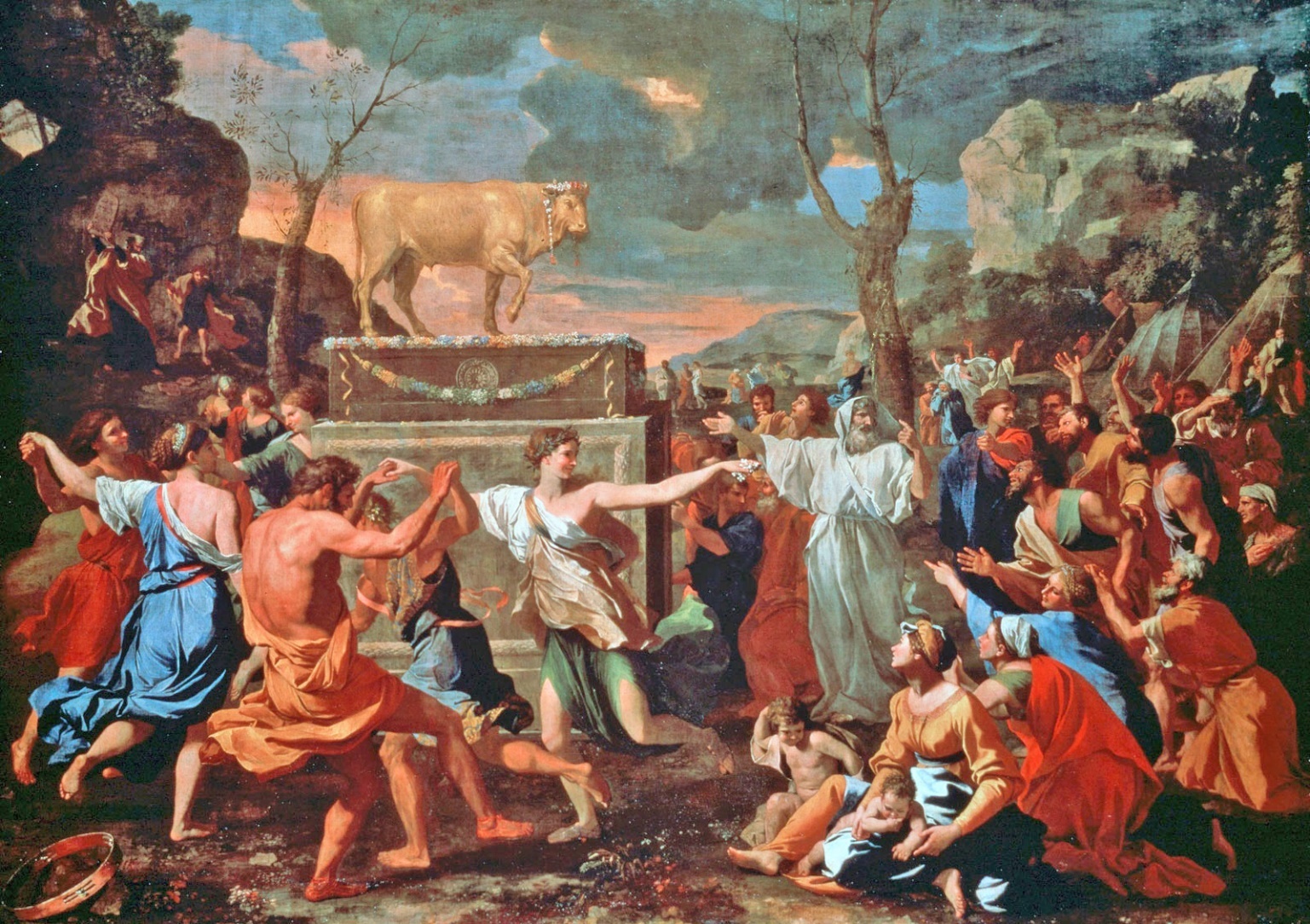
At the foot of Mount Sinai the Israelites made a golden calf and declared a feast day unto Yahweh.
And Aaron made a proclamation and said, “Tomorrow is a feast to Yahweh.”
Exodus 32:5
The symbol of the calf was most likely a reinvention of the Hapis Bull they would have encountered in Egypt, the land which God brought them out of. Also, Canaanite religion placed the bull as a central image in their worship of Baal. God warned them not to “play the harlot with their gods” (Exodus 34:12-16) but the Israelites worshiped Yahweh like the heathen do, just as He commanded them not to do. This displeased Him greatly.
And they made a calf in those days, offered sacrifices to the idol, and rejoiced in the works of their own hands. Acts 7:41
Therefore, since we are the offspring of God, we ought not to think that the Divine Nature is like gold or silver or stone, something shaped by art and man’s devising. Acts 17:29Now these things became our examples, to the intent that we should not lust after evil things as they also lusted. And do not become idolaters as were some of them. As it is written, “The people sat down to eat and drink, and rose up to play.” 1 Corinthians 10:6–7
God hates it when we try to worship Him how we want to instead of how He has shown us He wants us to worship Him. Paul called it idolatry. He didn’t even call out the calf, which would have been obvious. He pointed out the things that appeared normal. It might as well have been Cane’s offering. When we worship Him in ways that come from our own deceived hearts, He despises it. This not because He is a tyrant. It is because He is love to begin with. Consider the following statement:
Yahweh said to Moses, “… this people will arise and play the harlot with the strange gods of the land, into the midst of which they are going, and will forsake Me and break My covenant which I have made with them. Then My anger will be kindled against them in that day, and I will forsake them and hide My face from them, and they will be consumed, and many evils and troubles will come upon them; so that they will say in that day, ‘Is it not because our God is not among us that these evils have come upon us?’ But I will surely hide My face in that day because of all the evil which they will do, for they will turn to other gods.” Deuteronomy 31:16-18
What does “arise” mean but to act out of pride, that sin Satan committed in heaven and the sin which he convinced Eve and Adam to commit in the garden? What does it mean to play the harlot with strange gods of the land? Does a god have to be an entity? Hardly. The gods of today are the same gods as yesterday. Money, power, sex, pleasure, comfort, luxury and all the desires of this world become our gods. In ancient times people merely gave these desires a face and bowed down to them. In Genesis God sent the serpent on his belly to eat the dust of the earth all his days. This is a symbol of the lusting of the beast nature.
So Yahweh God said to the serpent: “Because you have done this, you are cursed more than all cattle,
And more than every beast of the field;
On your belly you shall go, and you shall eat dust all the days of your life.” Genesis 3:14
Paul referred to this symbol in the following passage, clearly inspired by the Genesis account of the fall of man:
Brethren, join in following my example, and note those who so walk, as you have us for a pattern. For many walk, of whom I have told you often, and now tell you even weeping, that they are the enemies of the cross of Christ: whose end is destruction, whose god is their belly, and whose glory is in their shame—who set their mind on earthly things. For our citizenship is in heaven, from which we also eagerly wait for the Savior, the Lord Jesus Christ, who will transform our lowly body that it may be conformed to His glorious body, according to the working by which He is able even to subdue all things to Himself. Philippians 3:17–21
Don’t be drawn in by the world around you to worship God with the works of man’s hands.
Do I have to bow to worship?
In looking back at the passage in Jeremiah 10 it mentions bowing down and worshiping the wooden idol made from a tree, but is worship always the literal act of bowing down to an image? The answer is no. Idolatry starts in the heart with pride and covetousness. Take for example the parable of going “on your belly” as a symbol of sin and idolatry. Then if, as Paul said, your god is your belly, then it is the bowing of your heart that matters. Your heart bows when you set your mind on earthly things.
If then you were raised with Christ, seek those things which are above, where Christ is, sitting at the right hand of God. Set your mind on things above, not on things on the earth. For you died, and your life is hidden with Christ in God. When Christ who is our life appears, then you also will appear with Him in glory. Therefore put to death your members which are on the earth: fornication, uncleanness, passion, evil desire, and covetousness, which is idolatry. Because of these things the wrath of God is coming upon the sons of disobedience, in which you yourselves once walked when you lived in them.
Colossians 3:1–7
Look again at the types of idolatry that Paul called out. Is fornication merely the act of sex outside of marriage? There are many places in the Bible that use fornication as an analogy for non-sexual sins. Revelation 14-19 has many of these analogies relating to the kings of the earth and the people who follow their lead doing things that are ungodly, meaning their own works instead of God’s. These things are unclean to God.
But we are all like an unclean thing, And all our righteousnesses are like filthy rags; we all fade as a leaf, and our iniquities, like the wind, have taken us away. And there is no one who calls on Your name, who stirs himself up to take hold of You; for You have hidden Your face from us, and have consumed us because of our iniquities. Isaiah 64:6–7
Declaring your own feast day unto God is worse than unclean. It is more filthy than old, soiled rags. You are not righteous for celebrating Christmas. There is nothing for God to respect in this act of selfish worship. Yes, it’s selfish, because you do it for yourself and your loved ones, not for God. You claim you do it to honor Jesus, that “Jesus is the reason for the season,” and in a way, that’s right. He is the reason that the season of winter even exists because He created it, but He didn’t create winter holidays. So, are you going to turn His creation into a spectacle to try and honor of Him? You never celebrated Christmas because it honors Jesus. You do it because everyone else does it, because you’ve been conditioned to, and you are PROUD of your Christianized, pagan holy day.
Sin is Pride
All sin and idolatry come down to pride. Why? Because we do what we want instead of what God wants. It is pride that caused Eve to eat to gain knowledge and be like God. It is pride that caused Adam to choose to covet his wife over God and eat. He was not deceived as she was. He ate knowing Satan was lying. So why did he eat, then? He did it for her.
And Adam was not deceived, but the woman being deceived, fell into transgression.
1 Timothy 2:14
But he who is married cares about the things of the world—how he may please his wife.
1 Corinthians 7:33
Is it not pride that causes us to want something God does not want us to have, like the fruit of knowledge, or to want something more than we want God? People tend to do it anyway. It’s the nature of the beast that lives in us now because our first father and mother on earth passed their sin to us. Pride is the sin that caused Satan to be unhappy with the station Yahweh gave him:
You were the anointed cherub who covers; I established you; You were on the holy mountain of God; You walked back and forth in the midst of fiery stones. You were perfect in your ways from the day you were created, till iniquity was found in you. By the abundance of your trading you became filled with violence within, and you sinned; Therefore I cast you as a profane thing out of the mountain of God; And I destroyed you, O covering cherub, from the midst of the fiery stones. Your heart was lifted up because of your beauty; You corrupted your wisdom for the sake of your splendor.
Ezekiel 28:14–17
Satan coveted what was above his station. Covetousness is commonly thought to mean “wanting what your neighbor has” but it has a broader scope than that. It more accurately means “to want in excess, often without regard to others.” Isn’t the spirit of the Christmas season all about excess? Lights everywhere to inspire wonderment, yet they are justified by Christians saying “they are the light of Christ.” The massive compulsion to buy and sell gifts, shopping till you drop, is justified by saying, “These gifts represent the gift of the magi to the baby Jesus.” Friends and families gorge themselves on food and drink and revel in their comfort, yet it is justified by saying, “Community is the body of Christ” and “Abundance is God’s desire for us.” They insist, “We are so blessed.” All of this is done in the name of family, friends, and having a good time. The idea of Christ is added to it. Christ is not, and never was, the basis for this holiday and you can’t legitimately force it. That’s one of the main points Tertullian was making. It is a season of materialism, and materialism is idolatry. People “sat down to eat and rose up to play,” at the foot of Mount Sinai, as is stated in Exodus 32:6 and 1 Corinthians 10:7. Is it reasonable to characterize that type of behavior as “a flood of dissipation?” Absolutely. They declared a feast day unto God, and everyone was expected to participate, even Aaron, the high priest.
Don’t be a ham
So far, we talked about how idolatry is much more than the narrow definition that is typically portrayed in modern Christianity and how you don’t need to bow in order to worship something. Can you be fooled into literally bowing in worship without realizing it? Picture the stereotypical Christmas morning. Children sleep restlessly, excited about the colorfully wrapped presents sitting under that sparkly tree for weeks. The excitement is almost too much to bear. Some impatient children come up with the most elaborate schemes to find out what their presents are before Christmas morning. Now it is here. The children wake up early, before their parents do, and congregate to the tree. What do they do? They KNEEL before it. The parents come to the tree, and they also kneel before the tree in order to distribute the presents. Although it is not necessary to kneel in order to worship an idol, is this practice not strange? How can a Christian feel comfortable doing this?
Even if you don’t have a tree, it’s still the same idea. The focus is not on Christ. Are the children really thinking about Christ when they get their presents? Could you even impose Christ on this tradition? Does that even seem right? “Children, you are getting these presents today because we are celebrating the birth of Jesus, and we all know the magi brought Jesus presents when he was born, so we should give each other presents too!” What an outstanding moral lesson to teach your children. I see a lot of potential for instilling entitlement issues into your child that way.
Then the family gathers together for a great feast, usually to eat a Christmas ham. What is the most iconic and sought-after food brand of the American Christmas dinner? Honey Baked Ham. Although it is certainly not a sin to eat ham (see Acts 10-9-15) it has always been considered a symbol of uncleanness and disregard. God commanded the Israelites to only eat animals that have cloven feet, a symbol of rightly dividing, and which chew the cud, meaning to ruminate, i.e.; to think long and hard. Obviously, they didn’t quite get it. Neither does the church today. Knowing this symbolic meaning, consider the following passage:
When He had come to the other side, to the country of the Gergesenes, there met Him two demon-possessed men, coming out of the tombs, exceedingly fierce, so that no one could pass that way. And suddenly they cried out, saying, “What have we to do with You, Yahshua, You Son of God? Have You come here to torment us before the time?”
Now a good way off from them there was a herd of many swine feeding. So the demons begged Him, saying, “If You cast us out, permit us to go away into the herd of swine.”
And He said to them, “Go.” So when they had come out, they went into the herd of swine. And suddenly the whole herd of swine ran violently down the steep place into the sea, and perished in the water.
Then those who kept them fled; and they went away into the city and told everything, including what had happened to the demon-possessed men. And behold, the whole city came out to meet Yahshua. And when they saw Him, they begged Him to depart from their region. Matthew 8:28–34
The demons were cast into the herd of swine, who immediately threw themselves off a cliff. If swine are a symbol of people who do not think or are lazy in disregard, what does that say about the undiscerning church? They are inviting demons into their midst and running straight for destruction. For lack of discernment no one seems to question the tradition of eating ham at Christmas. In disregard they leave themselves open to possession by unclean spirits. Again, it’s not the eating of the ham that is the problem. It is the unquestioned tradition. It is the disregard of God by superimposing Him on your holy day.
People celebrate Christmas because they want all these things, without consideration of what God wants of them. They don’t even realize that they have made an idol out their own desires for community, relationship, fun and an overly sated belly. They make up many excuses and justifications so they can feel good about Christianizing a pagan holiday that has nothing to do with Christ. They actually think they are doing something good by indulging in the spirit of the season as long as they are thankful that Christ was born. Did Christ die so that you could live a comfortable, prosperous, easy life? If this is what you think I urge you to read the New Testament again. We are called to difficulty, suffering and trials, yet through those trials we find solace and peace in trusting God’s plans for us. This is not to say we are to seek suffering, or that we’ll never have comfort as a Christian, but that suffering is a necessary part of our walk of faith. It is central to it. Christmas is antithetical to that message. It is nothing less than a declaration of the compromise of one’s faith and a rejection of the difficulties of being a follower of Christ. If you do not suffer, are you really walking in faith? We weep when the world rejoices because the world rejoices in itself. I can tell you that I suffer daily because of this. I have to endure watching people voluntarily jump off of cliffs. Paul suffered for the same reason, not because he was stoned or beaten, but by watching his churches fall away.
Is there not much to expose in this fallen world? Were we not told that the world would hate us for speaking the hard truth? Yet most professing Christians resist the truth at all costs while posing as what they believe a Christian should be, or what they think their neighbors expect them to be. There is a common term used for a person who acts showy when people are watching. Such a person is called a ham. There are a lot of Christmas hams out there who ignore the truth that the Bible teaches. Remember what Yahshua and His disciples said:
“If the world hates you, you know that it hated Me before it hated you. If you were of the world, the world would love its own. Yet because you are not of the world, but I chose you out of the world, therefore the world hates you. Remember the word that I said to you, ‘A servant is not greater than his master.’ If they persecuted Me, they will also persecute you. If they kept My word, they will keep yours also.” John 15:18–20
Therefore, since Christ suffered for us in the flesh, arm yourselves also with the same mind, for he who has suffered in the flesh has ceased from sin.
1 Peter 4:1
But may the God of all grace, who called us to His age-long glory by Christ Yahshua, after you have suffered a while, perfect, establish, strengthen, and settle you.
1 Peter 5:10By faith Moses, when he became of age, refused to be called the son of Pharaoh’s daughter, choosing rather to suffer affliction with the people of God than to enjoy the passing pleasures of sin, esteeming the reproach of Christ greater riches than the treasures in Egypt; for he looked to the reward.
Hebrews 11:24–26
My brethren, take the prophets, who spoke in the name of the Lord, as an example of suffering and patience.
James 5:10
For this is commendable, if because of conscience toward God one endures grief, suffering wrongfully.
1 Peter 2:19
But even if you should suffer for righteousness’ sake, you are blessed. “And do not be afraid of their threats, nor be troubled.”
1 Peter 3:14
Removing the High Places
While we are talking about pride, we should address another parable in the Old Testament. There were pagan worship sites called “high places,” where the Israelites worshiped gods such as Asherah (aka Ashtoreth) and Baal. These high places are not only sites of idolatry but symbols of pride.
Jehoash did right in the sight of Yahweh… Only the high places were not taken away; the people still sacrificed and burned incense on the high places. II Kings 12:2-3
[Amaziah] did right in the sight of Yahweh, yet not like David his father… the high places were not taken away; the people still sacrificed and burned incense on the high places. II Kings 14:3-4[Azariah] did right in the sight of Yahweh, according to all that his father Amaziah had done. Only the high places were not taken away; the people still sacrificed and burned incense on the high places. II Kings 15:3-4
[Jotham] did what was right in the sight of Yahweh; he did according to all that his father Uzziah had done. Only the high places were not taken away; the people still sacrificed and burned incense on the high places.
II Kings 15:34-35
These kings did everything right except one core sin that warranted documentation for all of history. These things were written down all future posterity. That includes you and I.
Moreover, brethren, I do not want you to be unaware that all our fathers were under the cloud, all passed through the sea, all were baptized into Moses in the cloud and in the sea, all ate the same spiritual food, and all drank the same spiritual drink. For they drank of that spiritual Rock that followed them, and that Rock was Christ. But with most of them God was not well pleased, for their bodies were scattered in the wilderness.
Now these things became our examples, to the intent that we should not lust after evil things as they also lusted. And do not become idolaters as were some of them. As it is written, “The people sat down to eat and drink, and rose up to play.” Nor let us commit sexual immorality, as some of them did, and in one day twenty-three thousand fell; nor let us tempt Christ, as some of them also tempted, and were destroyed by serpents; nor complain, as some of them also complained, and were destroyed by the destroyer. Now all these things happened to them as examples, and they were written for our admonition, upon whom the ends of the ages have come.
Therefore let him who thinks he stands take heed lest he fall. No temptation has overtaken you except such as is common to man; but God is faithful, who will not allow you to be tempted beyond what you are able, but with the temptation will also make the way of escape, that you may be able to bear it.
Therefore, my beloved, flee from idolatry. I speak as to wise men; judge for yourselves what I say.
We are a kingdom of priests (1 Peter 2:9, Revelation 1:6) and ambassadors for Christ (2 Corinthians 5:20). How has our pride made us fall short of God’s vision for us? What kind of caveat might God amend to your commendation? Are you following after the things of the world or are you truly and fully following Christ?
Consider next one king I have up to this point not mentioned. I saved him for last so you might better answer the questions above. Recall king Asa.
Now when Asa heard these words and the prophecy which Azariah the son of Oded the prophet spoke, he took courage and removed the abominable idols from all the land of Judah and Benjamin and from the cities which he had captured in the hill country of Ephraim. He then restored the altar of Yahweh which was in front of the porch of Yahweh… He also removed Maacah, the mother of King Asa, from the position of queen mother, because she had made a horrid image as an Asherah, and Asa cut down her horrid image, crushed it and burned it at the brook Kidron. But the high places were not removed from Israel… II Chronicles 15:8, 16-17
Surely Asa went though a lot of effort and personal sacrifice to remove idols from the land, including demoting his own mother from her high position in the kingdom because he was an idolator. He went though all that but still did not remove the high places. Why? Maybe they didn’t look like anything abominable because they had been there for many generations. They were built by the great king Solomon after all, but God hated them. There might not have been blatant idols there. They may have been simply nice places to visit in those days. Maybe they cleaned them up and repurposed them to honor Yahweh. Yet God wanted us to know that they were not removed.
Does the church in any way commit a similar error today? Here is an ancient Roman account of the Roman Catholic Pope giving instruction to do exactly what Asa did.
Pope Gregory I, Letter to Abbot Mellitus, c. 597-601 AD
To his most beloved son, the Abbot Mellitus; Gregory, the servant of the servants of God. We have been much concerned, since the departure of our people that are with you, because we have received no account of the success of your journey. Howbeit, when Almighty God has led, you to the most reverend Bishop Augustine, our brother, tell him what I have long been considering in my own mind concerning the matter of the English people; to wit, that the temples of the idols in that nation ought not to be destroyed; but let the idols that are in them be destroyed; let water be consecrated and sprinkled in the said temples, let altars be erected, and relics placed there. For if those temples are well built, it is requisite that they be converted from the worship of devils to the service of the true God; that the nation, seeing that their temples are not destroyed, may remove error from their hearts, and knowing and adoring the true God, may the more freely resort to the places to which they have been accustomed. And because they are used to slaughter many oxen in sacrifice to devils, some solemnity must be given them in exchange for this, as that on the day of the dedication, or the nativities of the holy martyrs, whose relics are there deposited, they should build themselves huts of the boughs of trees about those churches which have been turned to that use from being temples, and celebrate the solemnity with religious feasting, and no more offer animals to the Devil, but kill cattle and glorify God in their feast, and return thanks to the Giver of all things for their abundance; to the end that, whilst some outward gratifications are retained, they may the more easily consent to the inward joys. For there is no doubt that it is impossible to cut off every thing at once from their rude natures; because he who endeavours to ascend to the highest place rises by degrees or steps, and not by leaps. Thus the Lord made Himself known to the people of Israel in Egypt; and yet He allowed them the use, in His own worship, of the sacrifices which they were wont to offer to the Devil, commanding them in His sacrifice to kill animals, to the end that, with changed hearts, they might lay aside one part of the sacrifice, whilst they retained another; and although the animals were the same as those which they were wont to offer, they should offer them to the true God, and not to idols; and thus they would no longer be the same sacrifices. This then, dearly beloved, it behooves you to communicate to our aforesaid brother, that he, being placed where he is at present, may consider how he is to order all things. God preserve you in safety, most beloved son. Bede’s Ecclesiastical History of the English Nation, written in 731 (book 1, chapter 30) (see online)
To the undiscerning, who don’t know the God of the Bible, this might sound perfectly reasonable. Asa could have used a similar justification as his reasons to not remove the high places. Throughout history the Catholic Church made it a point to not remove pagan temples but to convert them to churches. Many cathedrals to this day were converted from or erected over top of pagan temples. Even some of the statues in some cathedrals are sculptures of Roman gods which have been relabeled as Catholic saints. More recently, you may have heard of the Pachamama controversy, where a figurine of an Andean goddess was allowed to be displayed in a Catholic Church with the approval of Pope John Paul II. Just last year, Pope Francis also repeated this act of idolatry. He said that it wasn’t intended to be worshiped but was merely a symbol of fertility. Pope John Paul II justified it by saying that the goddess has been reinterpreted as a mediator between man and God, like Mary. Do you think this pleases God? We can’t allow idols into our churches, and we can’t allow idols into our homes and hearts. Not if we desire purity and faithfulness towards God. Not if we desire our legacy to be as spotless as God desires.
The Origin of Sin and Idolatry
It is important to keep the whole Bible in perspective as a Christian. If we know that sin began with Satan, we know that idolatry also began in his heart. So then, all pagan practices can be traced back to him. His sin spread when he convinced many of the angels in heaven to rebel against God. God cast them down to the earth. Likewise, if we look at the Fall in the garden of Eden, we can see that sin began in Eve first when she desired to be like God. Through rebelling against His command, she attempted to rise above her station to gain the knowledge of good and evil. Then Adam ate and God confronted them about it. When they were expelled from the garden their sin spread with them, manifesting itself in many ways. They walked with God before but now they were walking in their own power. There was a truth that was understood by Adam from the beginning, that he was made in the image of God. There was a doctrine that existed in the original spoken Word which resonated with all of creation until sin was found in the heart of man. This original truth that Adam and Eve knew from the time of their creation before the Fall became more and more distorted and varied as man multiplied on the earth. The truth of God was mixed with man-made ideas giving rise to many pagan belief systems and traditions that imitated yet modified the original truth. Eventually God got tired of it and sent a flood to destroy all but 8 people on earth and the animals on Noah’s ark. Many of these pagan traditions died with the flood of Noah’s time, but it didn’t take long for man to continue with these same kinds of devices again. After all, sin was already in the heart of man. It was only a matter of time before it would manifest in diverse ways once more.
As an argument to discredit Christianity as the one true religion, many non-Christians say that it is just another syncretized religion that arose out of the Jewish, Babylonian, Egyptian and Grecco-Roman cultures. Christianity existed from the beginning, though, because Yahshua (Christ) existed from the beginning. That truth has always been present and understood by many prophets and saints in the Old Testament. For one, Abraham rejoiced to see Christ’s day:
“Your father Abraham rejoiced to see My day, and he saw it and was glad.” Then the Jews said to Him, “You are not yet fifty years old, and have You seen Abraham?” Yahshua said to them, “Most assuredly, I say to you, before Abraham was, I AM.” John 8:56–58
So did Moses:
By faith Moses, when he became of age, refused to be called the son of Pharaoh’s daughter, choosing rather to suffer affliction with the people of God than to enjoy the passing pleasures of sin, esteeming the reproach of Christ greater riches than the treasures in Egypt; for he looked to the reward.
Hebrews 11:24–26
and David:
“Men of Israel, hear these words: Yahshua of Nazareth, a Man attested by God to you by miracles, wonders, and signs which God did through Him in your midst, as you yourselves also know—Him, being delivered by the determined purpose and foreknowledge of God, you have taken by lawless hands, have crucified, and put to death; whom God raised up, having loosed the pains of death, because it was not possible that He should be held by it. For David says concerning Him [Yahshua]:
‘I foresaw the LORD (Kyrion) always before my face, for He is at my right hand, that I may not be shaken. Therefore my heart rejoiced, and my tongue was glad; Moreover my flesh also will rest in hope. For You will not leave my soul in Hades, nor will You allow Your Holy One to see corruption. You have made known to me the ways of life; You will make me full of joy in Your presence.’
“Men and brethren, let me speak freely to you of the patriarch David, that he is both dead and buried, and his tomb is with us to this day. Therefore, being a prophet, and knowing that God had sworn with an oath to him that of the fruit of his body, according to the flesh, He would raise up the Christ to sit on his throne, he, foreseeing this, spoke concerning the resurrection of the Christ, that His soul was not left in Hades, nor did His flesh see corruption. This Yahshua God has raised up, of which we are all witnesses. Therefore being exalted to the right hand of God, and having received from the Father the promise of the Holy Spirit, He poured out this which you now see and hear.
“For David did not ascend into the heavens, but he says himself: ‘The LORD (Kyrios) said to my Lord (Kyrio), “Sit at My right hand, till I make Your enemies Your footstool.” ’ “Therefore let all the house of Israel know assuredly that God has made this Jesus, whom you crucified, both Lord and Christ.”
Acts 2:22–36
God was not talking to Himself in that last paragraph. The Father was speaking to the Son, the Word. All these men foresaw Christ. They knew God’s plan of salvation before it arrived, and they rested in it even before the New Covenant came. This shows us that God has declared the end from the beginning, just as Scripture records:
Remember the former things of old, for I am God, and there is no other; I am God, and there is none like Me, declaring the end from the beginning, and from ancient times things that are not yet done, saying, ‘My counsel shall stand, and I will do all My pleasure,’ Isaiah 46:9–10
The beginning began with God speaking His Word. His Word is truth. Therefore, all the things we see in pagan religions which resemble and preceded the rise of Christianity in the first century AD are distortions of this truth that existed from the beginning. Satan ever tries to imitate God, but the Spirit of Christ gives us discernment to know the difference. When someone tells you Christianity came from paganism, or that it evolved out of polytheism into monotheism, tell them that monotheism existed from the start. The many came from the One. Now we are returning to the One.
History’s Many Fallacies
Often times scholars and researchers make the effort trace modern religious and cultural traditions back to Babylon. While this is a noble cause the truth is that even Babylon’s beliefs came from a time long before its existence. The further back you go the more muddied history gets. Do not cling to scholarly work done to expose these traditions through historical analysis alone. Archaeology, or any of the sciences for that matter, cannot provide us with a competent view of the development and proliferation of paganism. Even ancient historians will tell you that their knowledge of history might be wrong. Take the following for example:
I warn and advise everyone from the start, that no-one should ever pretend that he can be completely certain about matters of chronology. It will help if first we remember the advice of our true master, [p3] who told his companions [Acts, 1’7]: “It is not for you to know the hours and seasons which the Father has set under his own authority.” He, as our Lord and God, uttered this saying not only about the end of the world, but also, in my opinion, about all dates, to dissuade men from such pointless investigations.
Indeed, my own words here will confirm this saying of our master, [by showing] that it is not possible to gain an accurate knowledge of the whole chronology of the world from the Greeks, or from any others, not even from the Hebrews themselves. But it is possible to hope for this only: that what is said by us in this present treatise will help us to recognize two things. Firstly, no-one, like some have done, should believe that he is calculating dates with full accuracy, and be deceived in that way. But he should realize that this has been brought up for discussion, only so that he can know the means and manner of the proposed investigation, and so that he should not remain in doubt.
There is no reason to be surprised that the Greeks do not appear in the most ancient times. They have fallen into various fatal errors, and for a long time before the generation of Cadmus they were completely ignorant of writing. They say that Cadmus was the first to bring them the alphabet, from the land of the Phoenicians. And so the Egyptian in Plato’s book [ Timaeus, 22’B ] rightly despises Solon; “O Solon,” he says, “you Greeks are always children. An old Greek man is never to be found, and no-one can learn from you about ancient times.” But many improbable stories have been told by the Egyptians and Chaldaeans. For instance, the Chaldaeans calculate that their recorded history has lasted for more than 400,000 years. [p5] The Egyptians make up myths about gods and demi-gods, and also about some shades; and they tell many crazy myths about other mortal kings.
Yet what forces me to examine such matters in detail now, when I value the truth above all else? Even amongst my beloved Hebrews one can find inconsistencies, which I will mention at the appropriate time. But I have said this much in reproach of those chroniclers who are eager for such hollow glory.
In accordance with these objectives, I will scrutinize the books of the ancient writers. (Eusebius of Caesarea, Chronicon, Book 1)
Eusebius is telling us that his interest in history is not so much to prove the truth but to scrutinize historical writers, because he knows most of them are wrong on many points. It is not only Eusebius who makes this assertion. There are plenty of historians who have held precisely the same sentiment. In Eusebius’ Chronicon, you will find accounts from different sources that agree on some parts and differ on others.
This is the nature of historical writing, period. It is no different even in modern times. Writers are influenced heavily by their culture’s perceptions, as well as their own perceptions and biases. Often times these perceptions and biases are influenced by popular consensus or forced on writers by the patrons of their works. Remember, historians are usually paid for their work. In ancient times being a scribe was a very prestigious trade. Because of these and many other reasons, history is very murky and messy. Finding multiple sources that largely agree on any particular subject is rare, especially when it comes to the ancient near east, a place where an immense amount of syncretization and cultural exchange was happening in a relatively small region of the world.
For this reason, the Bible is possibly the most trustworthy book ever written. There aren’t many works out there that have thousands of semi-early reproductions of the original manuscripts available for analysis, versions which agree with about 95% accuracy. That level of agreement is unheard of in other ancient studies. Even so, there is still enough wiggle room for a 5% difference to devolve into hundreds of denominations. Even the earliest so-called “church fathers” disagreed on many points regarding theology, and they lived so shortly after the apostles. It doesn’t take much, and it doesn’t take long for the truth to get buried under a flood of reinterpretation. You can see why it is not so far-fetched to say that even Christianity has become corrupted in its 2000-year lifespan. So, it would be no shock to discover that Christmas, for example, is not Christian at all.
Looking back at the definition of evangelion in the Theological Dictionary of the New Testament, take note of the statement, “To the many messages, however, the NT opposes the one Gospel, to the many accessions the one proclamation of the [Kingdom of God].” The true Gospel corrects the incipient fractures in the human heart with all the doctrines it supposes by the singular, anointed truth that is contained in Yahshua, the One who was declared from the beginning. He gives us a new heart—His heart. When this happens, we see the truth. When we see the truth, we also see what masquerades as light and truth. These things are revealed as darkness and death. If we carry that light of truth with us at all times no darkness can fool us into thinking it is light. Paul warns in 2 Thessalonians 2:9-11:
The coming of the lawless one is according to the working of Satan, with all power, signs, and lying wonders, and with all unrighteous deception among those who perish, because they did not receive the love of the truth, that they might be saved. And for this reason God will send them strong delusion, that they should believe the lie, that they all may be condemned who did not believe the truth but had pleasure in unrighteousness.
With that said, even the best of us fall prey to error. We must be on guard at all times but also be ready to be challenged. When we think we know the truth we tend to become stubborn and obstinate in it. Stubbornness is never good because it is an attitude that comes from pride. Caution is always good when being presented with something new, but don’t just turn your nose up at it. Conversely, don’t just accept it, unless you know the voice of God well and know for certain the Spirit is confirming it. This takes much training, though. Test all things to see if they are true. This is how you exercise your senses and become trained in righteousness.
For everyone who lives on milk is still an infant, inexperienced in the message of righteousness. But solid food is for the mature, who by constant use have trained their senses to distinguish good from evil. Hebrews 5:13-14
Some will tell you, in their complacency and laziness, that it is God’s place to change your heart and to open your eyes to new things. While this is mostly true there is clearly effort required on your part. Further, if it is purely God’s work to change you or to keep you on track, then why do we have all these exhortations in Scripture? What would be the point of preaching the Gospel? Because we have a choice to go against the Spirit and the better judgment He has trained us in. For that reason, we all need correction. We also need to be willing to admit when we are wrong and correct ourselves.
Not that I have already attained, or am already perfected; but I press on, that I may lay hold of that for which Christ Jesus has also laid hold of me. Brethren, I do not count myself to have apprehended; but one thing I do, forgetting those things which are behind and reaching forward to those things which are ahead, I press toward the goal for the prize of the upward call of God in Christ Jesus.
Philippians 3:12–14Therefore, leaving the discussion of the elementary principles of Christ, let us go on to perfection, not laying again the foundation of repentance from dead works and of faith toward God, of the doctrine of baptisms, of laying on of hands, of resurrection of the dead, and of eternal judgment. And this we will do if God permits. Hebrews 6:1–3
Therefore, my beloved… work out your own salvation with fear and trembling. Philippians 2:12
Do you see the effort required on your part in these passages? The language is such that we are exhorted to do certain things and be certain ways through our own efforts, knowing that we have been trained by God’s Spirit. Yes, it is God who permits us, even enables us to move forward in our walk of faith, but it is our responsibility to walk out the faith which was given to us. Let us not be lazy or complacent. Let us test all things.
Do not quench the Spirit. Do not despise prophecies. Test all things; hold fast what is good.
1 Thessalonians 5:19–21
Beloved, do not believe every spirit, but test the spirits, whether they are of God; because many false prophets have gone out into the world. 1 John 4:1
I challenge you to test the Christmas spirit to see what the Spirit of God says, what Scripture says and what history says about it.
What is in your heart?
Many Christians argue that the holidays they celebrate only mean to them what is in their hearts, and any other association does not apply to them. If they are celebrating the birth of Christ, then it’s a Christian celebration. They say, “It’s what is in your heart that matters.” Well, what exactly is in your heart? The Bible tells us the heart of man is wicked and deceitful.
“The heart is deceitful above all things, and desperately wicked; Who can know it?
Jeremiah 17:9
We are our own worst enemy. The only way we can trust our hearts is if we have the heart of Christ. Did Christ put it in your heart to celebrate Christmas, or Easter for that matter? If not, what or who did? Where did your desire to celebrate such holidays come from?
To speak for a moment in psychoanalytical terms, we all have an unconscious mind. I’m not a huge believer in psychoanalytics, but there are some good points to ponder within the field. We certainly do all have a place in our minds where we bury things, a place that we are not always fully aware of which has some sort of influence over our thoughts and behavior. The heart and mind are the seat of the soul. It has been shown in science that the heart and the mind are more connected than previously assumed. It’s not a one-way street as was purported for so long, that the brain exercises complete control over the rest of the body. The heart holds some sway over the brain too. So, in a sense, there is a literal aspect to the phrase “of the heart.”
What is the primary function of the heart? To control the flow of blood. Blood carries oxygen to the entire body. Oxygen is a symbol of the Spirit, the breath of life that is breathed into us by God. The blood-brain barrier is a fascinating mechanism. As part of God’s design, it tells us that we need to constantly be receiving of His Spirit in order to live and think. When the blood is compromised, our thoughts are compromised because blood carries oxygen to the brain. Our flesh needs to be governed by the Spirit, not the soul.
For the life of the flesh is in the blood, and I have given it to you upon the altar to make atonement for your souls; for it is the blood that makes atonement for the soul.’ Leviticus 17:11
How does this effect our unconscious minds? Our flesh and blood send signals to our brains from the first trimester in the womb when our heart begins to beat. We are conceived and born under the influence of the flesh and therefore born into sin. As David says:
Behold, I was brought forth in iniquity, and in sin my mother conceived me. Behold, You desire truth in the inward parts [innermost being], and in the hidden part [closed off part of the inward self, ie; the hardened part of your heart and the deepest recesses of your mind] You will make me to know wisdom. Psalm 51:5
In writing this I am encouraging you to look into the deepest places of your heart and mind to search out why you desire to celebrate holidays. When you breath in focus on the Spirit God gave to you. May God give you the strength to confront yourself to see what you might have not been fully aware of before. May you see the things that motivate you and form your world view. May He expose your innermost places in the light so that you can discard the influence of worldly experiences to live in the glorious light and life of Christ.
It is also good to look at what is outside of us in order to weigh it against Scripture, to exercise our senses and be trained in righteousness, and ultimately to be able to test everything by the Spirit. When we have learned the leading of the Spirit we can then know when we are being led by what is buried deep within us, by who or what is around us, or if we are truly doing God’s will. Since the Spirit is truth our desire for truth is the catalyst for the working of the Spirit within us.
Brightwashed Tombs
Have you been Pealed? There is a well-known book titled The Power of Positive Thinking, written by a Freemason named Norman Vincent Peale. He was a self-proclaimed Christian who had a massive impact on the minds of Christians throughout the world. Chances are if you visit a Christian home you will find it on the coffee table or bookshelf. The idea is that you carry the joy, peace and light of Christ if you focus on things that are positive. It’s entirely propaganda and entirely unbiblical. I call these people brightwashed tombs or smiling vipers. They smile regardless of circumstances while harboring animosity inside. They lie to themselves because they think they are being more holy by not giving into “negativity.” These people are usually unapproachable about anything challenging to their lifestyle or walk of faith. They set their own rules about who they listen to.
They love to throw this verse at you: “Judge not lest you be judged!” Do you even know what Christ meant by saying that? Zoom out for once and look at the context. Did it say, “Don’t ever judge anyone.” No. The passage is about hypocrisy. Don’t try to pull a speck out of your brother’s eye when you have a plank in yours. That’s unjustified judgment. You would expect to get you own error thrown back in your face, either by that person or by God. Yet these people’s default reaction is to throw it back in your face defensively. They don’t stop for a moment to consider if what you said was true. Why? Pride. They are rebelliously happy.
Let’s flip that around. Should you try to remove the plank in your brother’s eye if you only have a speck in yours? That’s not nearly as bad, is it? How about if you have no speck in your eye? Well then you’re not a hypocrite at all. Christ then went on to TELL you to pull the speck out of your brother’s eye after you have removed yours.
We need to be able to challenge and confront one another. Christ and all His apostles did so.
Do not judge according to appearance, but judge with righteous judgment. John 7:24
But he who is spiritual judges all things, yet he himself is rightly judged by no one. For “who has known the mind of the LORD that he may instruct Him?” But we have the mind of Christ. 1 Corinthians 2:15–16
Justifying Syncretism
Recall that earlier, in our examination of Tertullian’s quote, I pointed out the word Brumae after “Winter Festivals.” Some have argued that Bruma or Brumalia has no connection to Saturnalia. They say there are no descriptions of this festival, that it simply means “wintertime.” Here is the Latin text behind Tertullian’s passage:
Nobis, quibus sabbata extranea sunt et numeniae et feriae a deo aliquando dilectae, Saturnalia et Ianuariae et Brumae et Matronales frequentantur, munera commeant et strenae, consonant lusus, conuiuia constrepunt.
Well, there you have it. There’s the connection—written by a Christian at the end of the 2nd century. Note that Tertullian gives a fairly detailed description of these events. If you need to, go back and read his statement again. Does the description sound familiar? He wasn’t chiding the churches for mimicking Roman temple prostitution, or literally bringing idols into the churches and bowing down to them. These people were merely having a good time. So why would Tertullian be rebuking them? There’s nothing wrong with feasting, giving gifts or playing games, right? Granted, but he was calling what they were doing idolatry and sin. Was he just a pesky legalist? Of course not. The problem is that the churches were adopting the parts of pagan holidays they deemed good, and they were trying to use them as ways to attract pagans to the faith. This is the earliest evidence by a non-biblical source I’ve found of the church syncretizing with pagan customs for this very reason. Many Christians will try to tell you that there is no evidence of Christians doing this. Tertullian’s quote confirms that the churches were doing just that. They do it to this very day.
To quote Tertullian again, he was saying that Christians were “assailing the Name with wicked suffrages… for fear the Name be blasphemed.” In other words, they were doing evil not realizing it was evil while thinking they would be evil if they didn’t do it. The worst part is they didn’t know they were doing anything wrong! This is the same type of mistake the Israelites made when making the golden calf, weeping for Tammuz, baking cakes for the Queen of Heaven and all sorts of other pagan traditions that they justified in their worship of Yahweh. Generation after generation bits and pieces of paganism crept in and became normalized. Over time, these traditions became automatic, and no one questioned why they were doing them in the first place. The book of the Law was even hidden for a long time before being discovered again in the 6th century BC by Hilkiah. Christians are doing the same thing today because the early church thought that it was a requirement of their faith to Christianize everything. In reality they were called to separate themselves in holiness. Christians call it “Christianization,” but God calls it “syncretization.”
Throughout history there have been many scribes and writers who have exposed the practice of syncretization. The church calls it “Christianization,” yet how is it possible to put Christ into something He was never in to begin with? It is not our charge to Christianize pagans but to make disciples of Christ. There is an obvious difference between a true disciple and a mere follower. A pagan is not converted into a disciple by appealing to his pagan, secular traditions. God has told us not to worship as the heathen do, to be a people set apart for Him, and that we are a peculiar people. Surely, if you decide not to celebrate Christmas or to participate in the spirit of the Holiday Season, you will look peculiar to the world. This appears to be the motivation Tertullian called out. Remember, he said they were not apprehensive to look like pagans when pagans were apprehensive to look like Christians.
When you decide to start examining yourself to see if you are in the faith, you will start to think more critically about yourself and the world around you. It is inevitable. When we look to Scripture, we can see things that we can’t get in the world, parables that God has sent to us to ponder. Consider that Yahweh gave the Israelites holy days for a specific reason, as shadows of things to come, as Paul said in Colossians 2:17 and Hebrews 10:1. In other words, they were prophetic. The Sabbaths, New Moons and Feast Days were given for them to ruminate over what God has done for them, and also what God has in store, namely that Christ must come to be the spotless sacrifice for their sins. Only a small remnant of people in the Old Testament seemed to have understood these parables. In the Law it was said that the Israelites were not to eat any animal that did not “chew the cud.” Chewing the cud is literally “rumination,” but also a metaphor for thinking about something until you have gotten the very last bit of wisdom and understanding from it. Most of the Jews did not “chew the cud” enough to gain spiritual understanding, even when God sent prophet after prophet to tell them. In fact, the prophets were persecuted by their own people because they were labeled evil. So they are today as well.
The God-appointed times and feasts given to the Jews were a parabolic reflection of God’s plan of the ages. This is why man-made traditions are not only inferior to, but profane God-given holy traditions. Our Gospel “Good News” is the promise made to those who enter Sabbath rest by Yahshua’s example and instruction, to receive the Holy Spirit who will lead us into all truth. This is a daily practice. A daily celebration. We do not need yearly celebrations like the pagans do nor Sabbaths and New Moons like the Jews. Our command is “do this in remembrance of Me” (speaking of communion). Remember the Scriptures, “Give us this day our DAILY bread” for He is the bread of life, and so “whoever has entered His rest has ceased from his works as God did from His” (Hebrews 4:10). All else is the works of our own hands which is filthy rags to Him - idolatry. “Whatever is not from faith is sin” (Romans 14:23). We were warned not to follow the traditions of men. Yahshua only did the will of the Father. He did none of His own works except what He learned from His Father. This example He passed on to His disciples. Paul said in 1 Corinthians 11:1, “Imitate me, just as I also imitate Christ.” Christ imitated His Father by observing Him.
Then Yahshua answered and said to them, “Most assuredly, I say to you, the Son can do nothing of Himself, but what He sees the Father do; for whatever He does, the Son also does in like manner. For the Father loves the Son, and shows Him all things that He Himself does; and He will show Him greater works than these, that you may marvel. For as the Father raises the dead and gives life to them, even so the Son gives life to whom He will.
For the Father judges no one, but has committed all judgment to the Son, that all should honor the Son just as they honor the Father. He who does not honor the Son does not honor the Father who sent Him.
John 5:19–23
Can you honestly say that you saw the Father, or even the Son for that matter, celebrating anything resembling Christmas? How about His apostles? Did Paul read Luke’s account of Yahshua’s birth and make a special day to commemorate it with choruses imitating angels singing with children in plays and lights and feasting and presents? If we are to imitate Paul as he imitates Christ, we have nothing to imitate in regard to celebrating the birth of Christ. The only thing we have to imitate is what came centuries later, and those things were imitations of paganism combined with Christianity.
Still, people will stubbornly say that Christians had the holiday first or that it only matters what it means to you in your heart. It doesn’t really matter who had the celebration first. It’s not a battle of who can win the “reason for the season.” It’s not about Christianizing everything in the world either. God has prophesied that all things of this world will perish, that there will be a New Heaven and New Earth. That is not only symbolic of our internal struggle, but a literal statement about re-creation.
Our hope is in the promise that was given to those who overcome this present world, this present age, called in Greek, “aion.” In this life, we overcome the world by taking dominion over our own bodies, which were formed from the dust of the earth, but we also look forward to the literal redemption of our bodies in the resurrection where we will receive glorified bodies. We receive a new creation now in ourselves, that is a new spirit (our inheritance of the Holy Spirit) by which we put on the mind of Christ and bring this flesh under subjection. We also look forward to a New Creation later, when all things will be reconciled to God. This is a huge part of the Gospel good news. As strangers and pilgrims on earth we don’t need to get caught up in worldly affairs, even the pursuit of “peace and safety” for all people, which if derived from worldly motivations is godless (For when they say, “Peace and safety!” then sudden destruction comes upon them, as labor pains upon a pregnant woman. And they shall not escape. 1 Thessalonians 5:3). More people have been killed for the “greater good” throughout history in the name of peace and safety than for the overt spite of tyranny and oppression. If we have no need to get involved in such man-made matters how much less should we need to be involved with man-made holidays?
If you celebrate the birth of Christ in December you are in fact declaring that it doesn’t matter when He was born, because He was certainly not born in December. The fact that you would choose to celebrate it on this date is dictated to you purely by tradition. Those traditions are in alignment with pagan midwinter festivals and the nativity of the unconquerable sun (Sol) rather than the birth of Christ. To ignore this fact and continue celebrating the holiday season anyway is a blatant disregard for discernment and truth. You are in essence doing what Christians have been trying to do for millennia, forcing your beliefs onto pagan practices so they change into something you can accept. That is a tyrannical attitude. The Gospel is not tyrannical. It radically changes the hearts of those who receive it.
It is easy to fool ourselves, to justify our desires and actions with false Christian messages like Dominionism, which teaches Christians need to take over the world, or the Prosperity Doctrine, which teaches God wants you to live a happy, prosperous life now and forever, or *The Power of Positive Thinking, *a book that teaches people to ignore whatever they think is “negative,“ or The Purpose Driven Life, which teaches people to seek a purpose rather than the Spirit. All these teachings have the shiny appearance of being biblical on the surface, and these ideas certainly fit in with the mainstream narrative, but underneath they are born of darkness in opposition to the Gospel truth. They rely on a partial, lazy understanding of Scriptures fueled by deep-seeded desires that have not been confronted by Christ. If Christians knew the book they claim so fervently to cling to perhaps these apostate doctrines and celebrations in our cultures wouldn’t be so prevalent. Perhaps if their deepest desires were for Christ rather than the world, we wouldn’t need to be having this conversation.
Probably the most important concept in the Bible is that of the Sabbath, the state of spiritual rest in God’s will. Its nemesis in the Bible is the beast of Revelation, a symbol of a humanist, world-wide system of government which aims to deceive the whole world into following Satan. This beast is described as having two horns like a lamb but speaks like a dragon. This means he looks like Christ, the Lamb of God, but speaks like Satan, who comes disguised as an angel of light. Both the servants of God, who are marked on their foreheads (Revelation 7:3), and the servants of the beast, who receive the mark of the beast (Revelation 13:16), have made a choice who they will serve. These marks are a sign on your forehead and right hand, symbols of what you think and do. If those who take the mark of the beast are deceived by a worldly system that poses in a Christ-like fashion, then they are unwittingly going to believe they are taking the mark of salvation. We MUST heed the repeated warnings in the Bible exclaimed to all Christians, “Do not be deceived!” Let us look at a few Scriptures to examine the two different marks.
Sabbath rest
There remains therefore a rest for the people of God. For he who has entered His rest has himself also ceased from his works as God did from His.
Let us therefore be diligent to enter that rest, lest anyone fall according to the same example of disobedience. For the word of God is living and powerful, and sharper than any two-edged sword, piercing even to the division of soul and spirit, and of joints and marrow, and is a discerner of the thoughts and intents of the heart. And there is no creature hidden from His sight, but all things are naked and open to the eyes of Him to whom we must give account. Hebrews 4:9–13
God’s servants sealed
Then I saw another angel ascending from the east, having the seal of the living God. And he cried with a loud voice to the four angels to whom it was granted to harm the earth and the sea, saying, “Do not harm the earth, the sea, or the trees till we have sealed the servants of our God on their foreheads.” Revelation 7:2–3
The beast’s servants sealed
“Those great beasts, which are four, are four kings which arise out of the earth.” Daniel 7:17
“Thus he said: ‘The fourth beast shall be a fourth kingdom on earth, which shall be different from all other kingdoms, and shall devour the whole earth, trample it and break it in pieces.’” Daniel 7:23
And I saw one of his heads as if it had been mortally wounded, and his deadly wound was healed. And all the world marveled and followed the beast. So they worshiped the dragon who gave authority to the beast; and they worshiped the beast, saying, “Who is like the beast? Who is able to make war with him?” Revelation 13:3–4
It was granted to him to make war with the saints and to overcome them. And authority was given him over every tribe, tongue, and nation. All who dwell on the earth will worship him, whose names have not been written in the Book of Life of the Lamb slain from the foundation of the world.
Revelation 13:7–8
Then I saw another beast coming up out of the earth, and he had two horns like a lamb and spoke like a dragon. And he… causes the earth and those who dwell in it to worship the first beast… He performs great signs… And he deceives those who dwell on the earth—by those signs… He was granted power to give breath to the image of the beast, that the image of the beast should both speak and cause as many as would not worship the image of the beast to be killed. He causes all, both small and great, rich and poor, free and slave, to receive a mark on their right hand or on their foreheads, and that no one may buy or sell except one who has the mark or the name of the beast, or the number of his name.
Here is wisdom. Let him who has understanding calculate the number of the beast, for it is the number of a man: His number is 666. Revelation 13:11–18
Ask yourself the most important question of your life: “Am I at Sabbath rest?” If the answer to that question is “no” then have you already been deceived into taking the mark of the beast? Have you received the spirit of the world instead of the Spirit of God and His good works?
Adulterers and adulteresses! Do you not know that friendship with the world is enmity with God? Whoever therefore wants to be a friend of the world makes himself an enemy of God.
James 4:4
Rockefeller Christmas
A family famously known for their Christmas celebrations are the Rockefellers. John D. Rockefeller was known to be a devout Christian and one of the most generous philanthropists of all time. Yet when one starts digging into the history of their family it starts looking less Christian the further you go.
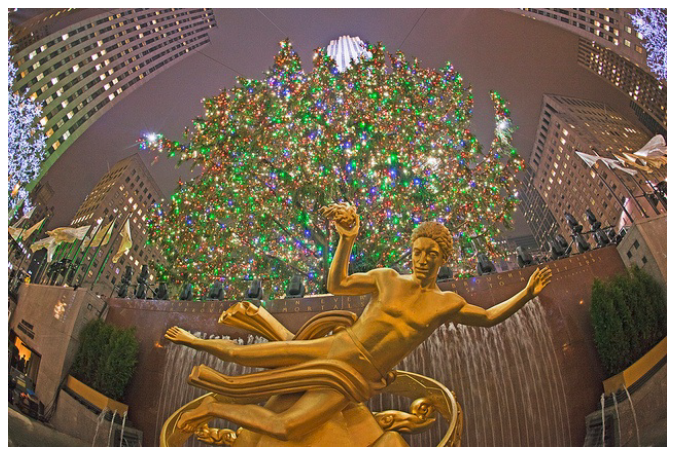 In this book, we have talked about the beast system, which is called the New World Order. If you want a glimpse into the power-elite, ruling class, the ones who are pulling out all the stops to create the New World Order, a good start would be the Rockefeller family. Listen to what David Rockefeller had to say about accusations from conspiracy theorists:
For more than a century, ideological extremists at either end of the political spectrum have seized upon well-publicized incidents such as my encounter with Castro attack the Rockefeller family for the inordinate influence they claim we wield over American political and economic institutions. Some even believe we are part of a secret cabal working against the best interests of the United States, characterizing my family and me as ‘internationalists’ and of conspiring with others around the world to build a more integrated global political and economic structure — one world, if you will. If that is the charge, I stand guilty, and I am proud of it. -David Rockefeller, Memoirs (2003) Wikiquote.org
 It’s hard to find a more freshly smoking gun than that. One doesn’t need to look far into this family to see what they believe. Take for example the Christmas tree they erect in front of Rockefeller Plaza every year. It sits above a sculpture of the Greek god Prometheus who is poised like a gift under the tree. Recall that in Greek mythology, Prometheus stole fire from heaven and brought it to mankind as a gift. Fire is a symbol of enlightenment. Prometheus is an obvious parallel to Satan who was cast out of heaven to the earth only to corrupt man by convincing him that he could obtain the knowledge of good and evil by disobeying God. In the popular occult movement called Theosophy, Lucifer (which is Satan’s name before he fell from grace), is the savior or mankind. They, along with influential Freemason Albert Pike, who wrote Morals and Dogma, say he came to earth to save mankind from the tyranny of Yahweh, who only wanted to keep us down and powerless by withholding knowledge from us. They teach that Lucifer is actually on our side! No kidding. The Bible says otherwise.
And He said to them, “I saw Satan fall like lightning from heaven.”
Luke 10:18
But I am afraid that as the serpent deceived Eve by his cunning, your thoughts will be led astray from a sincere and pure devotion to Christ.
2 Corinthians 11:3
… do not … give place to the devil.
Ephesians 4:27
We know that we are from God, and the whole world lies in the power of the evil one.
1 John 5:19“How you are fallen from heaven, O Lucifer (shining one, star of the morning), son of dawn! How you are cut down to the ground, you who laid the nations low! You said in your heart, ‘I will ascend to heaven; above the stars of God; I will set my throne on high; I will sit on the mount of assembly in the far reaches of the north; I will ascend above the heights of the clouds; I will make myself like the Most High.’ But you are brought down to Sheol, to the far reaches of the pit.
Isaiah 14:12-15

While we are on the subject of Prometheus, there was a movie by the same name released in 2012. I thought it was interesting that the first thing the captain of the ship did after awaking from his cryogenic sleep was erect a Christmas tree. Is this not an odd thing to do? Why did they put that in the script? One can only guess.
At Rockefeller Center there is also something else of note, which is very revealing of the Rockefeller family’s apostate, gnostic beliefs. Take a look at the following image and consider your first impressions. Then ask if those first impressions are correct. Only those who have investigated the matter more deeply will see what it really is. Anyone who knows the Bible well will see that the phrase “Wisdom and knowledge shall be the stability of thy times” is a quote from Isaiah 33:6. So WOW, the Rockefellers are Christians! Wonderful!
Not so fast. Who is this image a depiction of and why are his fingers holding a compass like it is emanating beams of light in a pyramid shape? The pyramid has been used as a symbol of enlightenment for a very long time, especially with Freemasons as well as in hermetic, gnostic and neoplatonic circles. Why did the Rockefellers choose this imagery? Well, this is actually a reinterpretation of a piece of art done by William Blake. To understand this image, we need to look at that painting and learn a little more about the man behind it.
Although Blake claimed to be a Christian, he was heavily influenced by Enlightenment philosophy, but in a way that put imagination over reason. He invented his own mythology that supported his prophecies, which had a basis in Christianity, as well as Greek and Norse mythology. He believed Jesus was to be regarded as merely a symbol. He was an early proponent of the “free love” movement and opposed the traditional view of marriage, believing multiple sex partners was healthy. He objected to orthodox Christianity because he felt it encouraged the suppression of natural desires and discouraged earthly joy. In A Vision of the Last Judgement, Blake says that:
Men are admitted into Heaven not because they have curbed and governed their Passions or have No Passions but because they have Cultivated their Understandings. The Treasures of Heaven are not Negations of Passion but Realities of Intellect from which All the Passions Emanate Uncurbed in their Eternal Glory. (E564)
If that isn’t a gnostic statement, I don’t know what is. Clearly, he didn’t believe the Bible and so he can’t rightly be called a Christian. It is telling that the Rockefellers chose to put a Bible verse on their adaptation of Blake’s art, a verse that, when taken out of context, supports their gnostic, illuminist, Freemasonic, satanic ideals. They agree with Blake. They are “Christians” in the same sense as Blake is, meaning, they are not Christians at all. They ride the beast along with the harlot of Babylon.
On the Rockefeller Center website, they tell us exactly what Prometheus represents. Here is what they say:
An icon of history can be recognizable to the eye, yet it’s possible that we know nothing about it.
That is often the case for the gold statue in Rockefeller Center’s lower Plaza. When picturing the skating rink, we don’t only imagine the sunken rink itself or the flow of skaters moving in a circle, but we see Prometheus, the 18-foot-tall, eight-ton, gilded cast bronze sculpture that was created by Paul Manship in 1934.
The sculpture has been in the background of countless concerts, tree lightings, skating shows and special events, but few are aware of its meaning or where it came from. Prometheus is just one piece of public art that was integrated into the plans of greater Rockefeller Center, but is definitely one of the most recognizable—in fact, many sources say this is the fourth most recognized statue in the country, behind the Lincoln Memorial, Statue of Liberty and Mount Rushmore, and is the most photographed piece of art in NYC.
Referencing Greek mythology, the statue depicts the Greek Titan Prometheus, best known for going against the wishes of the gods and providing fire to humanity (and thus is given credit for civilization and progress). Over time, this classical figure came to represent human striving and the quest for knowledge. Prometheus played a large role in the approach to the art and architecture in the Complex, especially given that the overall theme of the project was “New Frontiers and the March of Civilization.”
Prometheus perfectly embodies both ancient myths and forward-thinking progress. He is depicted in motion, thrusting forward with his right arm held high, handing off the eternal flame to all of mankind; he sits on a mountain (Earth), is surrounded by the fountain (sea) and is encircled by the ring of the zodiac (heavens).
For those that have never looked, an inscription accompanies the sculpture. It reads: “Prometheus, teacher in every art, brought the fire that hath proved to mortals a means to mighty ends.”
Put into the historical context of the 1930s—mid-Depression, leading up to WWII, the rise of 20th-century Modernism— this gilded, cast bronze sculpture starts to take on much more meaning .
In New York City, when you stop and take a closer look at something you’ve seen dozens of times, you are often rewarded with more thought-provoking stories than you ever expected.
They aren’t being shy about it. They have admittedly erected a pagan “icon” of eternal human knowledge and progress towards greatness. THIS is what they hold in the greatest regard.
The following description fits them pretty, don’t you think?
Professing to be wise, they became fools, and changed the glory of the incorruptible God into an image (eikon) made like corruptible man—and birds and four-footed animals and creeping things.
Romans 1:22–23
The Rockefellers are humanists more than they are Christians (if any of them are Christians at all). They even celebrate World Pride by replacing the row of various national flags resting above Prometheus with gay pride flags. It is difficult to get less Christian.
One more little tidbit I just discovered is that they started a flag project for artists. One of the artists they featured was Marina Abramović, the woman known for her “spirit cooking” parties where they eat cakes that are molded into mock cadavers. She also has all sorts of dark, sick, satanic “art.” She is apparently well-respected by celebrities in Hollywood, corporate America and politics. I’d include some images here for you but frankly, I don’t want to look at them. You can easily find them on Google. Should a Christian company be supporting an artist like that? I’m positive Christ wouldn’t, and neither would any of His apostles.
There’s a lot more I could call this family out on, proving that they are in fact NOT Christian, but rather satanic, however I could probably dedicate a whole book to that subject. I’ve oftentimes found that people professing to be Christians are the worst of all people. This is because they are either lying outright about their faith or they don’t know what a Christian is. The fact that the Rockefellers make such a big deal out of Christmas is not surprising considering they aren’t even Christian. That’s because the holiday isn’t Christian.
Don’t Judge My Festival!
 Many Christians cite the following verse to justify celebrating Christmas, but they lack understanding of its meaning. They apply it to their world view, disregarding the immediate cultural context.
So let no one judge you in food or in drink, or regarding a festival or a new moon or sabbaths, which are a shadow of things to come, but the substance is of Christ.
Colossians 2:16–17
At first glance an undiscerning person would say this is telling Christians not to judge people for celebrating any festival, but is that what Paul was talking about? No. Why would be chide them for this in Galatians 4 and encourage them in Colossians 2? If you go back and look at the context it is clear he was talking about the Law of the Jews. You see, in the early church the Jews were trying to impose the Law on Greek Christians, telling them that they did not have salvation apart from keeping it. Paul argued against this in several of his epistles. In one place he actually relates the feast days of the Jews to the pagan festivals that the Romans celebrated.
But then, indeed, when you did not know God, you served those which by nature are not gods. But now after you have known God, or rather are known by God, how is it that you turn again to the weak and beggarly elements, to which you desire again to be in bondage? You observe days and months and seasons and years. I am afraid for you, lest I have labored for you in vain.
Galatians 4:8–11
Again, to reiterate what we discussed earlier in the section, Pagan Midwinter’s Festivals, Paul is talking about Christians giving into the Judaizers. He chides them for leaving their Roman worldly ways only to adopt weak and beggarly elements that are just as bad. He clarifies that they were observing days, months, seasons and years, meaning they were taking on the Jewish feasts days as requirements of their faith just as they celebrated the Roman feast days when they were pagans. Paul worried that what he taught them regarding Christ and the Gospel was missed completely. Surely, if Paul were here today, he would say the same thing to the churches for celebrating Christianized versions of Saturnalia and Brumalia.
Still, many would ignore everything one could say against our modern holy days, replying simply, “Jesus is the reason for the season!” If they truly stopped and examined what they are saying with a critical mind they would see their folly. Sure, there is a time of year which we call a “season,” and Yahshua created that season. Does that mean we need to make it a holiday? The truth is no matter what reason you assign to a holiday like Christmas you are still only doing it because pagans started it. You are following THEIR tradition, only redefining and reshaping it to your liking. In a sense I would not be so bold as to pass judgment on those who choose to celebrate Christmas in a “Christian” way, ie; no tree or presents, simply preaching the birth of the Messiah and the Gospel that He declared. After all, Paul did write the Philippians:
“What then? Only that in every way, whether in pretense or in truth, Christ is preached; and in this I rejoice, yes, and will rejoice.”
Philippians 1:18
I have heard this verse used as an excuse to celebrate Christmas. The idea is that Christ is preached and even if it’s because of a pagan tradition at least Christ is preached. OK, sure, but wouldn’t Paul rather have those men who were preaching out of pretense preach out of a pure heart for pure reasons? Wouldn’t you rather simply preach Christ without having to make it about Christmas? Yet even though the masses walk in folly I, like Paul, will nonetheless rejoice that Christ is preached. I, personally, do not want nor need a special day, nor decorations nor feasts nor presents to do so. It is vanity, superstition and pretense that seeks such things.
Every day is a holy day
We started this journey off with a quote from Charles Spurgeon and it seems appropriate to finish on the same note for the sake of resolution.
“We have no superstitious regard for times and seasons…. Regarding not the day, let us give God thanks for the gift of His dear Son.” —C. H. Spurgeon
The conclusion drawn from this book is an authentically simple one. It radiates from Scripture offering inspiration and encouragement for all to listen to what the Holy Spirit has to say to us today.
Therefore, as the Holy Spirit says:
“Today, if you will hear His voice, do not harden your hearts as in the rebellion, in the day of trial in the wilderness, where your fathers tested Me, tried Me, and saw My works forty years. Therefore I was angry with that generation, and said, ‘They always go astray in their heart, And they have not known My ways.’ So I swore in My wrath, ‘They shall not enter My rest.’”
Beware, brethren, lest there be in any of you an evil heart of unbelief in departing from the living God; but exhort one another daily, while it is called “Today,” lest any of you be hardened through the deceitfulness of sin. For we have become partakers of Christ if we hold the beginning of our confidence steadfast to the end, while it is said:
“Today, if you will hear His voice, do not harden your hearts as in the rebellion.” Hebrews 3:7–15
I affirm, by the boasting in you which I have in Christ Jesus our Lord, I die daily. If, in the manner of men, I have fought with beasts at Ephesus, what advantage is it to me? If the dead do not rise, “Let us eat and drink, for tomorrow we die!” 1 Corinthians 15:31–32
Your kingdom come. Your will be done on earth as it is in heaven. Give us this day our daily bread. Matthew 6:10–11
Instead of listening to our fathers, mothers, brothers, sisters, cousins, friends and acquaintances about what we should do on certain days, let Scripture and the Holy Spirit tell us what day we should be focused on. We have the day of the Lord, which is a day to fear for those who are not in Christ. Our job is to preach that message to unbelievers so the fear of Yahweh will lead them to repentance, rest in God and salvation through our hope in His promise to restore those who come to Him in the age to come.
But the day of the Lord will come as a thief in the night, in which the heavens will pass away with a great noise, and the elements will melt with fervent heat; both the earth and the works that are in it will be burned up. Therefore, since all these things will be dissolved, what manner of persons ought you to be in holy conduct and godliness, looking for and hastening the coming of the day of God, because of which the heavens will be dissolved, being on fire, and the elements will melt with fervent heat? Nevertheless we, according to His promise, look for new heavens and a new earth in which righteousness dwells.
2 Peter 3:10–13“For behold, the day is coming, burning like an oven, and all the proud, yes, all who do wickedly will be stubble. And the day which is coming shall burn them up,” says Yahweh of hosts, “That will leave them neither root nor branch.”
Malachi 4:1…then the Lord knows how to deliver the godly out of temptations and to reserve the unjust under punishment for the day of judgment, and especially those who walk according to the flesh in the lust of uncleanness and despise authority. They are presumptuous, self-willed. They are not afraid to speak evil of dignitaries…
2 Peter 2:9–10
For those who are strong in Christ and persevere to the end there is no need to fear. We look for the blessed hope of the promise, that when we walk by faith and endure until the end, we will inherit God. The day of the Lord is a day of rejoicing for us.
The Spirit Himself bears witness with our spirit that we are children of God, and if children, then heirs—heirs of God and joint heirs with Christ, if indeed we suffer with Him, that we may also be glorified together.
Romans 8:16-17I thank my God always concerning you for the grace of God which was given to you by Christ Yahshua, that you were enriched in everything by Him in all utterance and all knowledge, even as the testimony of Christ was confirmed in you, so that you come short in no gift, eagerly waiting for the revelation of our Lord Yahshua Christ, who will also confirm you to the end, that you may be blameless in the day of our Lord Yahshua Christ.
1 Corinthians 1:4–8
Finally, there is laid up for me the crown of righteousness, which the Lord, the righteous Judge, will give to me on that Day, and not to me only but also to all who have loved His appearing.
2 Timothy 4:8
It is my hope that God will continue working with you and in you to help you distinguish between His voice and the many voices of this world clamoring to drown Him out. In this day and age there are so many distractions that it can be hard to sort through everything we are exposed to on a daily basis. May the blessings of Yahweh be upon you to receive His grace and truth by the leading of His indwelling Holy Spirit who was sent to us from our Lord and Savior, Yahshua the Messiah. It is only then that we can truly know God and choose to do the things that please Him.