Introduction
But even if our gospel is veiled, it is veiled to those who are perishing, whose minds the god of this age has blinded, who do not believe… 2 Corinthians 4:3–4
For millennia, Christian denominations have been debating the nature of God. Will we ever answer this crucial question? Who are these persons in the Bible referred to as the Father, Son and Holy Spirit and what is their relationship to one another? Is God a “Trinity” and if so, what does that mean? Even though the Nicene Creed in AD 325 established an official definition there has never been a true consensus among Christians. Even a comparison of the early and latter Nicene Creeds shows a change over time. How can we possibly place confidence in a doctrine that changes? If the Gospel is not meant to be changed why would our creed as Christians change? We need something solid to stand on. Something unchanging and immutable. Perhaps the truth contained in Bible is enough? If so, we would be standing on the Rock, not the shoulders of men.
First Council of Nicaea (325) | First Council of Constantinople (381) |
|---|---|
We believe in one God, the Father Almighty, Maker of all things visible and invisible. | We believe in one God, the Father Almighty, Maker of heaven and earth, and of all things visible and invisible. |
And in one Lord Jesus Christ, the Son of God, begotten of the Father [the only-begotten; that is, of the essence of the Father, God of God,] Light of Light, very God of very God, begotten, not made, consubstantial with the Father; | And in one Lord Jesus Christ, the only-begotten Son of God, begotten of the Father before all worlds (æons), Light of Light, very God of very God, begotten, not made, consubstantial with the Father; |
By whom all things were made [both in heaven and on earth]; | by whom all things were made; |
Who for us men, and for our salvation, came down and was incarnate and was made man; | who for us men, and for our salvation, came down from heaven, and was incarnate by the Holy Ghost and of the Virgin Mary, and was made man; |
He suffered, and the third day he rose again, ascended into heaven; | he was crucified for us under Pontius Pilate, and suffered, and was buried, and the third day he rose again, according to the Scriptures, and ascended into heaven, and sitteth on the right hand of the Father; |
From thence he shall come to judge the quick and the dead. | from thence he shall come again, with glory, to judge the quick and the dead; |
whose kingdom shall have no end. | |
And in the Holy Ghost. | And in the Holy Ghost, the Lord and Giver of life, who proceedeth from the Father, who with the Father and the Son together is worshiped and glorified, who spake by the prophets. |
In one holy catholic and apostolic Church; we acknowledge one baptism for the remission of sins; we look for the resurrection of the dead, and the life of the world to come. Amen. | |
[But those who say: ‘There was a time when he was not;’ and ‘He was not before he was made;’ and ‘He was made out of nothing,’ or ‘He is of another substance’ or ‘essence,’ or ‘The Son of God is created,’ or ‘changeable,’ or ‘alterable’ — they are condemned by the holy catholic and apostolic Church.] |
Millions, perhaps billions of Christians from the first century to the present time have held to the belief that Christ is separate from, made by, and subordinate to the Father. In the first few centuries of emerging Christianity, the Gauls, much of the eastern Roman Empire and parts of northern Africa were Arians. Arians believe the Son was “begotten” and therefore had a beginning. Could there be any merit of truth to this so-called heresy? The Nicene Creed sought to abolish this notion, and it succeeded eventually. Yet even despite a politically forced doctrinal fallacy, a somewhat high percentage of Christians held and hold to the belief that Christ is created by the Father. According to a survey done by LifeWay in 2016 of 3000 professing Christians, 56% believed that Jesus is the “first and greatest being created by God.” Granted, a survey of mainstream Christianity isn’t really a good gauge of what the truth is, but looking back to the writings of the early church one will find this statistic to be consistent with the earliest beliefs of the ante-Nicene fathers (before the Nicene Creed). Most preachers and universities would scoff at this notion as a heresy because they have been taught it is heretical, however a survey of the writings of early church fathers says otherwise. In this book we will be examining passages from several of these writings, which suggest Arianism might have well been the dominant belief up to the 4th century.
Now, Arius might not have gotten everything right, even if I believe he was closer to correct than the prominent bishops of his day. Athanasius, in his Orations Against the Arians, criticizes Arius for claiming the Son does not share the same substance, or essence, with the Father. If this claim is accurate, which is not present in Arius’ own surviving works (the Thalia fragments), and relies completely on Athanasius’ report, I would disagree on that one point with much zeal. Early Christian writers all agreed that the Son did share in the same substance with the Father and some of them attributed that essence to the Spirit. In this book I will pull from these writers and expound upon this idea from Scripture. However, in all fairness, without an argument from the original teacher Athanasius’ rebuttal cannot be completely trusted as a proper representation of Arius’ beliefs. The main point in question, then, is whether the Son was created and whether He is co-equal and co-eternal. So if I say Arianism, I am excluding the claim of separate substance and focusing solely on creation and subordination.
It is commonly professed among most Christian denominations that Christ is co-equal with the Father (Niceanism). How is it that a son is equal to his father? There is only one answer to that question, and we’ll be looking at it extensively. Alternatively, others hold that Jesus IS both the Father and the Spirit, that there is ultimately no difference between them. Although there are passages that seem to equate the Father and the Son the whole of Scripture presents the Son as having His own separate will. Still others say that the Father, Son and the Spirit are aspects or manifestations of the same being (Modalism or Sabellianism). This is a tempting explanation, but a cop-out. Again, the whole of Scripture says otherwise. Lifeway conducted another survey post-COVID and found that Christians were still just as confused, divided and sometimes as contradictory as they were in their previous survey.
How are we to resolve this debate once and for all? Is it even possible to prove the truth when there are so many conflicting, scripture-supported arguments floating around? Well, yes, anything can be “proven” using evidence framed in a certain light, but the real question is: will the truth prevail against bias? Is it even possible that billions of Christians could be wrong about something as basic as the relationship between the Father, Son and Spirit? If majority rule is what makes beliefs into facts, then God save us all.
The aim of this study is to examine the doctrine of the Trinity and the arguments both for and against believing in a triune God as well as an examination of the relationship between the Father, the Son and the Holy Spirit. This is a critical subject to nail down because it is the foundation of Christianity. If we can’t get this one thing right, then what does that say about the rest of our religion? Are we all merely contriving what sounds good to us, cherry picking our own beliefs or is there a universal, absolute truth? Are most of us simply following a tradition that was handed down to us from bygone generations without searching it out for ourselves? Paul says that the teachings about Christ are elementary, so then, let us set aside our doctorates and our years of service in the church so we can retrospectively return to elementary Bible school and examine whether we Christians have held fast to our faith over the millennia.
For though by this time you ought to be teachers, you need someone to teach you again the first principles of the oracles of God; and you have come to need milk and not solid food. For everyone who partakes only of milk is unskilled in the word of righteousness, for he is a babe.
Hebrews 5:12
Therefore, leaving the discussion of the elementary teachings about Christ and go on to perfection (maturity, completeness), not laying again the foundation of repentance from dead works, and of faith in God, instruction about baptisms, the laying on of hands, the resurrection of the dead, and age-long judgment.
Hebrews 6:1-3
Surely, the nature of the relationship between the Father, Son and Holy Spirit are elementary teachings, yet here we are, two millennia later, still arguing over who the Son is. Paul certainly knew. John certainly knew. Why don’t we have a consensus then? Some might say the consensus was established at the Council of Nicaea, but how is it possible that it took hundreds of years for Christianity to figure out who they were worshiping? This is a sign that they didn’t know! This is evidence of the corruption that crept into the churches even as Paul was establishing them.
I marvel that you are turning away so soon from Him who called you in the grace of Christ, to a different gospel, which is not another; but there are some who trouble you and want to pervert the gospel of Christ. But even if we, or an angel from heaven, preach any other gospel to you than what we have preached to you, let him be accursed.
Galatians 1:6–8
The Romans did the same thing back in their time that the Catholic Church did for over a thousand years, and people still do today. They gathered hundreds of bishops from across the Empire to argue over who the Son is, then forced a dogmatic consensus through political means. Ultimately, they devised a mandatory Christian creed and declared the truth to be a heresy. From then on, the Nicene Creed was established as doctrine, even though it is the real heresy. Anyone who spoke contrary to this mandated orthodoxy was exiled.
There is a phenomenon that occurs within groups of people called the bystander effect. It states that the larger the number of people present in a distressful situation, the less likely they are to help a person who is being victimized. I imagine Arius, the first man in history exiled for believing the Son had a beginning, experienced this. There is another term in psychology called group think. It states that people, for various reasons, will often choose consensus, conformity and group identity over personal beliefs and factual observations. The human desire for belonging exceeds the desire for truth and therefore people will most often set aside what they know to be true for something they know to not be true simply to keep the peace or to maintain their social composure. Often times they do it without even realizing their inward motivations. They lie to themselves to maintain a lie with others. This is how propaganda is used for mass deception. Group think is the fuel that ignites the spread of propaganda. In the case of the Nicene Creed, sound doctrine was sacrificed for what men deemed to be “the greater good.”
Surely Christianity has gone the way Yahshua (Jesus), Paul and John warned us about in the Bible. Christians drank the Kool-Aid of apostasy for the sake of unity, not being diligent to study the word of God deeply. It’s a grave error, for we are warned over and over in Scripture about being lazy and negligent in regard to our faith, like the lukewarm Laodiceans in Revelation 3. Many have compromised their faith by rejecting the knowledge of both God and the wiles of the devil, favoring instead a false sense of belonging.
Enter by the narrow gate; for wide is the gate and broad is the way that leads to destruction, and there are many who go in by it. Because narrow is the gate and difficult is the way which leads to life, and there are few who find it.
Matthew 7:13–14
Nevertheless, when the Son of Man comes, will He really find faith on the earth?
Luke 18:8
Well, the argument still ensues. On one side some Christians claim God is not triune, that there is no Trinity. On the other side of the argument God is three distinct persons in One. In between are a plethora of other assertions. I will ultimately be making the argument that God is triune, but not according to the Nicene tradition. I will do so by presenting a mountain of evidence against a molehill of Nicene and otherwise anti-trinitarian doctrine. I will do my best to present all of the arguments that were made to me by anti-trinitarians as well as other arguments I have come across in my research, arguments that I have been able to refute at every turn only by the grace of God.
The Nicene stance is pretty simple, albeit unsatisfactory. It places a veil on the Godhead, saying that the Father, the Son and the Holy Spirit are eternally three and one. This doesn’t really say anything concrete, though. If anything, it simply justifies two opposing positions. It does so weakly, without taking the whole of Scripture into account. This I will endeavor to do.
Anti-trinitarians have a rather simple stance as well, perhaps a bit too oversimplified for their own good. They say that if we as Christians are commanded to worship the one and only true God then how is it possible to have three separate persons in a supposed “Godhead?” That would be polytheism. They have difficulty in grasping how three can be one, yet it is not difficult when you consider the whole of Scripture. When doing so one can easily refute Niceanism and anti-trinitarianism with one fell swoop using the power of Scripture alone. It requires a full study of the Bible and some basic understanding of biblical languages, and although I will be doing much of that footwork here for you, I encourage you to test all of these things for yourself, because it is rare for anyone to truly receive anything from another person. If you arrive at a conclusion based on your own diligent research into Scripture with sincere prayer, you will appreciate your position much more than if you simply regurgitated what someone else told you. This is because, through prayer and seeking, God Himself led you to that conclusion and built you up in that knowledge.
In prayer and an earnest desire for God to show me the truth, I have dedicated years of my life to this matter and have come to a place where I am firm in this position. A compelling, if not unbreakable argument can be made that one God can indeed be three separate persons, and it is not a matter of mystery in any sense. In order to prove this concept, one would need to have a complete understanding of the nature of God as well as His plan of the ages. Even though this kind of knowledge comes primarily from the Spirit of God we must be able to prove it with Scripture to those who are babes in Christ, or to those who might need instruction in order to overcome their current beliefs. This is what I will do. From my research in prayer seeking the truth from God I have found that there is a much greater argument in Scripture to support the existence of the Trinity than there is against it.
You may have heard it said that “the devil is in the details,” that people who do what I am doing are grasping for something far out of their reach. It might have been a satanist who came up with that saying, because God and His disciples encouraged us to dig deep, to grasp at the robes of Christ with all our might. We should endeavor to live out the Proverb which says:
“It is the glory of God to conceal a matter, and it is the glory of kings to search a matter out.”
It is imperative to understand that there is a hierarchy within the relational stations of God. It is how each position interacts with the other that illustrates and reveals to us what role each person of God played in creation, and the roles they play in the ministry of reconciliation (the process of drawing man back to God). I can think of no better way to begin an exploration of the ministry of reconciliation than to start with the subject of baptism.
The Symbol of Baptism
Many think that baptism is merely a public confession of Christ, or an initiation ritual that Christians perform. While this is true, it is a very narrow and shallow view of something very deep and wide. There are layers and levels to the symbolism of the act of baptism. It is self-evident that we are dying to ourselves when we are fully immersed in the water, being taken into the depths to be deprived of life-sustaining oxygen. When we are brought back to the surface we immediately take in a big breath of air, which is symbolic of receiving the Holy Spirit, the breath of life from God. In this single act there is a transformation taking place on three levels all at once: mind, body and spirit.
First, one makes the conscious decision to give their life to Christ, making Him their Lord and Savior. Second, their body, or flesh, is fully surrendered, fully immersed in in the waters, a symbol of dying to oneself. Then the person is raised out of the waters to a new life, a symbol of resurrection, where the Holy Spirit is received. Through this process a person is declaring that they are a new person, reborn into Christ. They now have been given a new heart, a new mind and a new Spirit, which brings this body under complete subjection. Since Christ becomes Lord over our lives, we are given a renewed spiritual and psychological dominion over the flesh we reside in while we are here on this earth. Our charge then is to walk in the newness of life that has been given to us.
This is not simply a one-time event. Baptism is something we do continually. Take, for example Philippians 1:6:
He who has begun a good work in you will complete it until the day of Jesus Christ;
The writer could have easily written “began” instead of “has begun.” There is a reason this grammar was chosen. “Has” is the present perfect tense of the past participle “begun.” The Spirit is calling our attention to an action that started in the past but is continuing in the present. In fact, contrary to popular opinion, you aren’t required to be baptized by water to receive the Spirit. I was baptized in the Spirit before I was baptized in water. By the time I received water baptism I was already baptized in the Spirit. I had already died to myself and had been reborn. The ritual was just an outward confession of that. So there are two baptisms and they can come in any order. Baptism in the Spirit is the mightier of the two.
“I indeed baptize you in water for repentance, but he who comes after me is mightier than I, whose sandals I am not worthy to carry. He will baptize you in the Holy Spirit.
Matthew 3:11
“…he who sent me to baptize in water said to me, ‘On whomever you will see the Spirit descending and remaining on him is he who baptizes in the Holy Spirit.’
John 1:33
Paul said in 1 Corinthians 15:31, “I die daily.” He said that he buffets his body in 1 Corinthians 9:27. He clearly struggled with sin and temptations, but he fought against them by the power of the indwelling Holy Spirit. He is complete in claiming the power of the Spirit over his mind and body. This completeness is being formed in each of Christ’s followers “from glory to glory.”
But we all, with unveiled face, beholding as in a mirror the glory of the Lord, are being transformed into the same image from glory to glory, just as by the Spirit of the Lord.
2 Corinthians 3:18
The Three Parts of Man
Man was created in the image of God as described in Genesis 1-26-27:
“Let Us make man in Our image, according to Our likeness…” So God created man in His own image; in the image of God He created him…”
God exists in three parts, Father, Son and Holy Spirit, just as man is three parts, body, soul and spirit. Just as the Father is over the Son and the Spirit extends from the Father through the Son, so too does a man’s mind reign over his body and his spirit reigns over his mind, extending through his mind and body to the world. So it is the same with God.
The word “likeness” is also translated as “pattern” elsewhere. We are not a perfect imprint of God’s form, like His Son is. We are made in the pattern of His being, that is, in three parts. The parts of man represent the hierarchy in the station of God. God, the Father is over the Son. The Spirit extends from the Father through the Son to all of creation. The pattern in man is similar but not exact. His spirit governs over his mind and extends through his mind and body to the world. Now, we don’t call a man’s spirit a separate being from him do we? No. We understand a man’s name to refer to the whole of his parts. Is this evidence that God is also a single being since we are created in the same image and pattern? No, and here’s why. A man doesn’t exist in the exact pattern of God because God’s parts serve as junction points for the reconciliation of an innumerable amount of men. That pattern just isn’t part of our nature. It can’t be, because no part of our being is all-encompassing.
We will be going over plenty more evidence showing how and why God is three parts. For now, let’s dig more into the three parts of man.
Now may the God of peace Himself sanctify you completely; and may your whole spirit, soul, and body be preserved blameless at the coming of our Lord Yahshua (Jesus) Christ.
1 Thessalonians 5:23
It says here that God will preserve all three parts of our being IF we are blameless at the coming of Christ. Consider the implications of that. First, it confirms that man is three parts. Second, this verse begs the question: Is it possible that only a person’s soul and/or spirit might be preserved, and their body and/or soul be destroyed?
Paul said in 1 Corinthians 5:5:
…deliver such a one (speaking of a sexually immoral person in the church) to Satan for the destruction of the flesh, that his spirit may be saved in the day of the Lord Yahshua.
King Solomon said in Ecclesiastes 12:7:
Then the dust will return to the earth as it was, and the spirit will return to God who gave it.
He is acknowledging that the body dies and returns to the earth, but the spirit returns to God. These verses show that there are sometimes different ends to each part of man’s being. This has far-reaching implications. Although this is not the time and place to spell it all out, as I don’t feel I have all the answers at present, I do encourage you to “chew the cud” in prayer, asking God what this means. For now, let us carry this knowledge forward as we explore the design of man.
Does man have a spirit before baptism?
I have heard it said that man does not have a spirit until he receives the Holy Spirit, and that the Holy Spirit was not available to indwell man until Pentecost, but I have not found that to be Scriptural. I do believe Pentecost was a unique expression of the Spirit for a specific purpose, but man definitely has a spirit from birth, and man’s spirit is not God’s Spirit.
The Spirit Himself testifies with our spirit that we are God’s children. Romans 8:16
Or do you not know that your body is the temple of the Holy Spirit who is in you, whom you have from God, and you are not your own? For you were bought at a price; therefore glorify God in your body and in your spirit, which are God’s.
1 Corinthians 6:19–20
These verses make a distinction between the Spirit of God and the spirit of man. Let’s take a look at how man was formed to gain an understanding of our full construction.
And the LORD God (“Yahweh Elohim” in Hebrew) formed man of the dust of the ground, and breathed into his nostrils the breath of life; and man became a living being (nephesh – meaning a soul, or a person with emotions and desires, and one might add, free will).
Genesis 2:7
God’s breath is His Spirit. In the Old Testament, the Hebrew word “ruah” means a moving wind, breath or spirit. God breathed His Spirit into man and that is what made him a living being.
But there is a spirit (ruah) in man, And the breath of the Almighty gives him understanding.
Job 32:8
For I am full of words; The spirit (ruah) within me compels me.
Job 32:18
Then the dust will return to the earth as it was, And the spirit (ruah) will return to God who gave it.
Ecclesiastes 12:7
If He should set His heart on it, If He should gather to Himself His Spirit (ruah) and His breath, All flesh would perish together, And man would return to dust.
Job 34:14–15
Therefore take heed to your spirit (ruah)…
Malachi 2:15
The spirit (nisimat or “breath”) of a man is the lamp of Yahweh, Searching all the inner depths of his heart.
Proverbs 20:27
All these passages from the Old Testament corroborate the fact that a human being does indeed have a spirit when born. Adam was created with a spirit. When Adam decided to eat the forbidden fruit in the Garden of Eden his spirit became subject to the world.
For what man knows the things of a man except the spirit of the man which is in him? Even so no one knows the things of God except the Spirit of God. Now we have received, not the spirit of the world, but the Spirit who is from God…
1 Corinthians 2:11–12
Man has a spirit, a spirit that has become worldly from birth because of the sin of Adam, but the call of God on his life is to receive His Spirit, so that our spirits along with His may renew us, body and soul. This is the experience of being born again, which baptism is a symbol of.
John the Baptist undoubtedly knew a lot about the Spirit of God. Speaking of his own gestation, long before Pentecost mind you, the Bible says:
For he will be great in the sight of the Lord; and he will drink no wine or liquor, and he will be filled with the Holy Spirit while yet in his mother’s womb.
Luke 1:15
How appropriate it is that John was baptized by both water and the Spirit IN the womb, a place where an unborn baby is immersed in amniotic fluid (water) and cannot breathe. John didn’t need to die to himself. He didn’t need to be reborn. He was already baptized by God. Yahshua tells us this in the following passage:
Now when He came into the temple, the chief priests and the elders of the people confronted Him as He was teaching, and said, “By what authority are You doing these things? And who gave You this authority?”
But Yahshua answered and said to them, “I also will ask you one thing, which if you tell Me, I likewise will tell you by what authority I do these things: The baptism of John — where was it from? From heaven or from men?”
And they reasoned among themselves, saying, “If we say, ‘From heaven,’ He will say to us, ‘Why then did you not believe him?’ But if we say, ‘From men,’ we fear the multitude, for all count John as a prophet.” So they answered Yahshua and said, “We do not know.”
And He said to them, “Neither will I tell you by what authority I do these things.”
Matthew 21:23-27
When you are baptized you are fully immersed in the water, breathing out the air (symbolically your spirit) within. When you are raised again out of the water, you take in a big breath of air, which is a symbol of receiving the Holy Spirit. In that moment you are born again in spirit. A new life is breathed into you. Then begins the process of the renewal of your mind so that your flesh can be brought under subjection to the Spirit of God.
I beseech you therefore, brethren, by the mercies of God, that you present your bodies a living sacrifice, holy, acceptable to God, which is your reasonable service. And do not be conformed to this world, but be transformed by the renewing of your mind, that you may prove what is that good and acceptable and perfect will of God.
Romans 12:1–2
This analogy, this parable, can be found in the blood as well. It is one of the primary duties of the blood to carry oxygen to every part of the body. That very oxygen is a symbol of the Spirit of God.
A friend once told me he believes the soul is in the blood because Leviticus 17:11 says:
For the life of the flesh is in the blood, and I have given it to you upon the altar to make atonement for your souls; for it is the blood that makes atonement for the soul.‘
He claims that the word translated “life” is equated with the soul and therefore the soul is in the blood. I humbly disagree. The blood makes atonement for the soul as the Scripture tells us. The life that is in the blood is a gift of the Spirit of God. It is precisely why Jesus (Yahshua) said the following:
Then Yahshua said to them, “Most assuredly, I say to you, unless you eat the flesh of the Son of Man and drink His blood, you have no life in you.
John 6:53
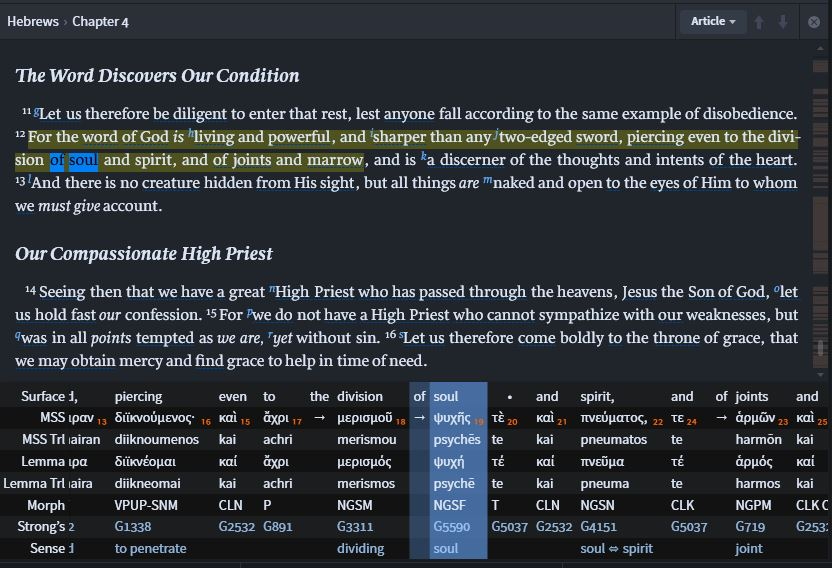
Although this verse is not literal it speaks from a place of practicality. Blood carries life (or spirit) into the soul. The Greek word “psuche,” transliterated to “psyche” in English, is the word translated as “soul” in the New Testament and Septuagint. Psyche is in the mind.
In human anatomy there is a system called the blood-brain-barrier, a pathway of blood vessels that regulate the movement of ions, molecules and cells between the blood and the brain. The balance of this system protects neural tissue from toxins and pathogens. Some neurological diseases that result from a breakdown of the blood-brain barrier include stroke and multiple sclerosis, for example. When you receive bad spirits, they breach your mind through your blood. Illnesses can sometimes be a manifestation of spiritual possession.
The soul is the battleground of the mind, the consciousness, where the fight between light and dark resides. Note, it is a conscious choice to be baptized. It is a result of obeying your call to God. It is also a conscious choice to seek and follow His Spirit every second of every day. In fact, every breath is meant to remind us of this innate need. In this way, baptism is not just a one-time event. Your life is continually and fully immersed in Christ’s death, and you are only alive through His resurrection.
This is the work that Yahshua (Jesus) did to reconcile man to God, to show us that man must lay down his current self, which is his body, soul and spirit, in order to receive the Spirit of God into himself and be born again as a new creation.
Therefore, if anyone is in Christ, he is a new creation; old things have passed away; behold, all things have become new.
2 Corinthians 5:17
That work begins with your spirit and ends with your body. It is a continual process in this life on earth.
I affirm, by the boasting in you which I have in Christ Yahshua our Lord, I die daily.
1 Corinthians 15:31
Men are called to die not only in spirit and soul now, but eventually in body too. Listen to what Paul says about the resurrection:
But someone will say, “How are the dead raised up? And with what body do they come?” Foolish one, what you sow is not made alive unless it dies. And what you sow, you do not sow that body that shall be, but mere grain — perhaps wheat or some other grain. But God gives it a body as He pleases, and to each seed its own body.
All flesh is not the same flesh, but there is one kind of flesh of men, another flesh of animals, another of fish, and another of birds.
There are also celestial bodies and terrestrial bodies; but the glory of the celestial is one, and the glory of the terrestrial is another. There is one glory of the sun, another glory of the moon, and another glory of the stars; for one star differs from another star in glory.
So also is the resurrection of the dead. The body is sown in corruption, it is raised in incorruption. It is sown in dishonor, it is raised in glory. It is sown in weakness, it is raised in power. It is sown a natural body, it is raised a spiritual body. There is a natural body, and there is a spiritual body. And so it is written, “The first man Adam became a living being.” The last Adam became a life-giving spirit.
However, the spiritual is not first, but the natural, and afterward the spiritual. The first man was of the earth, made of dust; the second Man is the Lord from heaven. As was the man of dust, so also are those who are made of dust; and as is the heavenly Man, so also are those who are heavenly. And as we have borne the image of the man of dust, we shall also bear the image of the heavenly Man.
Now this I say, brethren, that flesh and blood cannot inherit the kingdom of God; nor does corruption inherit incorruption. Behold, I tell you a mystery: We shall not all sleep, but we shall all be changed — in a moment, in the twinkling of an eye, at the last trumpet. For the trumpet will sound, and the dead will be raised incorruptible, and we shall be changed. For this corruptible must put on incorruption, and this mortal must put on immortality. So when this corruptible has put on incorruption, and this mortal has put on immortality, then shall be brought to pass the saying that is written: “Death is swallowed up in victory.”
1 Corinthians 15:35–54
For we know that the whole creation groans and labors with birth pangs together until now. Not only that, but we also who have the firstfruits of the Spirit, even we ourselves groan within ourselves, eagerly waiting for the adoption, the redemption of our body. For we were saved in this hope, but hope that is seen is not hope; for why does one still hope for what he sees? But if we hope for what we do not see, we eagerly wait for it with perseverance.
Romans 8:22–25
Notice that Paul tells us the natural man comes first, then the spiritual, while other Scriptures tell us man was created with a spirit. Is this a contradiction? No. It means that Adam was not motivated by the Spirit of God, even though he had a spirit. He was motivated by the spirit of the world, choosing his wife over God. The first man was made of dust (the world), yet the heavenly Man (Christ) is distinctly different, i.e.; spiritual.
In a sense, the curse that fell on Satan when God told him he would go on his belly eating dust all his days was also a curse on Adam, who spiritually returned to the dust from whence he came when he disobeyed God. Since we were all in Adam’s loins, this curse passed on to all his descendants. Because the spirit of man is now corrupt and has become enslaved to his dusty flesh, his body must literally die before his spiritual body can be born. This spiritual, resurrected body is often called the “glorified body”, and it is like the body that Christ has right now. In its current state, the body we have now, which was born in corruption, wars against the Spirit.
I say then: Walk in the Spirit, and you shall not fulfill the lust of the flesh. For the flesh lusts against the Spirit, and the Spirit against the flesh; and these are contrary to one another, so that you do not do the things that you wish.
Galatians 5:16–17
Our challenge, after we have received the Spirit, is to put this flesh under subjection to the Spirit of God so that we may overcome the world around us. We also must overcome our own bodies, which are made from the dust of the earth. This is the dominion we have in Christ which opposes the dominion Adam subjugated to Satan. This new dominion is given when one renews their mind, which is a part of our soul (psyche), to be trained in righteousness by the Holy Spirit. This is the basic premise the work of God does in us after we have been called to Him, have submitted to His Son as Lord over our lives and received His Spirit within us. These three beings work in concert with one another and in concert with us. Because of this the three parts of our being should work in harmony just as the three beings in the station of God work in concert with one another, with the Father, who is spirit (John 4:23-24) driving the other two. Each of them plays a specific role in our reconciliation to God. We will look more at these roles as we progress throughout this book, but first, we have to understand why there are obvious pluralities associated with the nature of God.
God is plural
The first reference to God being a plural being is in Genesis 1 where it is written, “Let US make man in OUR image.” For proof, on the next page is a screenshot of my Logos reverse interlinear Bible, showing the first-person plural form of the Hebrew word “naseh,” followed by the word “Our.”
Was God talking to Himself there? Does He have multiple personality disorder? No, it means there are multiple beings conversing in the Godhead, working in concert with one another. In this sense, it is appropriate to use a word like “station” or “position” to refer to the godhood of Jesus (Yahshua) or the Spirit. In other cases, when referring to the expression of God through the Son, it is more appropriate to use words like “imprint” or “express image.”
A well-known scholar named Michael Heiser claimed that Genesis 1 is Yahweh (the Father) speaking to the angelic host, including them in on the conversation preceding creation, but there is a glaring problem with that argument. The declaration, “Let US make man in our own image” is a concerted statement of action. Although Heiser agrees that the angels did not create anything, he is trying hard to fit his theology into the Nicene narrative as well as his “Two Yahwehs” theory. He states there was both a visible and invisible Yahweh in the Old Testament, the visible being the preincarnate Son. His theology is almost there, but not quite. Sure, I think almost all of us can agree that the angels didn’t create anything. There is nothing in Scripture to suggest it. They are part of the creation. All things, including the host of angels, were made through the Word, who is Christ, just as John and Paul tells us:
In the beginning was the Word, and the Word was with God, and the Word was God. He was in the beginning with God. All things were made through Him, and without Him nothing was made that was made.
John 1:1–3
He (the Son) is the image of the invisible God, the firstborn over all creation. For by Him all things were created that are in heaven and that are on earth, visible and invisible, whether thrones or dominions or principalities or powers. All things were created through Him and for Him. And He is before all things, and in Him all things consist.
Colossians 1:15–17
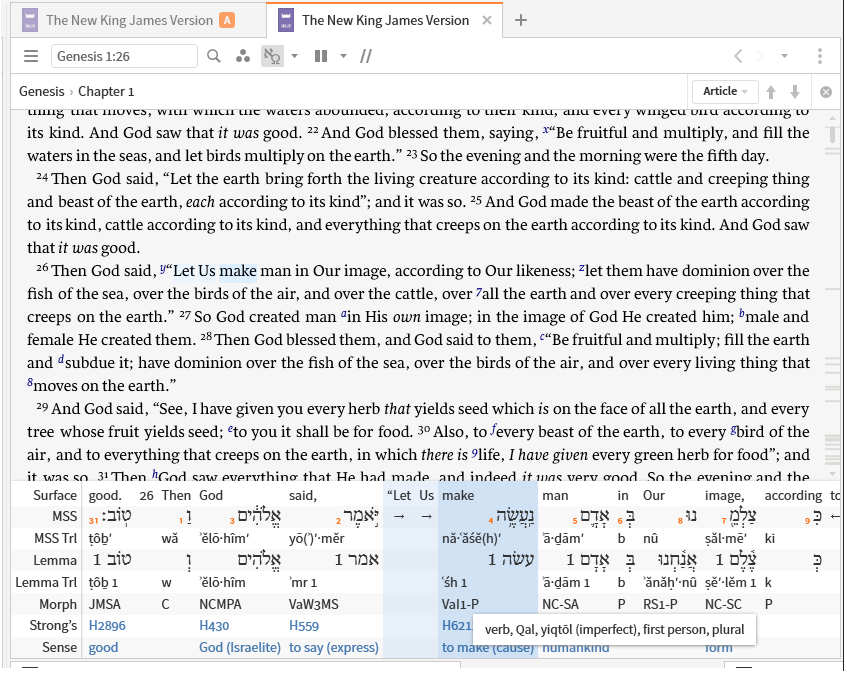
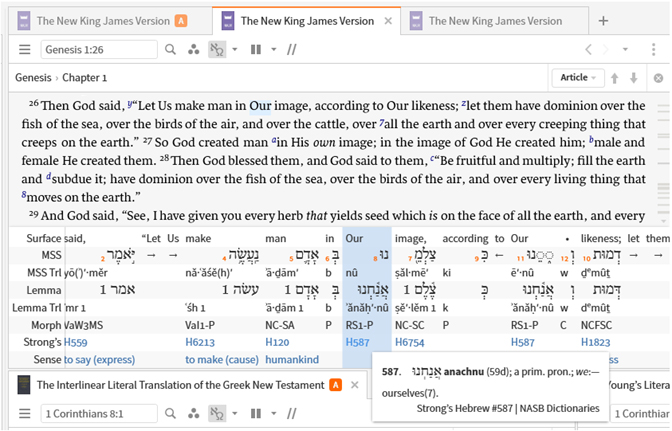
What Michael misses is the fact that Yahshua (Jesus) was not a second Yahweh, even if He was called Yahweh in several theophanies and prophecies. His theology is very close to Modalism, the claim that God manifested Himself in multiple modes but is still the same God. His statement dances between two opposing viewpoints trying form another, yet has no backing in Scripture unless you are cherry-picking. To make such a claim is a blatant attempt to justify one’s own beliefs. That kind of self-willed effort is called eisegesis, which is imposing your own meaning on the text, rather than exegesis, which is letting the text interpret itself. Further, it is cherry picking because he ignores other contradictory texts in order to support his own presupposed conclusion. We will be looking at this from many different angles, but primarily as a response to anti-trinitarianism, which has been on the rise in recent years.
I tried to communicate some of my Trinitarian points to an anti-trinitarian friend, but he rejects them on every front without consideration. One Scripture he threw at me was this:
By the word of Yahweh the heavens were made, And all the host of them by the breath of His mouth.
Psalm 33:6
This passage appears to be directly attributing creation to the Father, Yahweh, but it is not. It is saying the heavens were created by His word (John 1:1 says the Word is the Son of God) and the host (or angelic hosts) were created by His breath (Spirit). As you will come to find in reading this book, there IS a difference. I will explain how the breath of God, i.e.; His Spirit, moved through His Son to create all things. The Son is the orchestrator, and the Spirit is the power.
This anti-trinitarian friend of mine asked me to show him a specific verse in the Bible that explicitly defines the Son in a manner similar to this: “The Word is the Son of God and Christ Yahshua who existed before being incarnated on earth, was made by God and is separate from the Father but is still God.” This demonstrates how narrow-minded many people are when it comes to reading the Bible. They are unable to grasp the basic language of the Scriptures, let alone their parabolic meanings, poetry, elegance, power and yes, even the most obvious declarations are often glossed right over. They look at little pieces here and there to prove what they believe, things that “resonate” with their own soul or the traditions they were taught from youth, or perhaps they just simply see what they want to see in the moment. Forming a belief structure in such a manner creates logical fallacies through confirmation bias. It plants the seeds of compromise. Anti-trinitarianism and Niceanism are products of this way of thinking. Niceanism is a product of group-think. The only way to gain understanding of God is through Spirit-think. Let us all be of one mind as Paul bid us, as Bereans who search Scriptures daily.
Even though it isn’t really necessary to explicitly look for the term “Son” to describe Yahshua in the Old Testament there actually are references.
“I will declare the decree: The LORD has said to Me, ‘You are My Son, Today I have begotten You. Ask of Me, and I will give You The nations for Your inheritance, And the ends of the earth for Your possession. You shall break them with a rod of iron; You shall dash them to pieces like a potter’s vessel.’ ” Now therefore, be wise, O kings; Be instructed, you judges of the earth. Serve the LORD with fear, And rejoice with trembling. Kiss the Son, lest He be angry, And you perish in the way, When His wrath is kindled but a little. Blessed are all those who put their trust in Him.
Psalm 2:7–12
Now, my friend argued that the first verses are pointing to a prophecy fulfilled after Christ’s incarnation, and yes, they are in part, but the psalm directly addresses the present audience when the prophet commands his audience to kiss the Son. It is a multi-voiced psalm functioning as a warning to the Davidic kings as well as a projection of a Heavenly, Messianic perspective. Here’s another acknowledgment of the Son before His incarnation:
Who has ascended into heaven, or descended? Who has gathered the wind in His fists? Who has bound the waters in a garment? Who has established all the ends of the earth? What is His name, and what is His Son’s name, If you know?
Proverbs 30:4
Here’s another claim established supporting a concerted creation by the Father and His preincarnate Son.
Common Anti-Trinitarian Arguments
Some of the most common arguments used to disprove the Trinity are as follows. I added some brief responses to these arguments, which will be explained in more detail throughout the rest of this book.
Claim: Yahshua (Jesus) was not the Son of God before coming to earth. He was the Father. The Son of God did not exist until He was born on earth.
Reply: The last two verses examines should expel that myth. I would like to take some time to examine John 1 in this book, stating Yahshua was God. Could this be a double meaning? The Greek grammar indicates the nature and quality of God, but the context with the rest of Scriptures implies a unique transformation from one state to another, one which is difficult to describe with words. So he was God in the beginning, but what about before the beginning? There was a time when He was God in a sense. More accurately, He was the Wisdom of God until He was spoken into being – begotten. That is why He is called the Word. Do you not first think and then speak? It is wise to do so, and God is the author of wisdom. We’ll get back to this.
- Claim: Yahshua talking to or about the Father in third person is figurative because Yahshua IS the Father in the flesh.
Reply: Since when is speaking to yourself in third person a figurative act? When has that ever been anything but narcissistic or psychologically unstable? Well, when I was growing up it was considered such. Nowadays, psychologists are actually promoting narcissism as a way to gain confidence. Go figure. Narcissism is now confidence according to modern “science.” That’s satanic (the worship of self). - Claim: There can’t be more than one person who is God because that is by definition polytheism and a violation of God’s commandment to worship only Him.
Reply: OK, yes, there is technically only one God over all, who is the Father. He has a Son who created everything at His command and even gave up His seat of glory to come to earth as a man and die for our sins. Now, God has exalted Him to the name above all names. He has given Him the right to be God as His Son of inheritance because He is worthy. That is the Father’s prerogative to do. We will be proving this with Scripture. - Claim: The Greek word “monogenes” means “only unique,” not “only born.”
Reply: Actually, it can mean both and in this case, it does. We’ll get to that later. - Claim: There is no word “Trinity” in the Bible. It was made up by Catholics who syncretized with pagan religions.
Reply: While the word “Trinity” might not be in the Bible it doesn’t mean God is not triune, or in three parts. If the Bible describes God in three different persons, then He is a trinity.
I agree that there has been a lot of syncretization in the Catholic Church. Many of these corruptions became doctrinal baggage carried straight into Protestantism during and after the Reformation. However, I think there is a tendency to go overboard when it comes to proving the apostasy of mainstream Christianity. Too many pointing fingers are not attached to thinking heads. Critical thinking is not a skill taught in most schools, nor is it taught by most parents. There are many erroneous works out there spewing a diatribe of pseudo-intellectual arguments against the Catholic Church, like Alexander Hislop in his book The Two Babylons. While there are certainly many problems in Catholicism, we can’t just make things up in order to attack a denomination, not if we want to live by the truth. Every claim must be tested and proven if we are to argue the Spirit of truth to another person. Otherwise, we quickly lose credibility.
Do you not know that in a race all the runners run, but only one receives the prize? Run in such a way as to take the prize. Everyone who competes in the games trains with strict discipline. They do it for a crown that is perishable, but we do it for a crown that is imperishable. Therefore I do not run aimlessly; I do not fight like I am beating the air. No, I discipline my body and make it my slave, so that after I have preached to others, I myself will not be disqualified.
1 Corinthians 9:24-27
Have you ever found yourself judging another person’s erroneous beliefs thinking “that could never be me?” Don’t be so short-sighted. We must always be open to being wrong, to testing what we believe. Only then can we arrive at a greater understanding of the truth. This is how we remain humble. There is nothing humble about being stubborn, even if “for the things of the Lord.” This is how I arrived at the conclusions I am presenting to you now and if at any point someone challenges me in a way that is compelling, I will test these things to see if they are so, like the Bereans spoken of in the book of Acts.
Moving forward, I’ll be keeping the anti-trinitarian arguments presented above in mind, as well as any other rebuttals that the Spirit calls my attention to while presenting my case against these erroneous claims. Next, let’s answer the argument that every anti-trinitarian goes to first: We worship one God.
One God
What does Scripture mean when it says God is one? Is that solely a numerical statement? An anti-trinitarian would say yes, because making the Son both God AND a separate being as well as adding a third God, the Holy Spirit, makes three Gods. This statement is simple to correct. Take, for example, Tertullian’s apology for the Trinity and the Oneness of God:
But as for me, who derive the Son from no other source but from the substance of the Father, and (represent Him) as doing nothing without the Father’s will, and as having received all power from the Father, how can I be possibly destroying the Monarchy from the faith, when I preserve it in the Son just as it was committed to Him by the Father?
The same remark (I wish also to be formally) made by me with respect to the third degree in the Godhead, because I believe the Spirit to proceed from no other source than from the Father through the Son. Look to it then, that it be not you rather who are destroying the Monarchy, when you overthrow the arrangement and dispensation of it, which has been constituted in just as many names as it has pleased God to employ.
Tertullian, On Idolatry, Chapter 3, Against Praxeas, c. AD 200
When God prophesied through Isaiah, He said something that many anti-trinitarians claim is indisputable proof that Yahweh is the Son and the Spirit.
“Look to Me, and be saved,
All you ends of the earth!
For I am God, and there is no other.
I have sworn by Myself;
Isaiah 45:22
One must read the context, though. It says this immediately after:
The word has gone out of My mouth in righteousness,
And shall not return,
That to Me every knee shall bow,
Every tongue shall take an oath.
Isaiah 45:23
Does that sound familiar? Paul tells us the same thing, elaborating on what Isaiah said and telling us precisely who this “word” is:
Therefore God also has highly exalted Him and given Him the name which is above every name, that at the name of Yahshua (Jesus) every knee should bow, of those in heaven, and of those on earth, and of those under the earth, and that every tongue should confess that Jesus Christ is Lord, to the glory of God the Father.
Philippians 2:9–11
The word in Isaiah 45 is the Word in John 1. The word that came out of Yahweh’s mouth is Yahshua, His Son. His Son will not return to Him void.
So shall My word be that goes forth from My mouth;
It shall not return to Me void,
But it shall accomplish what I please,
And it shall prosper in the thing for which I sent it.
Isaiah 55:11
His Word is living and does His will. His Word will not fail, just as Yahshua did not fail when He was sent to earth to be tempted like all men are. He was obedient even to the point of death. Yahshua accomplished the thing which His Father sent Him to do.
Possession and Subordination
Two important concepts in the perception of the Trinity are possession and superiority. Yahshua owns His believers and Yahweh (the Father) owns Yahshua.
…that the God of our Lord Jesus Christ, the Father of glory, may give to you the spirit of wisdom and revelation in the knowledge of Him…
Ephesians 1:17
The Father of glory is Yahweh. He is the Father of Yahshua, who is His glory (see The Glory of the Father at the end of this chapter).
We give thanks to the God and Father of our Lord Yahshua Christ…
Colossians 1:3
And you are Christ’s, and Christ is God’s.
1 Corinthians 3:23
We are Christ’s purchased possession.
Or do you not know that your body is the temple of the Holy Spirit who is in you, whom you have from God, and you are not your own? For you were bought at a price; therefore glorify God in your body and in your spirit, which are God’s.
1 Corinthians 6:19–20
For he who is called in the Lord (Kyrio) while a slave is the Lord’s freedman. Likewise he who is called while free is Christ’s slave. You were bought at a price; do not become slaves of men.
1 Corinthians 7:22–23
And if you call on the Father, who without partiality judges according to each one’s work, conduct yourselves throughout the time of your stay here in fear; knowing that you were not redeemed with corruptible things, like silver or gold, from your aimless conduct received by tradition from your fathers, but with the precious blood of Christ, as of a lamb without blemish and without spot. He indeed was foreordained before the foundation of the world, but was manifest in these last times for you who through Him believe in God, who raised Him from the dead and gave Him glory, so that your faith and hope are in God.
1 Peter 1:17–21
In Him you also trusted, after you heard the word of truth, the gospel of your salvation; in whom also, having believed, you were sealed with the Holy Spirit of promise, who is the guarantee of our inheritance until the redemption of the purchased possession, to the praise of His glory.
Ephesians 1:13–14
Note that the Holy Spirit is personified in verse 14 above by the word “who.” This means He is not a “force,” but a person. I believe Tertullian is right, that the Spirit is the third “degree” in the Godhead.
Furthermore, Yahshua Himself tells us the Father is greater than Him.
You have heard Me say to you, ‘I am going away and coming back to you.’ If you loved Me, you would rejoice because I said, ‘I am going to the Father,’ for My Father is greater than I.
John 14:28
We have already shown that the Father, the Son and the Spirit are three separate Persons, not only by the mention of their separate names and titles, but also by the fact that Yahshua acknowledges that the Father is distinguished from and superior to Him. Tertullian wrote:
He who delivered up the kingdom, and He to whom is delivered up — and in like manner, He who subjected all things, and He whom they were subjected — must necessarily be different Beings.
The Father is distinct from the Son, being greater than the Son, just as He who begets is one, and He who is begotten is another; He who sends is one, and He who is sent is another, and again, He who makes is one, and He through whom the thing is made is another.
That which has come forth out of God [the Father] is at once God [deity] and the Son of God, and the two [Father and Son] are one… He [the Son] is made a second in manner of existence — in position, not in nature. And He did not withdraw from the original source, but went forth [from the Father].
Tertullian, C. AD 200, Ante-Nicene Fathers, vol 3, pages 34, 600, 604
Tertullian makes it plain that he believes the Son and the Spirit are of the same substance as the Father, not being separate from, but certainly distinct from Him. They are one in substance, but each has their own purpose. Also note that he says the Son I second in position, but not in nature. The Son is the exact imprint of the Father.
…who being the brightness of His glory and the express image (exact imprint) of His person…
Hebrews 1:3
So what does it mean then when Yahshua says:
I and My Father are one.
John 10:30
Hippolytus writes (C. 200AD):
If, again, he alleges His own word when He said, “I and the Father are one,” let him attend to the fact, and understand that He did not say, “I and the Father am one,” but are one. For the word are is not said of one person, but it refers to two persons, and one power. He has Himself made this clear, when He spoke to His Father concerning the disciples, The glory which You gave me I have given them; that they may be one, even as we are one: I in them, and You in me, that they may be made perfect in one; that the world may know that You have sent me. What have the Noetians to say to these things? Are all one body in respect of substance, or is it that we become one in the power and disposition of unity of mind? In the same manner the Son, who was sent and was not known of those who are in the world, confessed that He was in the Father in power and disposition. For the Son is the one mind of the Father. We who have the Father’s mind believe so (in Him); but they who have it not have denied the Son. And if, again, they choose to allege the fact that Philip inquired about the Father, saying, Show us the Father, and it suffices us, to whom the Lord made answer in these terms: “Have I been so long time with you, and yet have you not known me, Philip? He that has seen me has seen the Father. Do you not believe that I am in the Father, and the Father in me?” and if they choose to maintain that their dogma is ratified by this passage, as if He owned Himself to be the Father, let them know that it is decidedly against them, and that they are confuted by this very word. For though Christ had spoken of Himself, and showed Himself among all as the Son, they had not yet recognized Him to be such, neither had they been able to apprehend or contemplate His real power. And Philip, not having been able to receive this, as far as it was possible to see it, requested to behold the Father. To whom then the Lord said, “Philip, have I been so long time with you, and yet have you not known me? He that has seen me has seen the Father.” By which He means, “If you have seen me, you may know the Father through me.” For through the image, which is like (the original), the Father is made readily known. But if you have not known the image, which is the Son, how do you seek to see the Father? And that this is the case is made clear by the rest of the chapter, which signifies that the Son who has been set forth was sent from the Father, and goes to the Father.
Hippolytus, Against Noetus, 205 AD
Novatian, another early church father, similarly writes of the apostles being one in thought, but separate in being:
Writing to the Corinthians, [Paul] said, “I have planted, Apollos watered, but God gave the increase. Therefore, neither is he that plants anything, nor he that waters, but God who gives the increase. Now he that plants and he that waters are one (1 Corinthians 3:6-8)” And who does not perceive that Apollos is one person and Paul another, and that Apollos and Paul are not one and the same person…? Apollos indeed is one, and Paul another, so far as respects the distinction of persons, yet as far as respects their agreement both are “one.”
Novatian, AD 235, Ante-Nicene Fathers, vol. 5, pages 637-638
These writers agree that it is the oneness of mind that the Bible is referring to, be it in relation to the Father and the Son or of the Son and His followers. These historical evidences are some of the earliest church writings we have. They help lay to rest the propositions set forth by Nicean believers and anti-trinitarians, for these writers, being so near to the actual apostles of Christ, expound upon Scriptures as the original believers understood them. That’s not to say they didn’t have some deviations, but where they agree they reinforce one another as well as the Bible. These early church fathers were writing against heretics who were trying to corrupt the Gospel. These works are alive and well today alongside Scripture to help us see the truth. Most of the early church’s historical writings corroborate with Scripture to a large degree, at least, those which have not been hijacked and corrupted by the Catholic Church.
Upward Worship
One of the most quoted verses used to support anti-trinitarianism is the following:
“Hear, O Israel: The LORD (Yahweh) our God (Elohe), the LORD (Yahweh) is One.”
Deuteronomy 6:4
The verse above is speaking of Yahweh specifically. Notice that the Hebrew behind the word God here is “Elohe” and not “Elohim.” Elohe is singular. Elohim is plural. So, in this case it refers to the Father, who is the supreme authority over all creation. In contrast we can look back at Genesis 1:1 to see the plural form, Elohim:
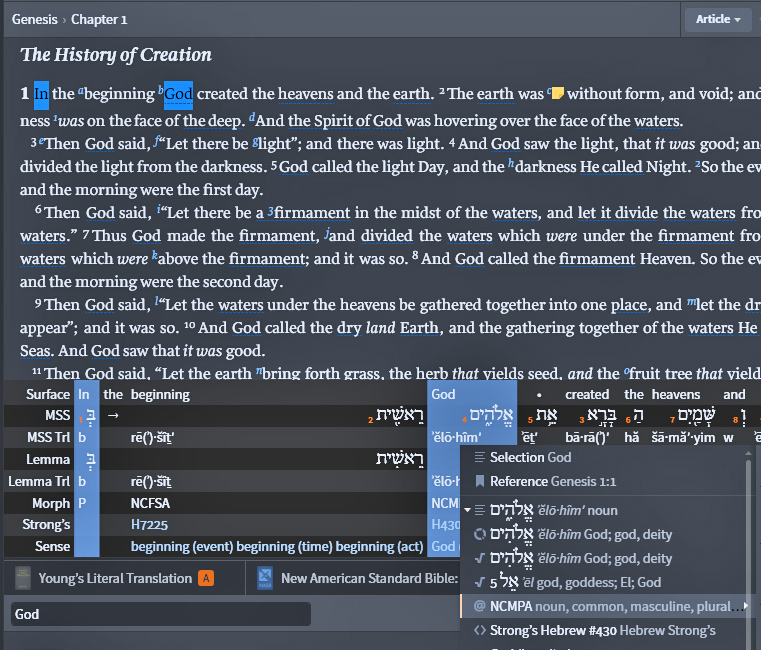
In this case, those participating in creation were God the Father, God the Son and the Spirit of God, because He was hovering over the face of the waters. This means the Son was begotten before the creation of the heavens and the earth. We aren’t given any insight into whether the Spirit was begotten. Since John tells us God is spirit (John 4:24), it would make sense that the Spirit is an extension of God the Father through His Son to creation. This might not be obvious unless you consider what it takes to speak a word. It takes breath. When God breathed out the Word, He also breathed out His Spirit. So, His Spirit, like His Word, is also distinct from Him once it leaves His mouth.
According to Tertullian, the Spirit is the substance the Son and the Father share, and this would make sense in light of the fact that Scripture speaks of the Spirit of God and the Spirit of Christ. They are the same Spirit, who comes from the Father. According to Hippolytus and Novatian, this substance carries the mind of God.
…searching what, or what manner of time, the Spirit of Christ who was in them was indicating when He testified beforehand the sufferings of Christ and the glories that would follow.
1 Peter 1:11
But you are not in the flesh but in the Spirit, if indeed the Spirit of God dwells in you. Now if anyone does not have the Spirit of Christ, he is not His. And if Christ is in you, the body is dead because of sin, but the Spirit is life because of righteousness. But if the Spirit of Him who raised Jesus from the dead dwells in you, He who raised Christ from the dead will also give life to your mortal bodies through His Spirit who dwells in you.
Romans 8:9–11
Now consider Deuteronomy 6:4 again. Why is Elohe singular? Because in the Old Testament worship is focused solely on the Father, however, the Law, stories and prophecies pointed to the Son. In fact, just about every page of the Old Testament is ultimately about the Son, the coming Messiah. Every single word concurrently points to Him, whether directly or indirectly.
In the New Testament, the Son who fulfills those prophecies always points to the Father. Ultimately, the Father is the final destination of all creation, but we only have direct access to Him through the Son. This is seen in the construction and practices of the temple in the Old Testament. The high priest went into the Holy of Holies once a year to atone for the sins of the people by sprinkling blood on the ark of the covenant. Now, Christ is THE High Priest, who shed His blood once for all sins. This is illustrated all throughout the book of Hebrews.
This vertical worship, focused upwards toward the Father, is important to understand as we proceed through this exposition.
No one can come to Me unless the Father who sent Me draws him;
John 6:44
Not only that, but we also rejoice in God through our Lord Jesus Christ, through whom we have now received reconciliation.
Romans 5:11
And whatever you do in word or deed, do all in the name of the Lord (Kyriou) Yahshua, giving thanks to God the Father through Him.
Colossians 3:17
The Ministry of Reconciliation
Another anti-trinitarian argument I’ve heard is that the following two verses together prove the Son and the Father are the same being:
Now when all things are made subject to Him, then the Son Himself will also be subject to Him who put all things under Him, that God may be all in all.
1 Corinthians 15:28
Christ is all and in all.
Colossians 3:11
The argument is that God is all in all and Christ is all in all, so they are the same. This fallacious association ignores the verses for a few words. It applies eisegesis to a cherry-picked phrase taken out of context. What the first verse is saying is there is an order to the ministry of reconciliation. Christ has the ministry of reconciliation, and that ministry is passed on to His apostles and disciples.
Therefore, if anyone is in Christ, he is a new creation; old things have passed away; behold, all things have become new. Now all things are of God, who has reconciled us to Himself through Yahshua Christ, and has given us the ministry of reconciliation, that is, that God was in Christ reconciling the world to Himself, not imputing their trespasses to them, and has committed to us the word of reconciliation.
2 Corinthians 5:17–19
So how can Christ be all in all while God is all in all? It is the summing up all things into Christ that brings all of creation back into reconciliation with God. Since Christ is the perfect image of God, reconciliation to Him is automatically reconciliation to the Father. The Greek word “Logos” is translated into “Word” in English. It broadly means “word” or “speech” but has also been used in extra-biblical Greek literature to mean “counting,” “to enumerate,” “reckoning,” “assembled again,” “to gather,” as well as “to narrate.”
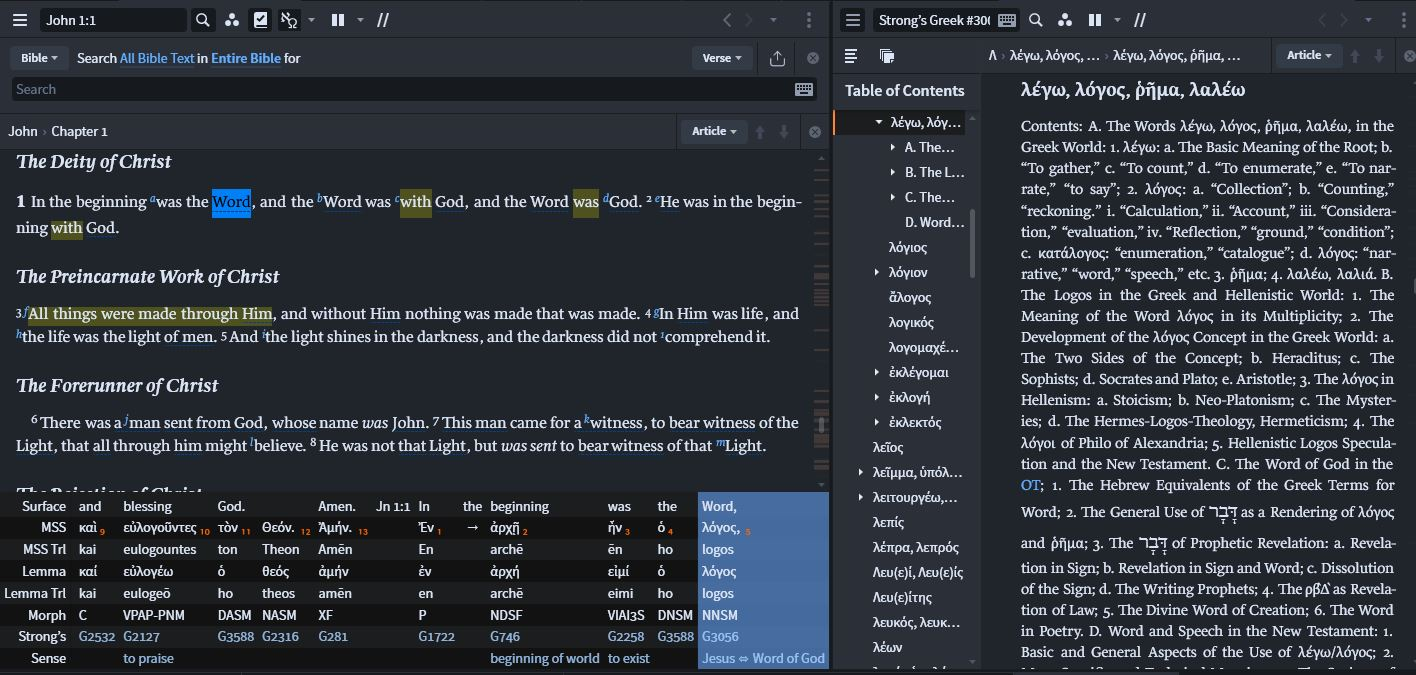
This is appropriate because Ephesians 1:9-10 says:
…having made known to us the mystery of His will, according to His good pleasure which He purposed in Himself, that in the dispensation of the fullness of the times He might gather together in one (summarize, encompass) all things in Christ, both which are in heaven and which are on earth — in Him.
The ministry of reconciliation begins within each of us when the Holy Spirit is given to a believer.
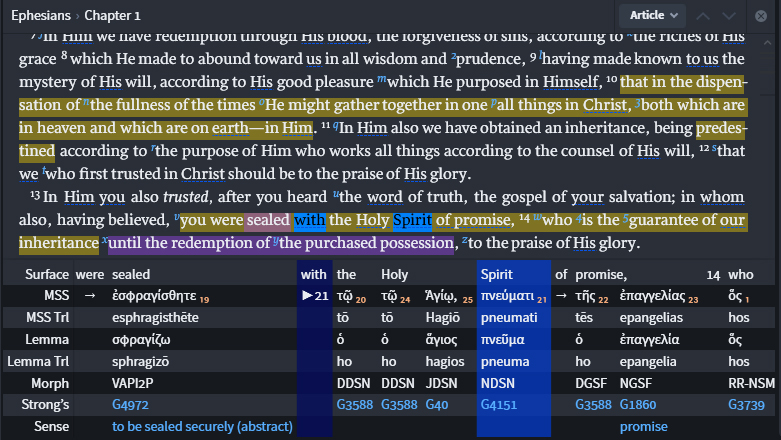
…having believed, you were sealed with the Holy Spirit of promise, who is the guarantee of our inheritance until the redemption of the purchased possession…
Ephesians 1:13–14
The Greek phrase for “with the Spirit” here is “pneumati” meaning “wind” or “breath.” Remember, the Hebrew word for “spirit” is “ruach,” also meaning “wind” or “breath.”
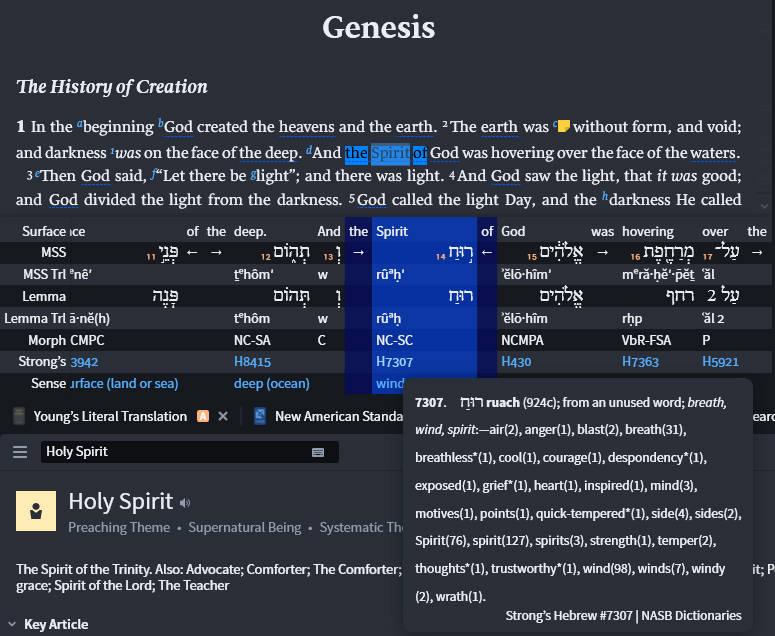
In summary, God the Father has sent His Word and Breath out in an act of creation. Once His Word and Breath left Him, they took on their own life outside of the Father. When you think of something to say you send it to the speech center of your brain and then inhale to get ready to speak it, “gathering your thoughts” so to speak. When that breath causes your vocal cords to vibrate it creates sound. When your mouth and tongue shape that sound it leaves your body as the words you intended to speak. The breath and words have left your body and now exist outside of you, independent of you. Others can feel your breath. They hear and comprehend your words. The words then live in the minds of those who heard them. Breathing and speaking are beautiful symbols, tangible reminders of the spiritual way God created the heavens and the earth as seen in Genesis 1, and subsequently a symbol of the ministry of reconciliation back to Him.
In the beginning God created the heavens and the earth… And the Spirit (breath) of God was hovering over the face of the waters.
Then God said, “Let there be light…”
Then God said, “Let there be a firmament in the midst of the waters…”
Then God said, “Let the waters under the heavens be gathered together into one place…”
Then God said, “Let the earth bring forth grass…”
Then God said, “Let there be lights in the firmament of the heavens…”
Then God said, “Let the waters abound with an abundance of living creatures…”
Then God said, “Let the earth bring forth the living creature according to its kind…”
Then God said, “Let Us make man in Our image…”
Creation was the act of God speaking. The parable of breathing reveals that the ministry of reconciliation is the process of everything returning to the Father according to His own Word!
Has any church ever taught you this? If I would have learned this when I was a youth at the very time my mind was expanding, when I needed meat instead of milk, I would have found Christianity to be much more compelling. I would have been established in truth with a hope that is unshakable. Yet what we are given in churches today is milk, not solid food, and frankly, that milk has been left to rot in the stagnant heat of a windless day. Paul said:
And I, brethren, could not speak to you as to spiritual people but as to carnal, as to babes in Christ. I fed you with milk and not with solid food; for until now you were not able to receive it, and even now you are still not able; for you are still carnal.
1 Corinthians 3:1–3
…we have much to say, and hard to explain, since you have become dull of hearing… For everyone who partakes only of milk is unskilled in the word of righteousness, for he is a babe. But solid food belongs to those who are of full age, that is, those who by reason of use have their senses exercised to discern both good and evil.
Hebrews 5:11, 13-14
Paul called most of what Christianity dwells on today milk for infants who are not ready for anything of real substance. I believe this is exactly why there was such controversy over the nature of Christ at the Council of Nicea in 325 AD. What transpired there was nothing less than complete compromise. The Nicean Creed was an attempt to make Christians play “nice.” In forcing this creed on all believers much was lost over the centuries.
The Nicene Creed teaches, in short, that the Son is co-equal with the Father in substance (clearly they didn’t know what this “substance” was), eternity and divinity, which means He is eternal just as the Father is eternal. However, being one in “substance” does not mean they are co-eternal. If this substance is the Spirit then that doesn’t mean we are co-eternal because we have Him indwelling us.
There was a teacher named Arius at the time who taught that the Son is a created, separate (or rather, distinct) being who is subordinate to the Father. Arius wasn’t the first to believe this. It was the dominant belief in the early days of Christianity. Origen and Tertullian taught the doctrine, among other early church fathers. Even though this is true, provably so with Scripture, Arius was banished from the Roman Empire by Constantine only to later have his ideas championed by Eusebius and Constantine’s own son. Eventually, over a century later, the bishops of Rome managed to stomp out the truth Arius taught, and the Nicean Creed won the day for the dominionist, Roman State which was made up of politicians, businessmen and bishops who were more concerned about politics than the truth. Ironically, the very next century, the Roman Empire was divided from within, the Western portion broken by the barbarians, and finished off by the Gauls and Vandals, many whom were Arians. Some might say this was the judgment of God, even though Christians are commanded to turn the other cheek. I’m touching very briefly on a massive subject here, one that you will have to search out for yourself in greater detail if you want to understand that time in history. At some point I will probably write more in depth about it. For now, I’ll close this section with a couple of relevant verses that I encourage you to chew on before you read the next 2 sections:
Repent therefore and be converted, that your sins may be blotted out, so that times of refreshing may come from the presence of the Lord, and that He may send Yahshua Christ, who was preached to you before, whom heaven must receive until the times of restoration of all things, which God has spoken by the mouth of all His holy prophets since the world began. Acts 3:19–21
For the creation was subjected to futility, not willingly, but because of Him who subjected it in hope; because the creation itself also will be delivered from the bondage of corruption into the glorious liberty of the children of God. For we know that the whole creation groans and labors with birth pangs together until now.
Romans 8:20–22
The Order of Reconciliation
Now let us broadly define the ministry of reconciliation and address the order in which its parts occur.
Now all things are of God, who has reconciled us to Himself through Yahshua Christ, and has given us the ministry of reconciliation, that is, that God was in Christ reconciling the world to Himself, not imputing their trespasses to them, and has committed to us the word of reconciliation.
Now then, we are ambassadors for Christ, as though God were pleading through us: we implore you on Christ’s behalf, be reconciled to God. For He made Him who knew no sin to be sin for us, that we might become the righteousness of God in Him.
2 Corinthians 5:18–21
Wow. Now this is really something to behold. God was IN Christ. This makes it clear that there is one inside of another, just as we receive the Holy Spirit who indwells us. It says we implore others on Christ’s behalf as if God is speaking through us! This means the mind of God works through us on Christ’s behalf. We are separate from Christ and Christ is separate from God the Father, yet God works through us as ministers because of Christ’s work reconciling us to Him. So now we see there is a hierarchy and a process to the ministry of reconciliation. The Father over Christ, Christ over man and man over woman.
But I want you to know that the head of every man is Christ, the head of woman is man, and the head of Christ is God.
1 Corinthians 11:3
If the head of Christ is God, then that means God is the authority over Christ. There is a distinguishment between the two and a clear hierarchy declared. In the passage above it describes how in God’s divine order this hierarchy carries over to man. This hierarchy is not about one dominating and controlling the other. It is about serving one another in love and truth. This is what distinguishes God’s ministry of reconciliation from the world’s attempts at unifying under man’s own wisdom. These days, the world has a humanist view of love, which is said to be “inclusive” and “tolerant.” This is not God’s love, which is necessarily corrective, punitive and exclusive (being that only those who come to Christ are saved). God is intolerant of those who do not follow His perfect Son. For as Paul tells us in Hebrews 12:7–8:
If you endure chastening, God deals with you as with sons; for what son is there whom a father does not chasten? But if you are without chastening, of which all have become partakers, then you are illegitimate and not sons.
God chastens all people because it is what we need. Those who are sons of God recognize and accept this, even rejoicing in His efforts to correct them. Likewise, Christ’s ministers offer correction to those who are under their authority and sometimes those outside their authority according to the leading of the Spirit.
The Love of God
To return to an understanding of the love of God we must first understand how man rejected and redefined love. In the Garden of Eden, Scripture tells us Eve was deceived by the serpent, but Adam wasn’t. This is another deep subject, but I want to focus in on why Adam ate the fruit if he wasn’t deceived. There’s only one reason. He did it for his wife. He loved her more than God and couldn’t bear the consequences of losing her, so he sinned with her. This was the first act of man defining love for himself, and it echoed the lie of the devil to Eve, that they would be like God, knowing good from evil.
Let us now look at how the ministry of reconciliation is ordained to take place and who it applies to.
For as in Adam all die, even so in Christ all shall be made alive. But each in his own order: (1) Christ the firstfruits, (2) afterward those who are Christ’s at His coming. (3) Then comes the end, when He delivers the kingdom to God the Father, when He puts an end to all rule and all authority and power. For He must reign till He has put all enemies under His feet. The last enemy that will be destroyed is death.
1 Corinthians 15:22–26 (Parentheticals and formatting added for clarity.)
This is one of the most critical passages to understand regarding God’s plan of reconciliation. Every word is important. Let’s break it down. ALL will be made alive, but each in their own order, as designated by God the Father. Yahshua must reign TILL He has put all His enemies under His feet. What does “till” mean? “Till” indicates that there will be an end to Christ’s reign. The natural question then is “What comes after?” This is what is explained in verse 28. Yahshua, along with those who have been given to Him, will be subject to God the Father and the Father will be all in all. Do you see what this means? Since Yahshua is already subjugated to the Father, when all things have been subjugated to the Son then the Father will be all in all.
Irenaeus wrote, circa 120-202 AD:
”… and to raise up anew all flesh of the whole human race, in order that to Christ Jesus, our Lord, and God, and Saviour, and King …”
- Against Heresies, Bk 1, Ch 10.
This is why it is so important to read the Bible critically, in prayer and deep study and also have a thorough knowledge of the history of Christianity, especially the first few centuries AD. Cherry picking and laziness are the reasons we have so many false doctrines and denominations in the Christian religion. The Bible and early extra-biblical Christian writers teach what is called Universal Reconciliation. This doctrine is not taught among mainstream Christians because it was stamped out by the Nicean Creed and further buried under ideas of eternal life and eternal damnation in the Catholic Church. Now, I will qualify my statement by warning you there is a new form of Universal Reconciliation that has compromised greatly on the original doctrines taught millennia ago. It takes more of an “inclusive” or Unitarian approach to Christianity. For this reason, I would urge caution in approaching this subject in your own research.
This doctrine is a long and deep study, but if you decide to test it for yourself, I advise starting with a study of the Greek word “aion,” which means “for an age,” or “a very long time,” and hyperbolically “forever” (an exaggerated figure of speech not meant to be taken literally but is used for emphasis).The word is a superlative pointing to an ideal, that is the perfection of an eternal God expressed through us. The same applies to the Hebrew word “olam.” While you are searching this out, chew on the following verse:
For the Lord will not cast off forever (olam). Though He causes grief, yet He will show compassion, according to the multitude of His mercies.
Lamentations 3:31–32
Contrary to sound doctrine, some Christians claim that because you can lose your salvation by entering into unrepentant sin after being born again, putting Christ’s sacrifice to an open shame (Hebrews 6:4-5), that you are unable to regain your salvation, but Paul doesn’t seem to think that way.
My little children, for whom I labor in birth again until Christ is formed in you, I would like to be present with you now and to change my tone; for I have doubts about you.
Galatians 4:19–20
If Christ can be formed in you again after you have fallen away, then there is always hope for those who wander from the fold. Is it not you who are Pharisaic by saying people will be eternally damned? By believing this you can’t possibly know the power of God’s love. I have personally experienced it. I fell away from the faith at age 13 and committed every sin in the book. Christ still sought me out. Me, the chiefest of sinners! Like Paul on the road to Damascus, He brought me to my knees and showed me His glory. When He does that, you can’t deny what you have witnessed. Something changes in you, and you know from that moment on what the truth is. You will always long for it, even if you wander off into the darkest pit. The parable of the prodigal son reminds us of God’s love for the whole world. The father welcomed his son back with open arms.
God sent His Son to die for the sins of the whole world. Everyone was forgiven on the cross and one day, every knee will bow to Him. THAT is the Gospel good news the apostles taught. THAT is the truth which has been suppressed for the better part of two millennia.
Before you go raving about the infallibility of Scripture and how God wouldn’t let the Bible become corrupted, remember that this is exactly what happened to the Jewish Torah and Tanakh when they removed the name of YHWH (Yahweh) from the bible because they felt His name should only be used sparingly. Think about that. How could God let His people remove His name from Scripture when all the fathers and prophets of the Old Testament spoke His name? Scripture tells us this!
In light of that, do you think you and your ancestors are somehow immune from corrupting the Gospel? People in the early church were already doing just that, and the Bible itself tells us. The infallible Scripture tradition only serves to box you into laziness and complacency. You have to study Scripture in the original languages thoroughly, in prayer and diligence, and when you do, the light becomes clear, only if you can set aside your bias and follow the Spirit of truth. Therefore, I urge you to take a fresh look at what has been preserved for us, to test it and prove it because God certainly did inspire and guide Scripture into existence. We must not, however, let the law of the letter kill. The entire point of the Bible is to lead us to Christ so we can receive and follow the Spirit, not letters printed on a page. Christ is no more a literal etching of God than the Bible is capable of encompassing the whole of the Spirit. If we cannot build a house for God to dwell in, we certainly can’t print a book for Him to speak through. As important as the Bible is, the Spirit is much more.
“…who also made us sufficient as ministers of the new covenant, not of the letter but of the Spirit; for the letter kills, but the Spirit gives life.”
2 Corinthians 3:6
Another argument I’ve heard from believers of the Nicean Creed goes something like this:
“If the eternal God is called ‘Father’ then He must have an eternal Son because He would not be a Father without a Son. Love depends on relationship, so the Son must be eternal because God could not be love without relationship.”
Anti-trinitarians would say:
“Since the only eternal being is God (because there is only one God who can be eternal), and the Father and the Son are both eternal then the Son must be the Father.”
Let me address the Nicean argument first. God is love.
And we have known and believed the love that God has for us. God is love, and he who abides in love abides in God, and God in him.
1 John 4:16
So, it is not a requirement for love to have relationship. It is love’s desire to be expressed in relationship. God created out of love and so love existed whole and pure before anything was ever created. The ministry of reconciliation is also based on love. That is how we abide in God and God in us; however, God does not need us, nor does He need a son. He brought forth His Son out of love and all of creation came through His Son as an act of love, and also truth, since the Spirit is truth. At the heart of the matter is the fact that since God is love and He is eternal, love is eternal. Love just IS. Yahweh told Moses, “I am that I am.”
Then Moses said to God, “Indeed, when I come to the children of Israel and say to them, ‘The God (Elohe) of your fathers has sent me to you,’ and they say to me, ‘What is His name?’ what shall I say to them?”
And God (Elohim) said to Moses, “I AM WHO (possibly “that” or “because”) I AM.” And He said, “Thus you shall say to the children of Israel, ‘I AM has sent me to you.’ ” Moreover God said to Moses, “Thus you shall say to the children of Israel: ‘The LORD God (Yahweh Elohe) of your fathers, the God of Abraham, the God of Isaac, and the God of Jacob, has sent me to you. This is My name forever (olam – for an age), and this is My memorial to all generations.’
Exodus 3:13–15
In previous verses we saw that God gave his name, Yahweh, as a memorial name. I can’t say for sure, but perhaps since the Father is eternal, we can’t possibly conceive of His eternal name.
…that Christ may dwell in your hearts through faith; that you, being rooted and grounded in love, may be able to comprehend with all the saints what is the width and length and depth and height — to know the love of Christ which passes knowledge; that you may be filled with all the fullness of God.
Ephesians 3:17–19
The Son reveals the love of the Father in a manner we can comprehend.
The Beginning and the End
Now that I’ve said this, let me breach a very controversial topic. The Son is not eternal. He had a beginning, and He has an end. I know that’s a shocking statement to most Christians, but listen to what Yahshua Himself says:
“I am the Alpha and the Omega, the Beginning and the End (telos), the First and the Last.”
Revelation 22:13
“These things says the Amen, the Faithful and True Witness, the Beginning of the creation of God…”
Revelation 3:14
If you read this directly in most bibles the words in Revelation 2 and 3 are printed in red because the editors recognized it was Christ speaking. Christ tells us explicitly that He is the beginning of the creation of God. There is no cause to interpret this as poetic metaphor or allegory. It’s literal. He is called the Beginning for a reason — because that is exactly what He is. The Greek word for “beginning” in 3:14 is arche. The Theological Dictionary of the New Testament says this word is most often used to denote non-eternality, especially in view of 21:6 and 22:13. It also says it represents the first point in time or the first appearing of something significant. Now, I am inclined to add that since all things (creation) were made through Him, He at least encompasses the age of ages, and possibly is even outside them altogether, not eternally or infinitely, but finitely, possibly even circularly.
So what do we do with Heb 7:1–3?
For this Melchizedek, king of Salem, priest of the Most High God, who met Abraham returning from the slaughter of the kings and blessed him, to whom also Abraham gave a tenth part of all, first being translated “king of righteousness,” and then also king of Salem, meaning “king of peace,” without father, without mother, without genealogy, having neither beginning of days nor end of life, but made like the Son of God, remains a priest continually.
Does this say the Son of God has no beginning or end? No, it points out how Melchizedek had no known history in the Bible. He is a mystery and that’s what Paul is playing off of. This was a man, so he did indeed have a father and mother. He was not spawned from out of nowhere. The emphasis of the broader context is on priesthood, and that is the culmination of this verse — the priesthood of Christ, which Melchizedek, being a priest himself, was a type and shadow of. It’s not sound to reason this verse negates other verses that contradict it. Many have exercised this verse to make bloated claims, like Melchizedek is Christ. The same applies to Christ having no beginning or end.
But what about further down, you say, where it says He has a endless life?
And it is yet far more evident if, in the likeness of Melchizedek, there arises another priest who has come, not according to the law of a fleshly commandment, but according to the power of an endless life. For He testifies:
“You are a priest forever (aion)
According to the order of Melchizedek.”
”Endless” here is akatalytou, which means indestructible, and by loose extension, endless. It sits besides words like blameless, undivided, incorruptible and unharmed. “Forever” is the word aion, which means “an age.” So it would best be translated, “according to the power of an indestructible life,” and “You are a priest for an age.” This makes perfect sense when you understand that eternal life only exists in an infinite God, but is manifested through the perfect image of His Son and subsequently, His saints. It is a statement of quality, not quantity. It enrobes Christ and all of creation through the ages. This wording is meant to evoke meditation on an eternal God continually, as a royal priesthood. It directs our eyes upward to the Image of God so we can comprehend within the limits of our abilities.
Paul especially favors a technique called literary rhetoric, more specifically an appeal called in Greek, kairos, meaning to use timely, well-known cultural references as metaphors pointing towards something else. It is a technique often employed to make an opposing argument against cultural behaviors and redirect the audience’s attention to something better. Paul is using kairos here to call to mind the Grecco-Egyptian myth of Aion, yet pointing to the correct application of the concept. If I may quote from my own book, here is an excerpt from Holy Daze:
The common belief that these myths are based on is that the sun wanes in the winter and is almost conquered by the dark, yet it rises again, reborn from the struggle. That is why the Romans also called their god Sol (who was a syncretization of Apollo, Helios and possibly Mithra) by the title, “Sol Invictus” or “Unconquerable Sun.” According to the Philocalian calendar of 354 AD they held a celebration on December 25th called “Natalis Invicti” meaning “Birth of the Unconquerable One” who is arguably Sol. The celebration was a prerequisite to the festival that occurred on the 6th of January honoring Kore (known as Persephone in Greece), the virgin maiden who gave birth to Aion at that time of year. Sound familiar?
Epiphanius, bishop of Salamis (c. 310–320 - 403AD) says that at Alexandria (Egypt) Aion’s birth from Kore the Virgin was celebrated January 6: “On this day and at this hour the Virgin gave birth to Aion.” The date, which coincides with Epiphany, brought new year’s celebrations to a close, completing the cycle of time that Aion embodies…
Wikipedia (Aion), December 2019
Do you see how the Greeks took the truth and made a myth out of it? Paul was issuing a correction to them, showing them with subtlety where the source of their myth came from.
For centuries now the concept of Christ having a beginning has been known as “the Arian heresy.” As we have covered already, so-called Arianism was the common belief among Christians long before Arius came along. The earliest example that I could find, besides the writings of Moses, John and Paul, is from about 210AD:
But since they will have the Two to be but One, so that the Father shall be deemed to be the same as the Son, it is only right that the whole question respecting the Son should be examined, as to whether He exists, and who He is and the mode of His existence. Thus shall the truth itself secure its own sanction from the Scriptures, and the interpretations which guard them. There are some who allege that even Genesis opens thus in Hebrew: In the beginning God made for Himself a Son. As there is no ground for this, I am led to other arguments derived from God’s own dispensation, in which He existed before the creation of the world, up to the generation of the Son. For before all things God was alone — being in Himself and for Himself universe, and space, and all things. Moreover, He was alone, because there was nothing external to Him but Himself. Yet even not then was He alone; for He had with Him that which He possessed in Himself, that is to say, His own Reason. For God is rational, and Reason was first in Him; and so all things were from Himself.
Tertullian, Against Praxaeus, Chapter 5. The Evolution of the Son or Word of God from the Father by a Divine Procession. Illustrated by the Operation of the Human Thought and Consciousness
I’m sure this will be hard to swallow for most of you, but let’s step back from our biases towards tradition and seek the truth of the matter. Kings and well-funded scholars were also writers of ancient history and they dominated people’s education through controlled propaganda. They have been at odds with the true Gospel from the start because it is a disruption to the “normal” operations of life on earth. It is the most confrontational message to ever be spoken. Why? Because it is difficult for worldly people to accept that this broken world is not where we should be placing our hope. The hope of the Gospel is placed in a much greater spiritual life beyond this present fallen existence. Speaking of Abel, Enoch, Noah, Abraham and Sarah, the Bible says:
These all died in faith, not having received the promises, but having seen them afar off were assured of them, embraced them and confessed that they were strangers and pilgrims on the earth. For those who say such things declare plainly that they seek a homeland. And truly if they had called to mind that country from which they had come out, they would have had opportunity to return. But now they desire a better, that is, a heavenly country. Therefore God is not ashamed to be called their God, for He has prepared a city for them.
Hebrews 11:13–16
Going back to the arguments presented at the beginning of this section, we know God as the Father and as Yahweh because that title and name is given for us to know Him by. This is because a father has children, and they need to call him by his proper title of respect. When Yahshua was brought into existence He became the Son and God became the Father, in title. Yahshua was the Son from the beginning, with all the divinity of His Father, yet He is still a separate being with His own will, and He chooses to do only the will of His Father. This free will is evidenced in many ways, one of which is in the garden of Gethsemane when Yahshua asked God to let the cup of crucifixion pass from Him. He cried out to God in agony, yet conceded, saying, ”Nevertheless, not my will, but Yours be done.” (See Luke 22:42.) God declared from the beginning that His Son would have to die as the perfect sacrifice for our sins. Christ was not going to run away from that just as Isaac didn’t run away from Abraham at the altar of sacrifice.
Now, saying “the beginning” requires there to be a time before the beginning when creation did not exist. “I am the first and I am the last” is repeated by Christ in Revelation three times (1:11, 1:17 and 22:13). He makes it a point to emphasize He is the beginning and the end. This is not an allegory attempting to express eternality because eternality by its nature cannot be expressed with a beginning and an end. That would defeat the whole purpose of being eternal. When you regurgitate popular Christian tradition by saying the phrases “beginning and end” and “first and last” are allegories of something eternal you project willing ignorance. Christ also says He is the “Alpha and the Omega.” These are the beginning and ending letters of the Greek alphabet. He is the Word, spoken from the beginning, which will be carried out to the end, for what is a prophecy if never fulfilled? All prophecies, which are words foretelling the future, come to an end when they are fulfilled. Written language itself reflects that truth.It cannot contain the love nor the law of God. It can only describe it in part.
Love never fails. But whether there are prophecies, they will fail; whether there are tongues, they will cease; whether there is knowledge, it will vanish away. For we know in part and we prophesy in part. But when that which is perfect has come, then that which is in part will be done away.
1 Corinthians 13:8–10
What is perfect but the love of God carried through all of creation as He intends it? The Father is not bound to time just as love is not bound to time. The Son is bound to time because He had a beginning. He was made from love, from everlasting. The Son will reconcile all of creation to the Father in love. He created all things at the will of His Father in love, and He will return all things to the Father through love. The hymn titled The Love of God declares this very understanding in a perfectly poetic way:
“The love of God is greater far than tongue or pen could ever tell. It goes beyond the highest star and reaches to the lowest hell.”
There is no place the love of God cannot go. It reaches to the lowest hell. Why? Because love is the true nature of all things, and all things desire it. Make no mistake, LOVE WILL PREVAIL.
Therefore God also has highly exalted Him and given Him the name which is above every name, that at the name of Yahshua every knee should bow, of those in heaven, and of those on earth, and of those under the earth, and that every tongue should confess that Jesus Christ is Lord, to the glory of God the Father. Philippians 2:9–11
When I point out to Christians that God has prophesied every knee will bow to His Son they scoff. It’s right there in plain text, yet they choose tradition over the obvious. They can’t fathom how love is the source of all things, and all things crave to reconnect to that source. Perhaps it is their inane desire for human justice that they want people to burn for eternity or maybe they just have Catholic baggage hanging over their heads. They don’t comprehend the length, width and height of His love, but they will, even if they have to go through fire themselves. I often say that witnessing to Christians is far more difficult than witnessing to non-believers and the lost. I imagine this is what the first disciples of Christ felt like witnessing to the Jews and Pharisees.
“Well did Isaiah prophesy of you hypocrites, as it is written:
‘This people honors Me with their lips,
But their heart is far from Me.
And in vain they worship Me,
Teaching as doctrines the commandments of men.’
Mark 7:6–7
Yahshua even told the Pharisees, “I have not come to call the righteous, but sinners, to repentance.” If you ever doubted that the Son of God uses sarcasm, here is your evidence. Note, He was speaking to people who thought they were righteous; however, He also told them they were a “brood of vipers” and “whitewashed tombs.” Calling them righteous in this case was certainly a jab. He is still saying the same things to the “new Pharisees” of modern, corrupt Christianity, the ones who avoid confrontation for the sake of unity – who compromise the gospel for the sake of peace. Telling Christians they are like Pharisees will get you dubbed a heretic. I know because I’ve been told, “You make yourself out to be the voice of God!” Spoken like a true Pharisee.
I’d be further accused of heresy if I told you Scripture prophesies an age after this age (Mark 10:30, Luke 18:30, Ephesians 1:21, Ephesians 2:7, Hebrews 6:5), after the heavens and the earth are dissolved by fervent heat (2 Peter 3:10-12) and a New Heaven and New Earth are made (2 Peter 3:13, Revelation 21:1).
That’s not simply a spiritual statement about what happens inside us now as believers, nor is it an allegorical statement about the political affairs on this planet, but a literal, future fulfillment of God’s plan which He declared from the beginning. It is apparent that God’s Word will endure through that coming age, when those who are not in Christ are cast into the Lake of Fire (also called the second death – see Revelation 2:11, 20:14, 21:8). Those who are in Christ will rule and reign with Him in that age over the New Heaven and New Earth.
I will not discount the importance of applying this here and now to our lives, but if we refuse to admit that there is a literal fulfillment to this prophecy then we are only focusing our hearts on the present time. We are not called to live our best lives now, to try and make this time on Earth as comfortable and pleasant as possible for ourselves and others. We are called to let go of this world and set our sights on the future promises of God. We apply these spiritual concepts to our lives now because we are preparing ourselves for that future in the age to come.
The following passage outlines the very essence of God’s plan of reconciliation through His Son. We see again that Yahshua was in the form of God in heaven. This is exactly how Yahshua was able to 1) speak for Yahweh and as Yahweh in the Old Testament, 2) how He spoke the words of the Father on earth and, 3) even now speaks from Heaven by the Holy Spirit.
Let this mind be in you which was also in Christ Yahshua, who, being in the form (“morphe” meaning “essence” or “external appearance”) of God, did not consider it robbery to be equal with God, but emptied Himself, taking the form of a bondservant, coming (“genomenos” or “to become” implying a change of state) in the likeness of men. And being found in appearance as a man, He humbled Himself and became obedient to the point of death, even the death of the cross. Therefore God also has highly exalted Him and given Him the name which is above every name, that at the name of Yahshua every knee should bow (worship), of those in heaven, and of those on earth, and of those under the earth, and that every tongue should confess that Yahshua Christ is Lord (Kyrios), to the glory of God the Father.
Philippians 2:5–11
Yahshua, in His preincarnate state, considered Himself equal with God, but that was not robbery. I have to ask anti-trinitarians, why would Paul even clarify that it wasn’t robbery if Yahshua and the Father are the same person? Why wouldn’t he just say that the Father emptied Himself to the point of death as a man? Why use a proxy as a figurative reference to something that needs no proxy? Because the proxy is important to God. That Proxy is His beloved Son!
Also, Yahshua considered Himself equal with God because God considered Him equal in Spirit. He exalted Him to His own state of Godhood because of His obedience to His will. God glorified Himself by exalting His Son who represents Him perfectly. This should offer a word of correction to believers in the Nicene Creed who claim the Son is equally eternal. Similar to how Christ is exalted by His Father, followers of Christ will be exalted and sit on His throne with Him in the regeneration.
“Assuredly I say to you, that in the regeneration, when the Son of Man sits on the throne of His glory, you who have followed Me will also sit on twelve thrones, judging the twelve tribes of Israel.
Matthew 19:28
To him who overcomes I will grant to sit with Me on My throne, as I also overcame and sat down with My Father on His throne.
Revelation 3:21
In Isaiah 42:1–9 there is a prophecy of the coming Messiah. There is a verse that an anti-trinitarian might use as an argument against the Son being separate from the Father.
“I am the LORD (Yahweh), that is My name; And My glory I will not give to another…”
To that I would direct them to Philippians 2:5-11 above. As we just read, God exalted Yahshua so that every knee would bow to Him, and that brings the Father glory. This confirms that the prophecy in Isaiah 42 declares the Father will not give His glory to anyone else other than Yahshua. This is the meaning of the word “another” in that verse.
Look back again at Philippians 2 above. The Greek word “morphe” is used throughout Hellenistic philosophy mainly to refers to the nature or character of something in both the internal and external form. In other words, morphe refers to a changing outward display of an inner reality or the essential form of something which never alters. Morphe does not mean a change of state of one tangible thing INTO another, but rather that something emerged from a connected source to become something separate from the source and tangibly unique.
Philo, in his De Migratione Abrahami used morphe to describe man being formed from the dust of the earth and returning to the dust when he dies. Man is distinct from the dust from which he came and yet he was formed in the image of God and given the breath of life to become a living soul. Although the word used in Scripture is “created” or “made” it is how Philo intended on using this word that matters. It is not his theology I’m backing, but his understanding of Greek and how he used the word. He used it with the meaning of God forming man from one thing to make another. Man is still first made of dust. Christ is still made of the essence of God, yet He appears in a different outward form.
After this, he appeared in another form (morphē) to two of them as they were walking along, going into the country.
Mark 16:12
…who, being in the form (morphē) of God, did not consider it robbery to be equal with God, but emptied Himself, taking the form of a bondservant, coming (genomenos or “to become,” implying a change of state) in the likeness of men. And being found in appearance as a man, He humbled Himself…
Philippians 2:6
Yahshua still was made of the essence of God even though He took on the form of a man. He left His station in Heaven to be put in the womb of a woman and became a man outwardly, even though He carried the same Spirit who impregnated the woman. He became a man but carried God’s Spirit. That is the essence of His life on earth. This is how He was able to be both God and man simultaneously. We as Christians are meant to echo that by being formed into the image of Christ. We, then, are gods (lower case, like in Psalm 82:6 and John 10:34-36) in Christ yet we are still merely men. God is speaking through us only because we have taken on the form of Christ. It is the Spirit we carry who makes us gods. Christ did not use the word “gods” in the same way mystics and occultists do. He used it to show our direct connection to God is a top-down gift resulting from faith, not evolutionary nor manifested by pursuit of knowledge, like Gnostics believe.
The real crux of Philippians 2 is that Yahshua became obedient to the point of death. This is the most extreme example of what is known as Sabbath rest, which we see defined in Hebrews 4:10. It is one of the most important verses in the Bible:
` q For he who has entered His rest has himself also ceased from his works as God did from His.
A similar verse, which corresponds to the one above, is what Yahshua said in Luke 22:42:
“…nevertheless not My will, but Yours, be done.”
It begs the question: If Yahshua was being obedient, who was He being obedient to? Why would He say “not My will, but Yours be done” to the Father if He was the Father? Surely there would have been no need to ask Himself to change His own mind. On His knees in the garden of Gethsemane, Yahshua had a choice to accept or reject the Father’s will. He asked the Father to let the cup of suffering and death pass from Him, yet He then submitted. This reminds me of 1 Corinthians 12:9, where Paul cried out to God three times to remove the thorn from His side, but God replied, “My grace is sufficient for you.” Similarly, this same message is implied in the garden of Gethsemane before Yahshua’s capture. God’s grace was upon Yahshua even though He was suffering. Now, if Yahshua had the will to ask the Father to change His mind, He was not the Father. Likewise, why would God exalt Himself to His own glory? No, God’s glory is that His Son did as He commanded, even though it was the most difficult thing one could ever do. His Son is, therefore, His glory.
Sent From God
While we are speaking of obedience let’s ask a few questions about some of the small words in the Bible that can and should have a marked impact on our Theology and Christology. Have you noticed that all throughout Scripture words like “sent,” “from,” “because of” and “granted” are used to denote a one way relationship from God to Christ? These minutiae indicate commands and responses as well as cause and effect. Since when is the cause the effect, or the command the response? How can one be sent somewhere to do something of their own accord? Wouldn’t they just go? If you came from someone it means you aren’t the one from whom you came. You are another. If you live because of another, then you are separate from the one who caused you to live. If it is granted by another that people come to you then it means you are not the one doing the granting. The wording below shows without a doubt that the Father and the Son are two separate beings, and that the Son is in subjection to the Father.
Yahshua therefore answered and said to them, “Do not murmur among yourselves. No one can come to Me unless the Father who sent Me draws him; and I will raise him up at the last day. It is written in the prophets, ‘And they shall all be taught by God.’ Therefore everyone who has heard and learned from the Father comes to Me. Not that anyone has seen the Father, except He who is from God; He has seen the Father… As the living Father sent Me, and I live because of the Father, so he who feeds on Me will live because of Me. This is the bread which came down from heaven — not as your fathers ate the manna, and are dead. He who eats this bread will live [for an age].”
These things He said in the synagogue as He taught in Capernaum.
Therefore many of His disciples, when they heard this, said, “This is a hard saying; who can understand it?” (But He was speaking in a parable!)
When Jesus knew in Himself that His disciples complained about this, He said to them, “Does this offend you? What then if you should see the Son of Man ascend where He was before? It is the Spirit who gives life; the flesh profits nothing. The words that I speak to you are spirit, and they are life [Because He is the Word of God who came by the Spirit of God into Mary’s womb]. But there are some of you who do not believe.” For Jesus knew from the beginning who they were who did not believe, and who would betray Him. And He said, “Therefore I have said to you that no one can come to Me unless it has been granted to him by My Father.”
From that time many of His disciples went back and walked with Him no more.
John 6:41–66
John belabors the point that Yahshua was sent by God, thus emphasizing the superior will of the Father and the submission of the Son.
“For I have come down from heaven, not to do My own will, but the will of Him who sent Me. This is the will of the Father who sent Me, that of all He has given Me I should lose nothing, but should raise it up at the last day. And this is the will of Him who sent Me, that everyone who sees the Son and believes in Him may have everlasting (age-long) life; and I will raise him up at the last day.”
John 6:38-40
In this the love of God was manifested toward us, that God has sent His only begotten (uniquely born) Son into the world, that we might live through Him. In this is love, not that we loved God, but that He loved us and sent His Son to be the propitiation for our sins.
1 John 4:9-10
Some other Scriptures that are used by anti-trinitarians to prove that God is one being are as follows:
“Right, Teacher,” the scribe replied. “You have stated correctly that God is One and there is no other but Him.” Yahshua replied, “This is the most important: ‘Hear O Israel, the Lord our God is One Lord…”
Mark 12:29,32
You believe that God is one. Good for you! Even the demons believe that — and shudder.
James 2:19
You can take this point blank as is without chewing on it to understand it further, or you can inquire of the text, “Is there more to the story?” What does the whole of Scripture say? The broader context should raise additional questions. Could “God” simply be a title, a position or a station? If so, then is it possible that the Father who is supreme over all could give His station to another? Is He willing or able to let another sit on His throne in His stead, as a steward of His kingdom? If so, why would He do this when He told the Jews specifically not to worship anyone but Him? These questions should arise in the mind of someone who reads the words God inspired. We will endeavor to test and answer these inquiries as we progress through Scripture together. Up to this point we have already seen in Scripture that the Father sent His Son to earth and has since exalted Him to be worshiped. May the Spirit help you receive this truth as we look further into what is further declared in the Bible about these questions.
Name, Character and Reputation
In what ways can the Son possibly be God? We’ve already seen how the Son is called the “express image” of God, meaning an exact imprint. Let’s expound upon that by looking at other descriptions of the Son in relation to the Father. Here is a prophecy in the Old Testament about the future arrival of Christ on earth.
For unto us a Child is born, Unto us a Son is given; And the government will be upon His shoulder. And His name will be called Wonderful, Counselor, Mighty God, Everlasting Father, Prince of Peace.
Isaiah 9:6
Anti-trinitarians would argue three main points from this verse:
- Since this text is a prophecy, it is not confirming a preincarnate Son. It is instead confirming that there was no Son until He was incarnated, a prophecy by nature using verbs in the future tense. Yahshua might have been God’s Son, but He did not have the name Yahshua (or Iesous/Jesus) yet.
- This verse equates the future incarnate Son with the Father.
None of these explanations hold up to scrutiny. Note that the verse above is implying a change of state, from Child/Son to God/Father/Prince, because it says the Child will be called such at some time in the future after His incarnation. At the time this passage was written, in the 8th century BC, He was not yet called Mighty God or Everlasting Father because He had not completed the work the Father gave Him to do on earth. He was not yet exalted. He had not yet secured His inheritance by the precious cost of His own perfect blood.
The word translated as everlasting here in Hebrew is ad, meaning continually or from perpetuity. It stems from the word adah, which means to pass on, or adorn oneself and sometimes take. The whole passage is a declaration of the passing of Godhood from Father to Son. This is why He is both called the Prince of Peace and Mighty God in the same context. The son of the king is a prince until he has received his inheritance and becomes king himself. In this case, the Prince is given stewardship of the throne until the fullness of His inheritance is complete. Of course, it’s quite a different scenario with God because He is eternal. His Son is really only ever a steward of the throne because His Father never dies. The Father’s inheritance eventually returns to Him because it came from Him. These are merely words used to express a spiritual reality, parables to give us a frame of reference, something we can relate to. On earth, because of death, the passing of human kingship is a one-way event. In Heaven, it is reciprocal. This is how Christ becomes all in all and then God becomes all in all.
Moreover, the Word was certainly named Yahshua before He was incarnated. There is evidence of this in Exodus 23:20-23:
“Behold, I send an Angel before you to keep you in the way and to bring you into the place which I have prepared. Beware of Him and obey His voice; do not provoke Him, for He will not pardon your transgressions; for My name is in Him. But if you indeed obey His voice and do all that I speak, then I will be an enemy to your enemies and an adversary to your adversaries. For My Angel will go before you…”
This was Yahweh speaking to the Hebrews after they came out of Egypt, being led by the pillar of smoke, yet it is also prophetically pointing forward to the new covenant, which Yahshua came to establish. Who could this Angel be other than Yahshua, who carries the name of Yah? It is not Michael or Gabriel. Neither of these angels have Yah’s name in theirs. They have El in their names, which is the Hebrew word for “God,” which is a title, not a name, but Yahshua literally has His Father’s name in His own name. Also, the passage reveals to us that Yahshua speaks for Yahweh by telling us to obey His voice and do all that Yahweh speaks. Who then is speaking? Yahweh or Yahshua? It is Yahweh speaking through Yahshua. You will see more evidence of this as you read on.
There are many references to Yahshua in the Old Testament where He is called the LORD of Hosts (or more accurately, Yahweh of hosts, “hosts” being the angelic hosts in heaven) and the Angel of God, among other titles we will be looking at in more detail.
Again, Yahshua quite literally has the Father’s name in His name. In the Old Testament there are over 40 uses of the name “Yah” as a shortened version of “Yahweh.” Yahshua means “Yah’s Salvation.” His name is derived from an early Hebrew word, “yasha,” meaning salvation. So, it is reasonable to say that He is called God and Father in name because he not only literally carries His Father’s name, but He also carries His character. In Greek, the word translated “name” is “onoma,” which means “one who is known by his name,” but also “one who is identified by his character or reputation.”
Here are some additional excerpts from The Theological Dictionary of the New Testament regarding the word onoma:
A. Religio-Historical Background.
There was and is a world-wide belief that the name of an object, man, or higher being is more than a mere label only incidentally associated with the one who bears it. The name is an indispensable part of the personality. One might say that a man is constituted of body, soul and name.
…the name contains mana.
The name is thus a power which is very closely associated with the bearer and which discloses his nature. Pronouncement or invocation of the name sets in operation the energy potentially contained in him.
C. The Old Testament.
…it originally denotes an external mark to distinguish one person or thing from others. It then means “name…”
…with ref. to the acts of the persons mentioned it can mean a “good” or “bad” “reputation,” and in the abs. “repute” or “esteem…”
When you see the word “name” in Scripture, consider the depth of the meaning involved in the context. Is it implying one who carries the character and reputation of another and thus they are known by that name? More so in distant history, people were inseparable from their family’s reputation. Dealing with a son was considered the same as dealing with his father in many cases. It is why sons carried their father’s last name. Last names are a fairly recent invention, so when you go back many centuries you see that it was a person’s career or reputation that determined how they were distinguished from another of the same name. You might be John from Damascus, but are you the John that is a tanner or the John that is a smith? In more recent centuries, these two would be known as John Tanner or John Smith. Sons usually followed after their father’s established careers, hence they carried on that title, which eventually became last names. It is reasonable to see how this is a reflection of how God exalted His Son and gave Him His name and reputation, which is literally, “Yah’s salvation.”
Let us take another look at the pages of John, for he has much to say about the Trinity.
“And in that day you will ask Me nothing. Most assuredly, I say to you, whatever you ask the Father in My name He will give you. Until now you have asked nothing in My name. Ask, and you will receive, that your joy may be full. These things I have spoken to you in figurative language; but the time is coming when I will no longer speak to you in figurative language, but I will tell you plainly about the Father. In that day you will ask in My name, and I do not say to you that I shall pray the Father for you; for the Father Himself loves you, because you have loved Me, and have believed that I came forth (exelthon) from God. I came forth from the Father and have come into the world. Again, I leave the world and go to the Father.”
John 16:23–28
In the passage above Yahshua is speaking of the Father as a separate person, as He always does, with the exception of a couple of times in the Gospels where He says that they are one. Upon further reading we see that Yahshua is also saying that those who are His are one with Him. Does that mean there is no distinction between Yahshua and His believers? Following through with the logic of anti-trinitarians we would have to be the same being as Christ, and although Scripture tells us that we believers are the body of Christ, that does not mean we are literally the same being as Christ. I don’t know about you but I’m not comfortable saying I am Yahshua, which would basically be saying I too am worthy to be called God. I am not worthy as He is. I did not live a sinless life and die as the ultimate sacrifice for the sins of the whole world. It is a privilege that because I believe in His sacrifice I am counted as one with Him. And what is it to believe but to live out His sacrifice in service to God?
Furthermore, when you ask the Father for something in Yahshua’s name you are asking in His character and reputation. You can only ask in His character and reputation if you are walking in the Spirit, as Yahshua did, seeking to do only the will of the Father.
Below is a continuation of John’s Gospel from above.
Yahshua spoke these words, lifted up His eyes to heaven, and said: “Father, the hour has come. Glorify Your Son, that Your Son also may glorify You, as You have given Him authority over all flesh, that He should give age-long life to as many as You have given Him. And this is age-long life, that they may know You, the only true God, and Yahshua Christ whom You have sent. I have glorified You on the earth. I have finished the work which You have given Me to do. And now, O Father, glorify Me together with Yourself, with the glory which I had with You before the world was.
John 17:1-5
Anti-trinitarians will tell you that the “and” in verse three between “You, the only true God” and “Yahshua Christ” is equating the two as one person. It clearly is not. First of all, Yahshua is speaking to the Father, declaring what age-long (aionion) life is, which is to know the Father, who is the only true God, and to also know Yahshua Christ Whom He sent. Again, one cannot send himself from one place to another. He sends another with work to do, which is exactly what the context of this passage is saying grammatically. There are no two ways about it.
Also, here is yet another reference to Yahshua’s existence with the Father before the world was created by Him. Antitrinitarians would say the words “together with” mean they are literally one, but this is assigning meaning where there is none. Being with someone means you are physically in the presence of yet apart from another. They would say that since there is no evidence of the Son before His incarnation on Earth that this passage can only mean a complete union of one. The grammar doesn’t allow for the union of two into one. This future event is being adamantly requested, harkening back to a time when the same circumstances existed – before the world, when they were with one another, when they both declared in unison, “Let us create man in our own image.”
· • ✦ • ·
“I have manifested Your name to the men whom You have given Me out of the world. They were Yours, You gave them to Me, and they have kept Your word. Now they have known that all things which You have given Me are from You. For I have given to them the words which You have given Me; and they have received them, and have known surely that I came forth from You; and they have believed that You sent Me.”
John 17:6-8
· • ✦ • ·
Voice and Presence
To you it was shown, that you might know that the LORD (Yahweh) Himself is God; there is none other besides Him. Out of heaven He let you hear His voice, that He might instruct you; on earth He showed you His great fire, and you heard His words out of the midst of the fire. And because He loved your fathers, therefore He chose their descendants after them; and He brought you out of Egypt with His Presence, with His mighty power, driving out from before you nations greater and mightier than you, to bring you in, to give you their land as an inheritance, as it is this day. Therefore know this day, and consider it in your heart, that the LORD (Yahweh) Himself is God in heaven above and on the earth beneath; there is no other. Deuteronomy 4:35-39
Why does the text need to say “with His Presence” as if it were a tool that He was using? If it were simply Yahweh doing it Himself, then this text would be superfluous and unnecessarily poetic. Also, how does one hear another speak? Through their words. If you hear God’s voice you are hearing His Word. A look at the Greek behind the following passage gives us further insight into why these phrases were used.
For certain men have crept in unnoticed, who long ago were marked out for this condemnation, ungodly men, who turn the grace of our God into lewdness and deny the only Lord (Despotēn) God (Theos – added by the translators but not in the Greek) and our Lord (Kyrios) Yahshua Christ (Messiah). But I want to remind you, though you once knew this, that the Lord (Kyrios), having saved the people out of the land of Egypt, afterward destroyed those who did not believe.
Jude 4-5
Two things are worth noting here. First, the word “God” after Lord is not present in the Greek. It was added by the King James Version translators in 1611. The translation should read “our only Master and Lord, Jesus Christ.” Even the Latin Vulgate translated it as “the only Master and Lord, our Jesus Christ,” which is forcing the Greek into English a little, but still accurate.
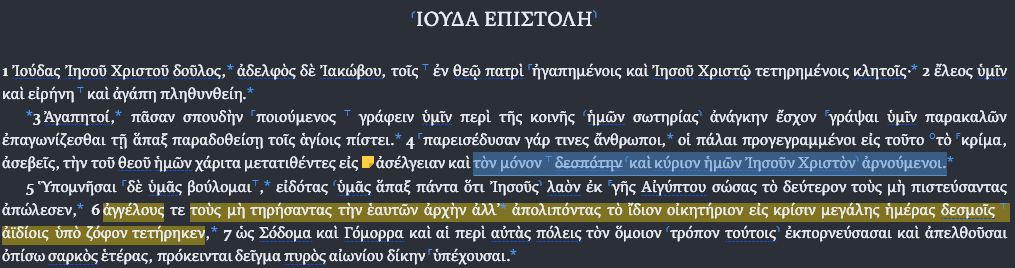
Second, either way you slice it, the verse tells us exactly who it was that led the Hebrew people out of Egypt. It was Yahshua. It was He who carried out Yahweh’s judgment on the Egyptians and Sodom and Gomorrah. This is because Yahshua has only ever done and will only ever do the will of the Father.
All that the Father gives Me will come to Me, and the one who comes to Me I will by no means cast out. For I have come down from heaven, not to do My own will, but the will of Him who sent Me. This is the will of the Father who sent Me, that of all He has given Me I should lose nothing, but should raise it up at the last day. John 6:36–39
Note above that Yahshua said He came down from heaven. Of course He did, because He was at the Father’s right hand! Also take note of the fact that Yahshua acknowledges that He has His own will but chooses to do His Father’s will instead. Not only that but His Father gave Him all, and He sent Him down to earth to do His will. Again, you cannot send someone somewhere if they weren’t a separate being from you just as it would make no sense to give an inheritance to yourself. You could get it, take it or buy it, but it makes no sense to give it to yourself. There are many places where the words “send” and “given” are used in this sense.
For the works that the Father has given Me to accomplish — the very works I am doing — testify about Me that the Father has sent Me. And the Father who sent Me has Himself testified about Me. You have never heard His voice nor seen His form, nor does His word abide in you, because you do not believe the One He sent.
John 5:37
The end of this passage speaks to how, in a specific sense, Yahshua can be called God and Father. It is because He reveals the Father to us. If you believe in the Son, then you have seen the Father because the Son represents the Father perfectly by doing only His will.
Just as the living Father sent Me and I live because of the Father, so also the one who feeds on Me will live because of Me.
John 6:57
The Greek word translated as “sent” is apesteilen which Strong’s Concordance defines as “dispatched”, and the Analytical Lexicon of the Greek New Testament defines in the following way:
send forth, send out (MK 11:1); in relation to a sender send with a commission, send with authority, send for a purpose (MT 11:10); (2) when used with other verbs that indicate the action in the situation was performed by someone else, have something done (e.g. MT 2:16 … he had (them) killed); (3) idiomatically … literally send the sickle, i.e. begin to harvest (MK 4:29)
Such an explicit definition gives much understanding to the context and meaning. Word studies using good lexicons lend such a wealth of knowledge to the reading of Scripture. We must be discerning in using them, because no lexicon is error-free, so doing word and chain studies across a variety of sources allows us to see where some of those errors are. I am thankful that Yahweh has allowed me the resources to do such studies and commissioned me to write about some of the things I’ve learned. It is my hope that in being obedient to this work given to me that those who truly love Him will see the real Christianity that was declared in the beginning.
Before I move on to the next section, I think it is important to address the word “Kyrios” one more time. The following verse was cited to me by an anti-trinitarian supposedly proving it is referring to Yahweh. He said it was because it references an Old Testament passage where the word “Kyrios” is used to replace the title for Yahweh, “The LORD.”
“However, the Most High does not dwell in temples made with hands, as the prophet says:
‘Heaven is My throne, and earth is My footstool. What house will you build for Me? says the LORD (Kyrios), or what is the place of My rest? Has My hand not made all these things?’
Acts 7:48–50
First, it is not improper to call Yahweh or Yahshua by the title Kyrios. It simply means “Lord.” It is most often used in the New Testament to refer to Yahshua, but it is the context, always, that tells us the details. In this context it is used for Yahweh. Second, it is also not inappropriate to attribute the creation of heaven and earth to Yahweh when Yahshua performed the act of creation. Everything was made at the command of Yahweh, so it is ultimately His creation. If a king orders a castle to be built, it is not the castle of the one he hired to build it. It is the king’s castle, and he has every right to claim that he built it. Third, Yahweh’s hand made all things. Who is called His right hand? Yahshua is His right hand man and all things were made by Him, through Him and for Him.
The god of this Age
Yahshua didn’t technically rule the world before He paid our sin debt and became the Son of inheritance.Even now His reign on earth has not been inaugurated. His kingdom is not of this world (John 18:36 )… yet.
For in that He put all in subjection under him, He left nothing that is not put under him. But now we do not yet see all things put under him.
Hebrews 2:8
His kingdom is being raised up in His believers. Yet, all things were created through Him and for Him (Colossians 1:16). Yahweh knew that He would send His Son to die for our sins in order to reconcile the world to Himself. He knew that because of this one act, Yahshua would one day rule and reign over all creation. This day, however, is the day of man.
The heaven, even the heavens, are the LORD’s (Yahweh’s); But the earth He has given to the children of men.
Psalms 115:16
This brings up a point that many people seem to miss. There is the kingdom of God and the kingdom of heaven mentioned in Scripture. They are two different things. The kingdom of God is within us, spiritually, but the kingdom of heaven is currently ruled by men. The kingdom of heaven does not reside in Heaven, for there are multiple heavens. This kingdom is in the lower heaven where men reside, and it is a physical manifestation of the hearts of men. The kingdom of God is in the highest Heaven and is spiritual. One day these two kingdoms will be in harmony, as Christ said in the Garden of Gethsemane, “Thy kingdom come, Thy will be done on earth as it is in Heaven.”
Of course, God (Yahweh) ultimately owns everything because He is the Creator of everything, but He has given the earth over to men. What did men do with the dominion we were given? We gave it over to the serpent in the garden of Eden. That is why Satan is called the god of this age.
…whose minds the god of this age has blinded, who do not believe, lest the light of the gospel of the glory of Christ, who is the image of God, should shine on them.
2 Corinthians 4:4
Satan has been given authority here because, when he was cast down to the earth after the rebellion in heaven (Isaiah 14:12-15, Jude 1:6, 2 Peter 2:4, Revelation 12:7-9), he came to man to deceive him into giving up his inheritance.
The moment Adam took the forbidden fruit sin entered the world through man. The only recompense for this sin was blood sacrifice. This is how Abel knew to make a blood offering from his livestock. This is why the Jewish people were required to make sacrifices. Yahshua came to restore man’s inheritance by purchasing our sin debt, ending blood sacrifice for sin and beginning the process of redemption.
Grace to you and peace from God the Father and our Lord Jesus Christ, who gave Himself for our sins, that He might deliver us from this present evil age (aion), according to the will of our God and Father, to whom be glory forever and ever (to the age of ages). Amen.
Galatians 1:3-5
Think of it like a landowner giving a free lease to some tenants for a time. He leaves for a while then comes back and finds them acting wickedly, in open rebellion against him as if the land were theirs. It never truly was. Man’s stewardship of this earth was a gift from the true Master of the land. Because of Adam’s sin we are under the curse of sin until Yahshua came to bring forgiveness.
What happened in the garden of Eden was a reversal of God’s order on earth.
But I want you to know that the head of every man is Christ, the head of woman is man, and the head of Christ is God.
1 Corinthians 11:3
There was one tree in the garden of Eden that man wasn’t even supposed to touch. Woman was deceived into eating the fruit of that tree and in doing so, she submitted to the beast nature, bringing lust into the world. Then man, who was not deceived but chose to sin against God and submit himself to the beast nature. He was told by God that death would enter the world if he ate that fruit. The fruit became an idol the moment he decided to touch it, and not only the fruit but his wife whom he chose over God.
And it was not Adam who was deceived, but the woman who was deceived and fell into transgression.
1 Timothy 2:14
The tree they ate from was called The Tree of the Knowledge of Good and Evil. God wanted man to walk with Him to learn good from evil. Man chose to decide for himself what was good and evil when he ate that fruit.
When God cast the serpent on its belly to eat dust all the days of his life, He was also making a statement about man’s appetite, since man submitted to the serpent. Man came from dust and was raised to life above and over the dirt, but he returns to dust and dirt because of sin. Yet Yahshua came to offer us deliverance from sin and death, to bring us resurrection. When we overcome this world, we are granted a place on His throne (Revelation 3:21), and thus given great authority, so much so that we will even judge angels (1 Corinthians 6:3). Let that sink in for a moment. For those who overcome this world, they will sit with Christ on His throne and judge angels. Of all the churches I’ve been to I’ve never heard that preached. Heaven is always presented as streets of gold and life without tears. For some reason preachers tend to leave out the best part. I think it’s because they aren’t really reading their bibles. They are merely regurgitating memes and tropes.
The Spotless Sacrifice
“I pray for them. I do not pray for the world but for those whom You have given Me, for they are Yours. And all Mine are Yours, and Yours are Mine, and I am glorified in them. Now I am no longer in the world, but these are in the world, and I come to You. Holy Father, keep through Your name those whom You have given Me, that they may be one as We are. While I was with them in the world, I kept them in Your name. Those whom You gave Me I have kept; and none of them is lost except the son of perdition, that the Scripture might be fulfilled. But now I come to You, and these things I speak in the world, that they may have My joy fulfilled in themselves. I have given them Your word; and the world has hated them because they are not of the world, just as I am not of the world. I do not pray that You should take them out of the world, but that You should keep them from the evil one. They are not of the world, just as I am not of the world. Sanctify them by Your truth. Your word is truth. As You sent Me into the world, I also have sent them into the world. And for their sakes I sanctify Myself, that they also may be sanctified by the truth.
“I do not pray for these alone, but also for those who will believe in Me through their word; that they all may be one, as You, Father, are in Me, and I in You; that they also may be one in Us (hemin, dative plural), that the world may believe that You sent Me. And the glory which You gave Me I have given them, that they may be one just as We are one: I in them, and You in Me; that they may be made perfect in one, and that the world may know that You have sent Me, and have loved them as You have loved Me.
“Father, I desire that they also whom You gave Me may be with Me where I am, that they may behold My glory which You have given Me; for You loved Me before the foundation of the world. O righteous Father! The world has not known (been intimately close with) You, but I have known You; and these have known that You sent Me. And I have declared to them Your name (character), and will declare it, that the love with which You loved Me may be in them, and I in them.”
John 17:1–26
Note Yahshua spoke of Himself and the Father as “Us” and that the Father loved Him before the foundation of the world. I assume that means, if we are following through with anti-trinitarian logic, that God is not only speaking to Himself in plurality, but He is simultaneously saying that He loved Himself before anything else? I suppose the most ultimate sacrifice ever made was God coming down to earth, hanging Himself on a tree and resurrecting Himself to go sit at His own right hand? That would mean God’s greatest treasure is Himself. Does that sound like Love to you? If our God IS love, then this doesn’t add up. Love by nature desires something to love besides oneself. That is why God begat His Son, and it is why He created us. It is also why He gave His only begotten Son for us.
“For God so loved the world that He gave His only begotten Son…”
John 3:16
If God loved the world enough to sacrifice His only begotten Son, then what does that say about His Son? Does He not love Him as much as He loves the world? Of course not. He loves the world so much that He gave His most precious beloved possession to us. John declares that love explicitly and boldly.
What is the sacrifice of Christ if God the Father put Himself on the cross? Did He SEND His most precious, perfect possession into the world as the spotless sacrifice, or was that perfect sacrifice Himself? What good does that do? What example does that set? Some might answer the question by saying that as God He is the only one worthy of sacrificing Himself for His creation, that His sacrifice was one of complete selflessness, that this is the example He has set for us. While not entirely false, it is not entirely true either.
By uniquely generating a Son He displayed the fact that He can indeed create something perfect that endures. No, His spotless sacrifice was not Himself. It was His beloved, perfect Son, as we see prophesied in the story of Abraham and Isaac. To say, as anti-trinitarians do, that the Word was not His Son until He was manifested in the flesh does great injustice to the love God showed us in sending His only begotten Son into the world to be the final sacrifice for our sins. That is a grave error.
To say God gave Himself on the cross is saying that God’s most precious possession is Himself. That doesn’t paint a picture of the God I know and love. It looks more like another “god.” It sounds more like the pride of Satan (Lucifer), who supposedly came to earth to “liberate” man from the tyranny of Yahweh, at least, according to satanic/Luciferian doctrine. In that case, Satan made a sacrifice too, only it was not a spotless one. He presents his plight as a noble cause, though, because he comes disguised as an angel of light.
And no wonder, for Satan himself masquerades as an angel of light. It is not surprising, then, if his servants masquerade as servants of righteousness. Their end will correspond to their actions.
2 Corinthians 11:14-15
You can see this deception when he said to Eve, “You will not surely die. For God knows that in the day you eat of it your eyes will be opened, and you will be like God, knowing good and evil.”
Genesis 3:4–5.
Perhaps one could argue that “there is no greater love than to die for one’s friends” (John 15:13), suggesting that this is what the one true God did. Yahweh killed Himself for His “friends,” for His creation, but this would be a rather thin argument all things considered. For one, this is the lie of the Promethean sacrifice, which seeks to corrupt the originally intended sacrifice. Secondly, if Christ is merely an extension of the Father, then is His sacrifice akin to the Father letting His own right hand get crushed? That’s not nearly the same sacrifice as birthing a child you love dearly and offering them as atonement for everyone’s sins. After all, this is exactly what His Son did in obedience to His Father, like Isaac who laid down willingly on the altar. It is also what His followers did and what they are still doing to this day. That pattern was established by the death of His beloved, first-born Son on the cross, a pattern we must also bear as Christians following Christ in a fallen world.
“…come, take up the cross, and follow Me.”
Mark 10:21
“As in Adam all die, so in Christ all will be made alive.”
1 Corinthians 15:22
Prototokos
Earlier I briefly mentioned Colossians 1. Let’s take a closer look at what is said there.
He has delivered us from the power of darkness and conveyed us into the kingdom of the Son of His love, in whom we have redemption through His blood, the forgiveness of sins.
He is the image (eikon) of the invisible God, the firstborn (prototokos) over all creation. For by Him all things were created that are in heaven and that are on earth, visible and invisible, whether thrones or dominions or principalities or powers. All things were created through Him and for Him. And He is before all things, and in Him all things consist. And He is the head of the body, the church (ekklesia, which means “assembly,” again hearkening back to the meaning of Logos), who is the beginning, the firstborn from the dead, that in all things He may have the preeminence.
For it pleased the Father that in Him (Yahshua) all the fullness should dwell, and by Him to reconcile all things to Himself, by Him, whether things on earth or things in heaven, having made peace through the blood of His cross.
Colossians 1:13–20
The Greek word “eikon” is defined in the Theological Dictionary of the New Testament as:
εἰκών (etym. linked with εἴκω, ἔοικα, “to be similar,” “to be like,” “to appear”), means an image in various senses: a. in the strict sense as an “artistic representation,” e.g., a painting, statue or impress on a coin (Hdt., II, 130; Mt. 22:20), the “image of a god” (Ditt. Or., 56, 61; P. Oxy., IX, 1380, 139; Rev. 13:14 f.), or naturally a “reflection” (Eur. Med., 1162) or “apparition” (Plat. Phileb., 396); b. in the metaph. sense of a “mental image,” τῆς ψυχῆς (Plat. Tim., 29b), ἀρετῆς (Epigr. Graec., 435, 4), a “similitude” (Plat. Resp., VI, 487e); and finally c. in the sense of a “copy,” a “living image,” a “likeness,” an “embodiment,” a “manifestation”
It goes on to say that in Greek thought, especially in relation to Plato’s writings, this image was considered to carry the actual essence of the thing represented. It was treated like the thing itself, much like how a little girl treats a baby doll like a real child or an Apollo worshiper bowed and prayed to a statue or figurine like it was Apollo himself. In the Christian sense it carries the same meaning, but in its proper context.
Paul is again using kairos here. In this case, Christ is certainly not an idol or a doll but an image (icon) that actually does contain the essence of God, unlike the idols and gods that the Greeks worshiped. This is an important concept to understand with Paul’s writings because without this knowledge one could easily draw fallacious conclusions using some of his cultural references out of context. For example, I’ve heard people justify participation in boxing because Paul makes a boxing reference in 1 Corinthians 9:26. Was Paul endorsing such activities? No. He was using kairos. Without an understanding of Platonism and Hermeticism, which Paul certainly had exposure to since he lived in a Hellenized culture, it might be difficult to accept the full depth of what is being said in his epistles.
Much of Greek philosophy exerted an effort to bring people out of a limited religious mindset and encourage them to ponder the deeper meaning of the universe. It didn’t really work out that way, though. People simply took new ideas and blended them with their old traditions, creating memes out of them. Hellenism and the syncretism it encouraged had a major influence on Jewish and Christian thought just as it did the rest of the world. It might not have manifested as plainly, but just as the Israelites adopted Canaanite and Babylonian religious elements, they also incorporated some of the ideas of other surrounding cultures. Some claim the Jews maintained their individuality, but a reading of the Old Testament will show you that they were punished time and time again for their apostasy. It is no different today. Judaism is not the religion of Abraham or Moses. It is an entirely new beast, yet even with the original parts that were holy, as Paul told us, it is an obsolete religion in the face of Christianity (see Hebrews 8:13). Actually, it goes a step further than that that. Christianity both preceded and superseded Judaism. We’ll dive into that soon.
Regarding Christ, we must note that this eikon, this logos, is still an image and not the actual thing it represents. There is a distinction between the Word and the One who spoke the Word. The word “Logos”, which is translated as “Word” in reference to Yahshua in the New Testament, according to the Analytical Lexicon of the Greek New Testament, also carries the meanings “speech, question, prophecy, command, report, word, message, teaching, declaration, statement, and assertion.” So, what we have in Christ is an image that carries a message. Keep this in mind as it will become more important later in this book. Now that we’ve established this let’s ruminate over some analogies relating to spoken words.
- Is God’s Word inseparable from Him?
Rhetorical response: If you speak words that become famous are those words you? Do they exist outside of you? Do they take on their own existence? Can people ascribe them to another? Twist them? Assign other meanings to them? Once they exist in the minds of others, are they still purely your words? Can they perceive them differently than you intended them? Conversely, can they perceive them the way you did intend? Words do take on a life of their own after they are spoken and so God’s Word took on His own life after He was spoken. - Did God’s Word have to take on flesh to become His Son?
Rhetorical response: Do your spoken words have to be immortalized on paper or in song in order to exist? Can they carry on a life of their own without you or someone else repeating them? Once someone else has heard your words, do they metastasize into a form that is outside of your control? When God spoke His Word, it existed whether anyone else heard it or not. It is why no one has an excuse to ignore what God has said. We all hear God’s voice. Whether we want to acknowledge it is another story. Coming in the flesh was a way for God’s Word to be undeniable, since man is so focused on the his flesh he lacks spiritual ears. Yahshua came at an appointed time so men could witness God’s Word face-to-face. In doing so He removed all possible excuses for denial.
If you ponder the questions asked above, you should be able to answer them with a cohesive response. It should be clear what the nature of the Word is to the Father. He existed first as the eikon then as the prototokos. He was first wisdom in the mind of God, then He was spoken into tangible existence by the Father as His living Word and Icon. Finally, He was manifested in the flesh by the Spirit of God who impregnated Mary.
The Greek word “prototokos” is defined in the Analytical lexicon of the Greek New Testament like so:
πρωτότοκος, ον firstborn, existing before; (1) literally, as the oldest son in a family (LU 2:7; HE 11:28); (2) figuratively and substantivally; (a) singular ὁ π. used of Jesus Christ, as the unique preexistent Son of the heavenly Father (HE 1:6); as the one existing before all creation (CO 1:15); as the first to be resurrected from the dead (CO 1:18); as the head of a spiritual family of “many siblings” (RO 8:29); (b) plural οἱ πρωτότοκοι, of redeemed mankind as God’s honored family (HE 12:23)
Again, context is key to understanding Scriptures. Sometimes a word changes meaning according to grammatical clues. I have heard anti-trinitarians say that “prototokos” does not mean “firstborn” but “first preferred.” While partially true this is a flagrant display of ignorance in the face of the rest of Scripture. I find this type of attitude occurs especially at times when there is a dual meaning. Two dangers of pseudo-intellectualism common among bookworm academics are 1) a tendency towards a lack of imagination (or sometimes too much), and 2) an inability to read between the lines to glean the original intended meaning. The Bible is chock full of subtext. It requires critical thinking skills and spiritual discernment to know when one is imposing their own meaning where it doesn’t exist.
Yet it is not a stretch of the imagination to grasp what Colossians 1 is saying. I will indulge you in another line of rhetoric if I may. If all things were created through Yahshua, then who was the source of creation? Clearly not Yahshua Himself, so He can’t be the originator of the power behind creation. If all things were created for Him, then who was doing the giving? Clearly not Himself. So, it would stand to reason that if He is before all things then He was with the Father before all things were created, as a separate being.
OK, so one might argue that the Greek prefix “pro” in “prototokos” translated “before” might mean “in front of,” and in some places, it does. Does this really make any difference to the overall theology, though? The context tells us all things were created through the Word, so “pro” is a multiphasic way of simultaneously describing His birth/generation, His preexistence to creation AND His preeminence over creation.
Also consider that the Greek word theotokos, a term not used in the Bible, but later coined by the Catholic Church in relation to Mary, means “God-bearer.” The prefix “theo” denotes God and “tokos” means “the bearer of” or “one who gave birth to.” In this sense it actually means that Mary carried God in her womb and gave birth to Him, yet Catholic doctrine ran away with the meaning, venerating Mary as if she were divine and pure, worthy of veneration as the Queen of Heaven. Apart from this apostate error, if we look at the basic meaning of the suffix “tokos” as born, it stands to reason that “Prototokos” primarily means first born since that is the essence of what Mary did. She gave birth.
Christ is both the first born and preeminent Son.
The meanings “before” and “in front of” are granted within the context of Christ’s first Divine birth, being that the Son came forth from the Father in a completely unique type of spiritual, birth-like generation. God condescended a part of Himself as the beginning of creation. This is how the Son was before all things. He is both the first born and preeminent Son. His preeminence became a defining characteristic in the beginning and was reasserted when He demonstrated obedience on the cross. He is both the first born of God and the inheritor of preeminence. His preeminence is a God-ordained, natural result of His first born status.
Let’s consider God’s statements, as read in Romans 9:12-13, “Jacob I have loved and Esau I have hated,” and “the older shall serve the younger.” Paul explained these to mean how Israel of the flesh (Jews who reject their Messiah) will serve Christians, who are, and have been from the beginning, the people of God. Did you know Abraham was a follower of Christ? That may come as a surprise, but we’ll get into that in a moment. It is hard not to get ahead of myself. The beginning of Israel of the flesh was in Abraham (even though Abraham was of the Israel of God). They were called out of a people who had wandered far from God. They were not, however, the first people of God, even though God chose them and called them at a specific point in time. For the context of Romans they are considered the “firstborn,” even if Adam was technically the firstborn Christian and Abel was his firstborn son, also a Christian. God started something new with Abraham, a new opportunity to become the “firstborn” out of an apostate people.
But just how Esau sold his birthright to Jacob, so did the Jews squander their birthright, as did the apostates before them in Noah’s day, as did Adam. It’s a repeating pattern with men. Only a remnant has ever really been faithful, a seed if you will. Most people are like the prodigal son, who demanded his inheritance and squandered it away. He no longer had his birthright, even if his father welcomed him back home.
The point is that the birthright of Christ is not the same as the birthright of men, at least not within this world. To us, preeminence was sold when Adam, the first prodigal son, squandered his birthright. Christ never did. The ideal pattern of being the first child born AND the preeminent one of the house remains in tact according to God’s design. For us, the pattern that Adam set lives in us by the flesh, but by Christ and His indwelling Spirit it is resolved.[ ADD more Scripture and early church father quotes here
bywat, 4/18/2026 12:41 PM]
The Wisdom of God
Yahshua is characterized as the Wisdom of God in Proverbs 8. This explains perfectly what John 1:1 means by “the Word was God,” and this is echoed by Tertullian in Against Praxeus. Yahshua was the wisdom of God before He was brought into existence as the firstborn of all creation. By necessity, if He is the firstborn of all creation He was created. We can quibble over the word we want to use here but it’s all the same, whether you like “generated” or “made” or “born” or “created.” It really doesn’t matter. Scripture all the way around tells us the same glorious message about the origin of the Son of God. The Bible itself stands in the face of dogmatic traditions which claim Christ is eternal just as the Father is.
“I, wisdom, dwell with prudence,
And find out knowledge and discretion.
The fear of the LORD is to hate evil;
Pride and arrogance and the evil way
And the perverse mouth I hate.
Counsel is mine, and sound wisdom;
I am understanding, I have strength.
By me kings reign,
And rulers decree justice.
By me princes rule, and nobles,
All the judges of the earth.
I love those who love me,
And those who seek me diligently will find me.
Riches and honor are with me,
Enduring riches and righteousness.
My fruit is better than gold, yes, than fine gold,
And my revenue than choice silver.
I traverse the way of righteousness,
In the midst of the paths of justice,
That I may cause those who love me to inherit wealth,
That I may fill their treasuries.
“Yahweh possessed me at the beginning of His way,
Before His works of old.
I have been established from everlasting (olam – meaning “age,” “antiquity” or “ancient times”),
From the beginning, before there was ever an earth.
When there were no depths I was brought forth (holalti – meaning “to be created, conceived, or brought forth by labor or anguish”),
When there were no fountains abounding with water.
Before the mountains were settled,
Before the hills, I was brought forth (holalti);
While as yet He had not made the earth or the fields,
Or the primal dust of the world.
When He prepared the heavens, I was there,
When He drew a circle on the face of the deep,
When He established the clouds above,
When He strengthened the fountains of the deep,
When He assigned to the sea its limit,
So that the waters would not transgress His command,
When He marked out the foundations of the earth,
Then I was beside Him as a master craftsman;
And I was daily His delight,
Rejoicing always before Him,
Rejoicing in His inhabited world,
And my delight was with the sons of men.
“Now therefore, listen to me, my children,
For blessed are those who keep my ways.
Hear instruction and be wise,
And do not disdain it.
Blessed is the man who listens to me,
Watching daily at my gates,
Waiting at the posts of my doors.
For whoever finds me finds life,
And obtains favor from Yahweh;
But he who sins against me wrongs his own soul;
All those who hate me love death.”
Proverbs 8:12–36
If you can’t hear your Savior’s voice in the above passage you really need to examine who it is you are actually following. Who is the way, the truth and the life (John 14:6)? Yahshua is. So then, hear His voice.
“My sheep hear My voice, and I know them, and they follow Me. And I give them age-long life.“
John 10:27–28
David sang in Psalm 51:4, “Behold, I was brought forth (holalti) in iniquity, and in sin my mother conceived me.” The Hebrew word halati means born. Furthermore, If Yahweh possessed this personification of wisdom — who is depicted as a separate being, who was present before creation, was established from ancient times and was brought forth before the earth was created — then there is no other explanation than for this to be the Son of God, especially since Yahshua is explicitly called the wisdom of God in other passages.
For the message of the cross is foolishness to those who are perishing, but to us who are being saved it is the power of God. For it is written:
“I will destroy the wisdom of the wise,
And bring to nothing the understanding of the prudent.”
Where is the wise? Where is the scribe? Where is the disputer of this age (aionos)? Has not God made foolish the wisdom of this world? For since, in the wisdom of God, the world through wisdom did not know God, it pleased God through the foolishness of the message preached to save those who believe. For Jews request a sign, and Greeks seek after wisdom; but we preach Christ crucified, to the Jews a stumbling block and to the Greeks foolishness, but to those who are called, both Jews and Greeks, Christ the power of God and the wisdom of God. Because the foolishness of God is wiser than men, and the weakness of God is stronger than men.
For you see your calling, brethren, that not many wise according to the flesh, not many mighty, not many noble, are called. But God has chosen the foolish things of the world to put to shame the wise, and God has chosen the weak things of the world to put to shame the things which are mighty; and the base things of the world and the things which are despised God has chosen, and the things which are not, to bring to nothing the things that are, that no flesh should glory in His presence. But of Him you are in Christ Jesus, who became for us wisdom from God — and righteousness and sanctification and redemption — that, as it is written, “He who glories, let him glory in the LORD (Kyrio).”
1 Corinthians 1:18–31
He has made the earth by His power,
He has established the world by His wisdom,
And has stretched out the heavens at His discretion.
Jeremiah 10:12
To bring this point full circle I’d like to reference another early church writer who unites several concepts in one concise statement which I have written about. It is also great preparation for the next section and chapter. Theophilus of Antioch, who studied under Ignatius (who studied under John), said circa AD 180-185:
You will say, then, to me: “You said that God ought not to be contained in a place, and how do you now say that He walked in Paradise?” Hear what I say. The God and Father, indeed, of all cannot be contained, and is not found in a place, for there is no place of His rest; but His Word, through whom He made all things, being His power and His wisdom, assuming the person of the Father and Lord of all, went to the garden in the person of God, and conversed with Adam. For the divine writing itself teaches us that Adam said that he had heard the voice. But what else is this voice but the Word of God, who is also His Son? Not as the poets and writers of myths talk of the sons of gods begotten from intercourse [with women], but as truth expounds, the Word, that always exists, residing within the heart of God. For before anything came into being He had Him as a counselor, being His own mind and thought.
But when God wished to make all that He determined on, He begot this Word, uttered, the first-born of all creation, not Himself being emptied of the Word [Reason], but having begotten Reason, and always conversing with His Reason. And hence the holy writings teach us, and all the spirit-bearing [inspired] men, one of whom, John, says, “In the beginning was the Word, and the Word was with God,” showing that at first God was alone, and the Word in Him. Then he says, “The Word was God; all things came into existence through Him; and apart from Him not one thing came into existence.” The Word, then, being God, and being naturally produced from God, whenever the Father of the universe wills, He sends Him to any place; and He, coming, is both heard and seen, being sent by Him, and is found in a place.
Theophilus to Autolycus. Book II. Chapter XXII. — Why God is Said to Have Walked. (See Ante-Nicene Fathers, Vol. 2)
We have several early church writers, some of whom have close association with the apostle John, confirming the same doctrine, that God was alone with His Wisdom/Reason/Word then produced His Reason outside of Himself as a separate person, and that this Reason was not disconnected from God, but still separate.
I’d like to take a little journey through the book of Micah now and make a few of these same connections there.
The word of the LORD (Yahweh) that came to Micah… (1:1)
For out of Zion the law shall go forth,
And the word of the LORD from Jerusalem. (4:2)
I will consecrate their gain to the LORD,
And their substance to the Lord of the whole earth. (4:13)
Yet out of you shall come forth to Me
The One to be Ruler in Israel,
Whose goings forth are from of old,
From everlasting (yme, from yom, olam – meaning “days of old, or antiquity”) (5:2)
Then the remnant of His brethren
Shall return to the children of Israel.
And He shall stand and feed His flock
In the strength of the LORD,
In the majesty of the name of the LORD His God;
And they shall abide,
For now He shall be great
To the ends of the earth;
And this One shall be peace. (5:3–5)
For I brought you up from the land of Egypt… (6:4)
The LORD’s voice cries to the city —
Wisdom shall see Your name (6:9)
Scripture is so amazing. Only God would have written such a profound passage. First, we have the word of Yahweh coming to Micah. Lower case or not, we know Who that is. It tells us there will be One who will be Ruler in Israel. We know Who that is. Also note that Israel is not merely a nation. It is the sacral people of God. That is why the church is called the New Jerusalem in the New Testament.
He who overcomes, I will make him a pillar in the temple of My God, and he shall go out no more. I will write on him the name of My God and the name of the city of My God, the New Jerusalem, which comes down out of heaven from My God. And I will write on him My new name.
Revelation 3:12
But it is not that the word of God has taken no effect. For they are not all Israel who are of Israel…
Romans 9:6–11:2
For this is the covenant that I will make with the house of Israel after those days, says the LORD: I will put My laws in their mind and write them on their hearts; and I will be their God, and they shall be My people.
Hebrews 8:10
This is not Replacement Theology. It’s Precessionist Theology describing Proto-Christianity. The work of the Holy Spirit is to renew your mind and write the law of God on your heart. Paul’s entire epistle of Hebrews is about the obsolescence of the Jewish law and the official re-inauguration of the true law of God (the indwelling Spirit), which preceded the Law of Moses, and which the law always pointed to. The law of God existed before Abraham and therefore before God’s covenant with him. This law existed in the Word spoken from the beginning. It is what Adam was supposed to obey. Yahshua simplified it as such:
“Love the Lord your God with all your heart and with all your soul and with all your mind and with all your strength.’ The second is this: ‘Love your neighbor as yourself.’ No other commandment is greater than these.”
Mark 12:30
What else do you need?
One of the last things stated in the passage from Micah above is who brought the Israelites out of Egypt. Take note of that because it will be very significant in a moment.
The Gospel preached in the Old Testament
The heading of this section might come as a surprise to you since it is not something I’ve heard taught in any church I’ve ever attended. The Gospel preached in the Old Testament? Yes, indeed. It is there for everyone to see, yet almost no one acknowledges it.
For who, having heard, rebelled? Indeed, was it not all who came out of Egypt, led by Moses?
…For indeed the gospel was preached to us as well as to them; but the word which they heard did not profit them, not being mixed with faith in those who heard it.
Hebrews 3:16, 4:2
Let us look at the word “He” again from Colossians 1 (at the beginning of the last section) in order to glean more understanding of how the Gospel was known from the beginning. Recognizing which “He” is the Father, and which is the Son is crucial. In verse 13 the first “He” is the Father, and the focus transfers to the Son in the latter half of the sentence by virtue of the description, “His blood,” which references the Son on the cross. So “He” in the first verse is the Father leading to and pointing to the Son, who becomes the focus of the discussion. We then see the words “eikon” and “prototokos” in relation to the Son. Since we now understand that He existed before creation and is the image of God, we can conclude that He was not only the firstborn, literally, but was also the first preferred and is also preeminent. There is no need for divisive doctrine. He is all of the above! Keeping in mind that He existed before creation…
Therefore do not be ashamed of the testimony of our Lord (Kyrios), nor of me His prisoner, but share with me in the sufferings for the gospel according to the power of God, who has saved us and called us with a holy calling, not according to our works, but according to His own purpose and grace which was given to us in Christ Yahshua before time began, but has now been revealed by the appearing of our Savior Yahshua Christ, who has abolished death and brought life and immortality to light through the gospel, to which I was appointed a preacher, an apostle, and a teacher of the Gentiles.
2 Timothy 1:8-11
His purpose, given to us in Christ Yahshua before time began… I hope this is more confirming. God had a plan for Yahshua before time began. Although that plan was revealed to all at the appearance of His Son on Earth, it was prophesied from the beginning. This is why Abel knew to offer a blood sacrifice and it was pleasing to God. This is how Abraham saw Christ’s day and rejoiced:
“Your father Abraham rejoiced to see My day, and he saw it and was glad.” Then the Jews said to Him, “You are not yet fifty years old, and have You seen Abraham?” Yahshua said to them, “Most assuredly, I say to you, before Abraham was, I AM.”
John 8:56–58
It is how Moses esteemed the riches of Christ greater than the treasures of Egypt:
By faith Moses, when he became of age, refused to be called the son of Pharaoh’s daughter, choosing rather to suffer affliction with the people of God than to enjoy the passing pleasures of sin, esteeming the reproach of Christ greater riches than the treasures in Egypt; for he looked to the reward. By faith he forsook Egypt, not fearing the wrath of the king; for he endured as seeing Him who is invisible. By faith he kept the Passover and the sprinkling of blood, lest he who destroyed the firstborn should touch them.
Hebrews 11:24–28
Did Moses see Yahweh? No, because no one has seen Yahweh but Yahshua. He saw Yahshua because he esteemed the riches of Christ greater than the treasures of Egypt. Peter concurs, telling us how the prophets of the Old Testament, who had the Spirit of Christ IN them, suffered in order to seek out the Gospel and prophesy it to those who would live during and after Christ’s lifetime.
In this you greatly rejoice, though now for a little while, if need be, you have been grieved by various trials, that the genuineness of your faith, being much more precious than gold that perishes, though it is tested by fire, may be found to praise, honor, and glory at the revelation of Jesus Christ, whom having not seen you love. Though now you do not see Him, yet believing, you rejoice with joy inexpressible and full of glory, receiving the end of your faith — the salvation of your souls.
Of this salvation the prophets have inquired and searched carefully, who prophesied of the grace that would come to you, searching what, or what manner of time, the Spirit of Christ who was in them was indicating when He testified beforehand the sufferings of Christ and the glories that would follow. To them it was revealed that, not to themselves, but to us they were ministering the things which now have been reported to you through those who have preached the gospel to you by the Holy Spirit sent from heaven — things which angels desire to look into.
1 Peter 1:6–12
Moses, as well as all the prophets of old, saw the reward that was in Christ even back then! Not only that but Moses wrote about Yahshua, as the Lord tells us Himself:
“For if you believed Moses, you would believe Me; for he wrote about Me. But if you do not believe his writings, how will you believe My words?”
John 5:46–47
Paul said David saw Yahshua Christ always before his face:
“Men of Israel, hear these words: Yahshua of Nazareth, a Man attested by God to you by miracles, wonders, and signs which God did through Him in your midst, as you yourselves also know — Him, being delivered by the determined purpose and foreknowledge of God, you have taken by lawless hands, have crucified, and put to death; whom God raised up, having loosed the pains of death, because it was not possible that He should be held by it. For David says concerning Him (Yahshua is the subject here as seen at the beginning of this paragraph):
‘I foresaw the LORD (Kyrion – ie; Yahshua) always before my face, for He is at my right hand, that I may not be shaken. Therefore my heart rejoiced, and my tongue was glad; Moreover my flesh also will rest in hope. For You will not leave my soul in Hades, nor will You allow Your Holy One to see corruption. You have made known to me the ways of life; You will make me full of joy in Your presence.’
“Men and brethren, let me speak freely to you of the patriarch David, that he is both dead and buried, and his tomb is with us to this day. Therefore, being a prophet, and knowing that God had sworn with an oath to him that of the fruit of his body, according to the flesh, He would raise up the Christ (Anointed, Messiah) to sit on his throne, he, foreseeing this, spoke concerning the resurrection of the Christ, that His soul was not left in Hades, nor did His flesh see corruption. This Yahshua God has raised up, of which we are all witnesses. Therefore being exalted to the right hand of God, and having received from the Father the promise of the Holy Spirit, He poured out this which you now see and hear.
“For David did not ascend into the heavens, but he says himself: ‘The LORD (Kyrios, ie; Yahweh) said to my Lord (Kyrio, ie; Yahshua), “Sit at My right hand, till I make Your enemies Your footstool.” ’ “Therefore let all the house of Israel know assuredly that God has made this Yahshua, whom you crucified, both Lord (Kyrion) and Christ.” Acts 2:22–36
This is one of those instances where Kyrios is used for the Father, but it is also used for the Son, but one is the subject, and one is the object. The second is the dative object being acted upon, the Son. In the next sentence it states God made Yahshua Lord (Kyrion) and Messiah. This is the action the Father took to exalt the Son to the status of Lord. The key thing to note is that David spoke of Christ and fully understood what he was talking about!
Anti-trinitarians might say that this whole “before time began” business was merely contained as a thought in God’s mind. That thought was finally revealed when His Son was incarnated, meaning Yahshua’s incarnation was the beginning of a new creation. If that were the case it would mean the New Testament passages stating Christ and the Gospel were preached in the times of the Old Testament cannot be taken literally, even though they are explicitly so. A look at the previous exposition should clarify the error. Yet to further refute this idea we should go ahead and offer up clear evidence of Yahshua in the Old Testament. Anti-trinitarians would say this is impossible without misinterpreting Scriptures, but one of the hindrances to deeper understanding seen in scholarly circles is the tendency for them to be too academic in their reading. They tend to ignore unmistakable metaphorical and proximal references to Yahshua in the Old Testament because they can’t find “smoking gun” words like “Son” or “Jesus” together even though the New Testament tells us plainly He was present and active back then. Further, our Father often speaks in parables, especially when prophesying, the Old Testament being no different than the New in that regard. Parables, types and shadows taken in context with what is declared plainly, we can gain much understanding. Paul said that all the God-appointed practices of the Law are a shadow of Christ and of things to come, and his preaching demonstrated that the entire Old Testament was also full of foreshadowing, all pointing to Christ and God’s plan of reconciliation through Him.
So let no one judge you in food or in drink, or regarding a festival or a new moon or sabbaths (God’s appointed times according to Jewish Law), which are a shadow of things to come, but the substance is of Christ.
Colossians 2:16–17
For every high priest is appointed to offer both gifts and sacrifices. Therefore it is necessary that this One also have something to offer. For if He were on earth, He would not be a priest, since there are priests who offer the gifts according to the law; who serve the copy and shadow of the heavenly things, as Moses was divinely instructed when he was about to make the tabernacle. For He said, “See that you make all things according to the pattern shown you on the mountain.” But now He has obtained a more excellent ministry, inasmuch as He is also Mediator of a better covenant, which was established on better promises.
Hebrews 8:3–6
Therefore it was necessary that the copies of the things in the heavens should be purified with these, but the heavenly things themselves with better sacrifices than these. For Christ has not entered the holy places made with hands, which are copies of the true, but into heaven itself, now to appear in the presence of God for us;
Hebrews 9:23–24
For the law, having a shadow of the good things to come, and not the very image of the things, can never with these same sacrifices, which they offer continually year by year, make those who approach perfect. For then would they not have ceased to be offered? For the worshipers, once purified, would have had no more consciousness of sins. But in those sacrifices there is a reminder of sins every year. For it is not possible that the blood of bulls and goats could take away sins.
Therefore, when He came into the world, He said:
“Sacrifice and offering You did not desire, But a body You have prepared for Me.
In burnt offerings and sacrifices for sin, You had no pleasure.
Then I said, ‘Behold, I have come —
In the volume of the book (bibliou) it is written of Me —
To do Your will, O God.’ ”
Hebrews 10:1–7 (Psalms 40:6-8)
Peter said many of the things Paul taught were hard to understand:
…and consider that the longsuffering of our Lord is salvation — as also our beloved brother Paul, according to the wisdom given to him, has written to you, as also in all his epistles, speaking in them of these things, in which are some things hard to understand, which untaught and unstable people twist to their own destruction, as they do also the rest of the Scriptures.
You therefore, beloved, since you know this beforehand, beware lest you also fall from your own steadfastness, being led away with the error of the wicked; but grow in the grace and knowledge of our Lord and Savior Yahshua Christ.
To Him be the glory both now and forever. Amen.
2 Peter 3:15–18
These things may be hard to understand but in truth they aren’t veiled for those who read with spiritual eyes. Try it. Pray for discernment and read the following passage.
These things we also speak, not in words which man’s wisdom teaches but which the Holy Spirit teaches, comparing spiritual things with spiritual. But the natural man does not receive the things of the Spirit of God, for they are foolishness to him; nor can he know them, because they are spiritually discerned. But he who is spiritual judges all things, yet he himself is rightly judged by no one. For “who has known the mind of the LORD (Kyriou) that he may instruct Him?” But we have the mind of Christ.
1 Corinthians 2:13–16
“He who has an ear, let him hear what the Spirit says to the churches.”
Revelation 2:11
Even Christ’s disciples found Him hard to understand but they eventually got it, especially after He sent Paul to them. Paul corrected Peter in front of the disciples for refusing to eat with gentiles. Peter received this correction and all of them were the better for it. People often can’t comprehend what is unfamiliar unless they can see past their own biases and mental roadblocks. Peter was telling the churches that some people were misunderstanding Paul, teaching things that were not true (like keeping the law). I have come across this all my life as someone who was raised in the church. I actually walked away from the faith when I was 13 years old because I wasn’t taught the truth. Ministers could not answer my questions except with rote, mechanical statements. Too many ministers today don’t understand the depth of the Scriptures they cling to. They just don’t put the effort in.
Then, on the other hand, there are those who put a lot of effort into cherry-picking Scripture in order to justify their own beliefs or traditions. I’ve sat with brothers for hours reading Scriptures to them that cannot be taken any other way than written, and they say, “Well, I don’t know what that means.” It can be incredibly frustrating to witness that level of obstinance and closed-mindedness, but sometimes we have to kick the dust from our heals and move on.
If the Gospel was being distorted in Paul’s time and John was still warning us at the end of the 1st century about the same types of things, then the church by and large didn’t get it. Apostasy began at the outset and grew until Christianity was divided into many sects. When well divided, the Roman Empire intervened and wrote a creed for mainstream Christianity. Ever since then the truth of the original gospel message has been severely hindered to the masses, but not for those who seek it with all their heart, mind, soul and strength.
We are creatures of habit, fallacious prey to denial. The truth is often hard to swallow because it tastes bitter at first. If you don’t coat it with sugar and sneak it down the gullet it will rarely make it past the tongue. Paul rebuked the churches for not being able to stomach the truth. Yahshua righteously rebuked His disciples several times for not understanding Him. So, let us take a moment for prayer, and have a brave look at the Old Testament with spiritual eyes, and yes, we will find Yahshua on almost every page, both literally and prophetically.
Before moving deeper into finding Yahshua in the Old Testament I’d like to revisit quickly John 8:56–58, recalling what we discussed about how God ministers through Christ and by proxy through His disciples. Remember, God pleads through us. This can give us more understanding of what Yahshua meant when he said the following:
“Your father Abraham rejoiced to see My day, and he saw it and was glad.” Then the Jews said to Him, “You are not yet fifty years old, and have You seen Abraham?” Yahshua said to them, “Most assuredly, I say to you, before Abraham was, I AM.”
When Yahshua said to the Jews, “…before Abraham was, I AM,” He was not confessing to be Yahweh. He was telling them what John wrote about Him in John 1:1: …and the Word WAS God. Yahshua once was God in that there was a time when He was part of Him. Then, as John tells us: …the Word was WITH God, that is, He was in the bosom of the Father. Saying, “before Abraham was, I AM” is a confession of Christ’s closeness to God, of doing only His will and of His preexistence to creation. He was saying that He is the closest to God out of anyone, being that He is the Son of God. The Jews didn’t know how to take that other than assuming He was trying to make Himself equal to God. He wasn’t. He was commenting on His proximity, relationship and service to God, specifically evoking and confessing His presence in the burning bush.
Then Moses said to God, “Indeed, when I come to the children of Israel and say to them, ‘The God of your fathers has sent me to you,’ and they say to me, ‘What is His name?’ what shall I say to them?”
And God said to Moses, “I AM WHO I AM.” And He said, “Thus you shall say to the children of Israel, ‘I AM has sent me to you.’ ” Moreover God said to Moses, “Thus you shall say to the children of Israel: ‘The LORD God of your fathers, the God of Abraham, the God of Isaac, and the God of Jacob, has sent me to you. This is My name forever, and this is My memorial to all generations.’ Go and gather the elders of Israel together, and say to them, ‘The LORD God of your fathers, the God of Abraham, of Isaac, and of Jacob, appeared to me, saying, “I have surely visited you and seen what is done to you in Egypt;”
Exodus 3:13–16
Verse 15 contains prophetic words, meaning Yahweh is commanding Moses to speak FOR Him. Moses is relaying the message, speaking as God, and yet, even these words are not coming to him directly from God. They are coming from Yahshua, who is also relaying the words of God. This is indicated by the statement, “Yahweh Elohe (singular)… has SENT me to you. This is MY name…” This Angel was sent by Yahweh. And He is telling us His name. This is Yahshua speaking for Yahweh. The message is being relayed from Yahweh to Yahshua to Moses to the people. The word of righteousness flows from Yahweh to Yahshua to His ministers and to the rest of the world just as it did through Moses. The point was to demonstrate the necessity of the condescension of an eternal God into His creation as well as the power that permeates everything because of honoring this arrangement in the way God intended it.
Yahshua in the Old Testament
Something profound came to me about the meaning of “Melchizedek” as mentioned by Paul in Hebrews. As many already know, it means “King of Righteousness,” but there is more to it than that. Most Christians think the Gospel is something completely new and only applies after Yahshua’s incarnation. We saw in the last chapter that the Gospel was preached in the Old Testament. This is how Abraham knew to make an offering to Melchizedek, who is a type (shadow) of Christ. I believe there is sufficient evidence to say this king was also a Christian.
It is well known in Christianity that Yahshua was prophesied in the Old Testament in hundreds of places, but there are many things antitrinitarians seem to miss, like the fact that Yahshua was the Son of God from the beginning. Let us take a closer look at the Old Testament as well as the New Testament to see if we find a preincarnate Son of God. Although we do find that exact term used for Him in a couple of places, we also find plenty of other evidence He existed as a separate being from Yahweh, as His Son who took on various roles and titles for His Father. These roles and titles are what we will be examining very closely in this chapter.
Theophanies
In the following passage we again see the Angel of Yahweh. Keep in mind what we covered earlier regarding the use of the phrase “with His Presence” in Deuteronomy 4 (see Voice and Presence). Wouldn’t it similarly be superfluous to say “the Angel of” if it were Yahweh directly performing the act of appearing in the burning bush? Most Christians read the text and conclude that it is Yahweh in the bush without investigating it further. They will sometimes even call you a heretic for saying otherwise. Some say it was an archangel appearing for Yahweh. If this were an archangel, why include an article designating this angel as THE angel of Yahweh? Why not AN angel? In the context “The” implies either foreknowledge on the part of readers of who this angel was, but since there was no immediately preceding reference to an angel it can’t be, or it means the status of being the only one of its kind.
The angel of Yahweh appeared to him in a blazing fire from the midst of a bush; and he looked, and behold, the bush was burning with fire, yet the bush was not consumed… When the LORD (Yahweh) saw that he turned aside to look, God (Elohim) called to him from the midst of the bush and said, “Moses, Moses!” And he said, “Here I am…” He said also, “I am the God of your father, the God of Abraham, the God of Isaac, and the God of Jacob.” Then Moses hid his face, for he was afraid to look at God. The LORD (Yahweh) said, “I have surely seen the affliction of My people who are in Egypt, and have given heed to their cry because of their taskmasters, for I am aware of their sufferings. So I have come down to deliver them from the power of the Egyptians…” Exodus 3:2
Taking this text at face value, the Angel of Yahweh appeared, but it was Yahweh Himself that spoke. Why would the Angel, (in Hebrew “malak,” meaning “messenger”) merely appear and not speak? No, it was the Angel that spoke for Yahweh even though the text reads that Yahweh spoke. This happens often in the Old Testament. Yahweh is not speaking directly to men. He is speaking through His Angel… His Messenger. Let us look at some other texts to further prove this. In this passage it says “I have come down…” Who came down?
“But will God indeed dwell on the earth? Behold, heaven and the heaven of heavens cannot contain You.” 1 Kings 8:27
No one has seen God at any time. The only begotten Son, who is in the bosom of the Father, He has declared Him. John 1:18
Here it says that the Son of God is the only one who has seen God. The Son has made God known. The Son is also in the Father’s bosom. Can a father be in his own bosom? It would be ridiculous to say that.
In the Old Testament there are several places where God was physically present with men. One such instance is in the story of Jacob.
Then Jacob was left alone; and a Man wrestled with him until the breaking of day. Now when He saw that He did not prevail against him, He touched the socket of his hip; and the socket of Jacob’s hip was out of joint as He wrestled with him. And He said, “Let Me go, for the day breaks.” But he said, “I will not let You go unless You bless me!” So He said to him, “What is your name?” He said, “Jacob.” And He said, “Your name shall no longer be called Jacob, but Israel; for you have struggled with God and with men, and have prevailed.” Then Jacob asked, saying, “Tell me Your name, I pray.” And He said, “Why is it that you ask about My name?” And He blessed him there. So Jacob called the name of the place Peniel: “For I have seen God (Elohim, plural) face to face, and my life is preserved.” Genesis 32:24–30
Jacob wrestles with a Man who was God. Did Jacob see the Father face to face? No. God is Spirit.
God is Spirit, and those who worship Him must worship in spirit and truth. John 4:24
This is why no one has seen Him, but Yahshua has a body, a form, so that we can see God through Him. This is why the passage says Jacob saw Elohim, which is plural. Jacob saw Yahweh through Yahshua.
Here is the proof of who Jacob saw:
“The LORD (Yahweh) also brings a charge against Judah, And will punish Jacob according to his ways; According to his deeds He will recompense him. He took his brother by the heel in the womb, And in his strength he struggled with God (Elohim, plural). Yes, he struggled with the Angel (“Malak” meaning “Messenger, Ambassador”) and prevailed; He wept, and sought favor from Him. He found Him in Bethel, And there He spoke to us— That is, the LORD (Yahweh) God (Elohe) of hosts (of armies, in heaven or on earth). The LORD (Yahweh) is His memorable name.” Hosea 12:2–5
This passage equates the plural God with the Angel and with Yahweh God of hosts. Jacob struggled against God in Genesis 32. Here in Hosea He struggled with God, yes, the Angel. “Yes” is a confirmation of the two being one being, God and the Angel. Why use three titles if this was just Yahweh? Why not just say Yahweh? Because it’s trying to tell us something specific. It carries a deeper meaning. The Angel is God’s Messenger, and that Messenger rules over the hosts of heaven as well as the armies of the earth. That Messenger is none other than the Word of God, for all things were created through Him and for Him, whether things on earth, in heaven or under the earth. Need further evidence of this? Here is Jacob’s blessing on his sons:
And he blessed Joseph, and said: “God, before whom my fathers Abraham and Isaac walked, The God who has fed me all my life long to this day, The Angel who has redeemed me from all evil, Bless the lads; Let my name be named upon them, And the name of my fathers Abraham and Isaac; And let them grow into a multitude in the midst of the earth.” Genesis 48:15–16
On the surface it would appear the last passage is equating God and the Angel. In a way this is true but how can an ambassador or messenger be the same entity as the one who sends them? Recall the phrase, “Do not shoot the messenger.” The messenger is sent to speak for the king. He brings the exact words of the king, but he is not the king. Throughout history it was common to kill the messenger in wartime because it was symbolic of killing the king. Symbolic, but the king was not actually killed. It was the ultimate threat, like saying, “The king is dead already by my hand.” Yahshua is that messenger. The Jews didn’t know how to reconcile the presence of two powers in the Godhead, let alone three. They documented what they witnessed but few of them actually knew what was going on in the subtext. Very few people understood that Yahweh had a Son and fewer still understood the nature of His purpose. However, Hosea clearly understood because he spelled it out for us in the passage above. Here’s another perplexing theophany:
Now Yahweh descended in the cloud and stood with him there, and proclaimed the name of Yahweh. And Yahweh passed before him and proclaimed, “Yahweh, Yahweh God (El), merciful and gracious, longsuffering, and abounding in goodness and truth, keeping mercy for thousands, forgiving iniquity and transgression and sin, by no means clearing the guilty, visiting the iniquity of the fathers upon the children and the children’s children to the third and the fourth generation.” Exodus 34:5–7
Is it not strange for Yahweh to descend and proclaim Himself in third person? Remember, no one has ever seen Yahweh but the Son. It makes much more sense if the scribe wrote this with the understanding that there are two heavenly powers at work here. It is a separate entity speaking as Yahweh, but it is not Yahweh that descended. He is also shown to be physically standing with Moses. The third Yahweh in verse 6 is a doubling up for clarification, that the one who is speaking is placing emphasis on Yahweh.
Yahweh does not manifest Himself on the earth directly in physical form. It is His Presence, His Angel, His Right Hand, His Voice, His SON Who makes Him known. This is the role of the Word, and who is this Word but the mind of Yahweh spoken into existence? Here is another confirmation to drive this point home:
“Behold, I (Yahweh) send an Angel before you to keep you in the way and to bring you into the place which I have prepared. Beware of Him and obey His voice (the Angel); do not provoke Him (the Angel), for He will not pardon your transgressions (who can pardon transgressions but God?); for My name is in Him (Yahweh’s name is literally in Yahshua, that is, “Yah” in Yahshua). But if you indeed obey His voice (third person – the Angel) and do all that I (first person - Yahweh) speak, then I will be an enemy to your enemies and an adversary to your adversaries. For My Angel will go before you and bring you in to the Amorites and the Hittites and the Perizzites and the Canaanites and the Hivites and the Jebusites; and I will cut them off.” Exodus 23:20
This says to obey the Angel’s voice and do all that Yahweh speaks. The whole point of this command is to tell the Israelites that God is sending someone else to them that will speak for Him and lead them according to His word. In fact, this very message came to them that way! So that pillar of smoke and fire that went before the Hebrews through the wilderness… That was the Angel, and as we already saw in Jude 3-4, Yahshua was the One who led them. Here’s more proof of that assertion:
Then the Angel of the Lord came up from Gilgal to Bochim, and said: “I led you up from Egypt and brought you to the land of which I swore to your fathers; and I said, ‘I will never break My covenant with you. And you shall make no covenant with the inhabitants of this land; you shall tear down their altars.’ But you have not obeyed My voice. Why have you done this? Therefore I also said, ‘I will not drive them out before you; but they shall be thorns in your side, and their gods shall be a snare to you.’ ” So it was, when the Angel of the Lord spoke these words to all the children of Israel, that the people lifted up their voices and wept. Judges 2:1
Take note that the Angel led the Israelites out of Egypt, through the desert and into the promised land. There is much more Scriptural evidence that we will be examining regarding this. For example, again, we see the Angel of the Lord speaking for God, the Father.
Now the Angel of Yahweh came and sat under the terebinth tree which was in Ophrah, which belonged to Joash the Abiezrite, while his son Gideon threshed wheat in the winepress, in order to hide it from the Midianites. And the Angel of Yahweh appeared to him, and said to him, “Yahweh is with you, you mighty man of valor!” Judges 6:11-12
Why would Yahweh come down to Gideon and not say, “I am with you” instead of “Yahweh is with you?” Again, the Angel of Yahweh was physically present on Earth speaking of Yahweh as a separate person, yet the Angel declared that Yahweh was with them. Also, if no one has seen God except the Son then who was it that sat under the terebinth tree? The answer should be obvious, but if you need more…
Moreover, brethren, I do not want you to be unaware that all our fathers were under the cloud, all passed through the sea, all were baptized into Moses in the cloud and in the sea, all ate the same spiritual food, and all drank the same spiritual drink. For they drank of that spiritual Rock that followed them, and that Rock was Christ. 1 Corinthians 10:1–4
Now, Christ was not literally the rock that Moses struck in the desert, which split and poured forth water for the complaining, thirsty Hebrew people. Christ was, however, present because it was He who caused the power of God to show forth in all the miracles they witnessed. Just like how the Hebrews disregarded what was plainly before their faces then, so too are Christians ignoring what is plainly declared in Scripture.
…nor let us tempt Christ, as some of them also tempted, and were destroyed by serpents. 1 Corinthians 10:9
In this example, Paul is telling us that when the Hebrews complained in the desert about having to eat only mana, they were tempting Christ. Now do you see who Moses is talking about when he says, “Why do you tempt Yahweh?”
Therefore the people contended with Moses, and said, “Give us water, that we may drink.” So Moses said to them, “Why do you contend with me? Why do you tempt Yahweh?” Exodus 17:2
Paul is telling us explicitly that it was Christ, typified in Moses, that the Hebrews were testing in the wilderness, and by doing so they were ultimately tempting Yahweh.
Now that we’ve seen who it was that was performing the miracles the Hebrews witnessed, let’s see who it was carrying out God’s judgment.
“I overthrew some of you, As God (Elohim - plural) overthrew Sodom and Gomorrah, And you were like a firebrand plucked from the burning; Yet you have not returned to Me,” Says Yahweh. Amos 4:11
Who overthrew the Hebrews in this passage? Again, Jude 4-7 told us Yahshua was the one who punished Sodom and Gomorrah (see Voice and Presence), but here it says God did the punishing. Now don’t you think it’s strange that Yahweh is speaking of Himself in third person again? It only makes sense if the Father is talking about the Son, or if the Son is talking about the Father. In this case it is Yahshua speaking for Yahweh, as Yahweh. Yahshua is saying that He overthrew Israel just like Elohim overthrew Sodom and Gomorrah. Elohim (plural) is used here because it was a concerted effort. The Son did it for the Father.
Let’s take a broader look at the book of Judges, where God is speaking to Gideon.
Then the Angel of Yahweh came up from Gilgal to Bochim, and said: “I led you up from Egypt and brought you to the land of which I swore to your fathers;” Judges 2:1-2
Now the Angel of Yahweh came and sat under the terebinth tree which was in Ophrah, which belonged to Joash the Abiezrite, while his son Gideon threshed wheat in the winepress, in order to hide it from the Midianites. And the Angel of Yahweh appeared to him, and said to him, “Yahweh is with you, you mighty man of valor!” (Yahshua said, “Yahweh is with you…”) Gideon said to Him, “O my lord (adonai), if Yahweh is with us, why then has all this happened to us? And where are all His miracles which our fathers told us about, saying, ‘Did not Yahweh bring us up from Egypt?’ But now Yahweh has forsaken us and delivered us into the hands of the Midianites.” (Notice the changing of who is speaking next, yet it is the same person sitting before him. Yahweh is speaking through the Angel.) Then Yahweh turned to him and said, “Go in this might of yours, and you shall save Israel from the hand of the Midianites. Have I not sent you?” So he said to Him, “O my Lord, how can I save Israel? Indeed my clan is the weakest in Manasseh, and I am the least in my father’s house.” And Yahweh said to him, “Surely I will be with you, and you shall defeat the Midianites as one man.” Then he said to Him, “If now I have found favor in Your sight, then show me a sign that it is You who talk with me. Do not depart from here, I pray, until I come to You and bring out my offering and set it before You.” And He said, “I will wait until you come back.” So Gideon went in and prepared a young goat, and unleavened bread from an ephah of flour. The meat he put in a basket, and he put the broth in a pot; and he brought them out to Him under the terebinth tree and presented them. The Angel of God (Elohim) said to him, “Take the meat and the unleavened bread and lay them on this rock, and pour out the broth.” And he did so. Then the Angel of Yahweh put out the end of the staff that was in His hand, and touched the meat and the unleavened bread; and fire rose out of the rock and consumed the meat and the unleavened bread. And the Angel of Yahweh departed out of his sight. Now Gideon perceived that He was the Angel of Yahweh. So Gideon said, “Alas, O Lord GOD (Adonay Yahweh)! For I have seen the Angel of Yahweh face to face.” Then the LORD (Yahweh) said to him, “Peace be with you; do not fear, you shall not die.” So Gideon built an altar there to the LORD (Yahweh), and called it The-LORD-Is-Peace (Yahweh salom). To this day it is still in Ophrah of the Abiezrites. Judges 6:11–24
Notice Gideon said he saw the Angel of Yahweh face to face. Jacob said he saw God face to face. Gideon’s account should offer some clarity to the fact that Jacob didn’t see Yahweh, nor merely an angel. He saw Yahshua, THE Angel of Yahweh.
The kind of switching back and forth between Yahshua speaking and Yahweh speaking takes place consistently in the Old Testament, especially in the book of Zechariah, which we will be covering later. Most people don’t seem to notice it. They just attribute it all to Yahweh or an angel without discerning who is speaking, but some did notice. This is one of the reasons why some of God’s people knew about the Son before He was incarnated. Those select few ruminated over Scripture to get every last bit of truth and wisdom from what God has given us, just as I have done in writing this in prayer with the Spirit of truth, and just as I hope you are doing right now reading it.
I have heard it said that God cannot be an angel. After reading this chapter, I believe that theory should be thoroughly debunked in your mind, that is, if you have received it. Since the Hebrew word for angel is “malak” which also means “messenger,” and if Christ is perceived as God and is the Word of God, then why can’t He be the Messenger (Angel) of God?
There is a romanticized vision of angels in the minds of people around the world, mostly because of Catholic iconization. An angel does not have to specifically be a special class of being in Heaven, although there certainly is a class of beings in Heaven called angels. The word is used in multiple ways. We’ll get to that in a bit. For now, here’s a hint:
And my trial which was in my flesh you did not despise or reject, but you received me as an angel of God, even as Christ Jesus. Galatians 4:14
Remember, in Genesis it was the Angel that redeemed Joseph from all evil. As I mentioned earlier, Yahshua, the Redeemer, is also referred to as the LORD (Yahweh) of hosts. The translators capitalized “Redeemer” in the following verse because they perceived it was talking about Christ.
Their Redeemer is strong; The LORD (Yahweh) of hosts is His name. He will thoroughly plead their case, That He may give rest to the land, And disquiet the inhabitants of Babylon. Jeremiah 50:34
Reading this as a Christian and applying its parabolic meaning to an A.D. perspective (After the Death of Christ), one should see that it speaks of Christ pleading His followers’ cases, giving them rest and then judging Babylon, that symbolic place where the world comes together under idolatry and syncretism (the practice of bringing together religious and cultural elements of many cultures). Israel, on the other hand, is a sacral title given to God’s people, not a literal nation. Israel and Zion are directly related in this sense. Isaiah 46:13 says, “I will place salvation in Zion, for Israel My glory.” That salvation is Yahshua.
Thus says the Lord, the King of Israel, And his Redeemer, the Lord of hosts: (a concerted statement) ‘I am the First and I am the Last; Besides Me there is no God. And who can proclaim as I do? Then let him declare it and set it in order for Me, Since I appointed the ancient people. And the things that are coming and shall come, Let them show these to them. Do not fear, nor be afraid; Have I not told you from that time, and declared it? You are My witnesses. Is there a God besides Me? Indeed there is no other Rock; I know not one.’ ” Isaiah 44:6–8
Yahweh is the Father and Yahweh of hosts is the Son. Just like in Genesis 1, they are speaking together. This is made clear by the fact that this prophecy is pointing to the coming Messiah, using terms like “Rock” (the Rock of Salvation) and “Redeemer.”
Who is this Redeemer in Isaiah 44? Again, is it capitalized in some translations because the translators recognized that it was Christ, our Redeemer who pled our case to Yahweh so that He could give peace to the land. For some reason, over the last few centuries, this truth in the Old Testament has been overlooked. It is not taught anymore in churches. What happened? What changed? Certainly, the truth that was known from the beginning didn’t change. Christianity did.
Everyone is dull-hearted, without knowledge; Every metalsmith is put to shame by the carved image; For his molded image is falsehood, And there is no breath in them. They are futile, a work of errors; In the time of their punishment they shall perish. The Portion of Jacob is not like them, For He is the Maker of all things; And Israel is the tribe of His inheritance. Yahweh of hosts is His name. “You are My battle-ax and weapons of war: For with you I will break the nation in pieces; With you I will destroy kingdoms;” Jeremiah 51:17-20
The Maker of all things is Yahweh of hosts. Again, John and Paul told us that Yahshua made all things at His Father’s command. The Portion of Jacob is Yahshua. The tribe of His inheritance is the sacral Israel, His saints – those who hear His voice and keep His commands.
Now let us look back at John 8:56–58 and also recall what we discussed about how God ministers through Christ and by proxy through His disciples. Remember, God pleads through us. This can give us more understanding of what Yahshua meant when he said the following:
“Your father Abraham rejoiced to see My day, and he saw it and was glad.” Then the Jews said to Him, “You are not yet fifty years old, and have You seen Abraham?” Yahshua said to them, “Most assuredly, I say to you, before Abraham was, I AM.”
When Yahshua said to the Jews, “…before Abraham was, I AM,” He was not confessing to be Yahweh. He was telling them what John wrote about Him in John 1:1: “…and the Word WAS God,” like Theophilus, student of John, stated. Yahshua once was God in that there was a time when He was part of Him. Then, as John tells us: “…the Word was WITH God,” that is, He was in the bosom of the Father. Saying, “before Abraham was, I AM” is a confession of Christ’s closeness to God, of doing only His will and of His preexistence to creation. He was saying that He is the closest to God out of anyone, being that He is the only Son of God. The Jews didn’t know how to take that other than assuming He was trying to make Himself equal to God. He wasn’t. He was commenting on His origin, proximity, relationship and service to God compared to Abraham, specifically, His presence in the burning bush.
Also (just a little sidenote), as Yahshua does quite often, He was using kairos as a double meaning, pointing to the fact that Abraham paid his respects to Melchizedek, who was a proto-Christian priest. Note these two men broke bread and drank wine together, a precursor to the last supper and a nod to communion. How rich the Bible is.
Then Moses said to God, “Indeed, when I come to the children of Israel and say to them, ‘The God of your fathers has sent me to you,’ and they say to me, ‘What is His name?’ what shall I say to them?”
And God said to Moses, “I AM WHO I AM.” And He said, “Thus you shall say to the children of Israel, ‘I AM has sent me to you.’ ” Moreover God said to Moses, “Thus you shall say to the children of Israel: ‘The LORD God of your fathers, the God of Abraham, the God of Isaac, and the God of Jacob, has sent me to you. This is My name forever, and this is My memorial to all generations.’ Go and gather the elders of Israel together, and say to them, ‘The LORD God of your fathers, the God of Abraham, of Isaac, and of Jacob, appeared to me, saying, “I have surely visited you and seen what is done to you in Egypt;” Exodus 3:13–16
Verse 15 contains prophetic words, meaning Yahweh is commanding Moses to speak FOR Him. Moses is relaying the message, speaking as God, and yet, even these words are not coming to him directly from God. They are coming from Yahshua, who is also relaying the words of God. This is indicated by the statement, “Yahweh Elohe (singular)… has SENT me to you. This is MY name…” This Angel was sent by Yahweh. And He is telling us His name. This is Yahshua speaking for Yahweh. The message is being relayed from Yahweh to Yahshua to Moses to the people. This is how the power of the Gospel is in the person of our Lord Yahshua. It flows from Yahweh to Yahshua to His ministers and to the rest of the world just as it did for Moses.
One amazing example of a Christian speaking for Christ is Stephen just before he was stoned to death. This is Stephen’s testimony, describing the events of Exodus:
“And when forty years had passed, an Angel of the Lord appeared to him in a flame of fire in a bush, in the wilderness of Mount Sinai. When Moses saw it, he marveled at the sight; and as he drew near to observe, the voice of the Lord came to him, saying, ‘I am the God of your fathers—the God of Abraham, the God of Isaac, and the God of Jacob.’ And Moses trembled and dared not look. ‘Then Yahweh said to him, “Take your sandals off your feet, for the place where you stand is holy ground. I have surely seen the oppression of My people who are in Egypt; I have heard their groaning and have come down to deliver them. And now come, I will send you to Egypt.” ’
“This Moses whom they rejected, saying, ‘Who made you a ruler and a judge?’ is the one God sent to be a ruler and a deliverer by the hand of the Angel who appeared to him in the bush. He brought them out, after he had shown wonders and signs in the land of Egypt, and in the Red Sea, and in the wilderness forty years. Acts 7:30–36
Who brought them out of Egypt? Remember what we covered in the section Voice and Presence regarding Jude 4-5. It was Yahshua who led them out of Egypt. It was Yahshua who spoke and acted for Yahweh. Stephen confirms this because the whole point of his message was to illustrate to the Jews how Yahshua was their Messiah.
Now it should be clear who the Angel of Yahweh is, as well as what it means when Yahweh’s Presence does something in the Old Testament. Yet why not keep proving the point? After all, we have an entire Bible full of evidence.
Yahweh of hosts
”… but now you will permit me first to recount the prophecies, which I wish to do in order to prove that Christ is called both God and the Lord of hosts …” Justin Martyr, Dialogue with Trypho, The Ante-Nicene Fathers, Ch XXXVI, c. 110-165 AD
Justin Martyr equates Christ, God and the Lord of hosts. Does that mean they are all the same being? Yes, it does. Here we see plainly that Justin witnessed a time when people were falling away from the truth and he felt the need to correct them. He claims Christ is the Lord of hosts in the Old Testament. It’s a n easy claim to make since there is so much Scriptural support for it. The hard thing for people to reconcile in their minds is the word God, but when you understand God in the proper context, it is not difficult.
And it came to pass, when Joshua was by Jericho, that he lifted his eyes and looked, and behold, a Man stood opposite him with His sword drawn in His hand. And Joshua went to Him and said to Him, “Are You for us or for our adversaries?”
So He said, “No, but as Commander of the army of the LORD (Yahweh) I have now come.” And Joshua fell on his face to the earth and worshiped, and said to Him, “What does my Lord say to His servant?”
Then the Commander of the LORD’s army said to Joshua, “Take your sandal off your foot, for the place where you stand is holy.” And Joshua did so. Now Jericho was securely shut up because of the children of Israel; none went out, and none came in. And the LORD (Yahweh) said to Joshua: “See! I have given Jericho into your hand…” Joshua 5:13–6:2
This Man, capitalized by the translators, was the commander of the armies of Yahweh. There would ne need to speak of Yahweh in the third person if this was the army of the Commander. If this was Yahweh He would simply say, “I am Yahweh who commands my own army.” This Man said He was the Commander of another’s army, attributing the ownership to Yahweh. Note they worshiped this Commander and there was no warning or correction. Notice also that the text says Yahweh said Jericho was given into Joshua’s hand, but it was, more specifically, Yahshua speaking for Yahweh.
If you jump all the way to the end of the Bible you’ll find this:
Now I saw heaven opened, and behold, a white horse. And He who sat on him was called Faithful and True, and in righteousness He judges and makes war. His eyes were like a flame of fire, and on His head were many crowns. He had a name written that no one knew except Himself. He was clothed with a robe dipped in blood, and His name is called The Word of God. And the armies in heaven, clothed in fine linen, white and clean, followed Him on white horses. Now out of His mouth goes a sharp sword, that with it He should strike the nations. And He Himself will rule them with a rod of iron. He Himself treads the winepress of the fierceness and wrath of Almighty God. And He has on His robe and on His thigh a name written: KING OF KINGS AND LORD OF LORDS Revelation 19:11–16
The armies in heaven follow the Word of God. It was this way from the beginning, and it will be this way at the end. Some of the best places to find evidence of Yahshua acting as the LORD of hosts are in the minor prophets. It’s not necessarily a cake walk, though, since it requires an almost algebraic mind to hold the variables in place as you read. Admittedly, this is not my strong suit, so it took me a while to work through these books.
Arguably, the most difficult passages to resolve when asking, “Who is The LORD of hosts?” lies in the pages of Zechariah and Malachi. These two prophecies seem to switch back and forth between at least three or four entities almost randomly. The tendency of the lazy is to either say they are all God, the Father, speaking, or angels intermingled. Let us not be lazy with the handling of Scriptures simply because we think we aren’t able to solve a problem. Let us not say in ignorance, “I don’t know what that means.” Let us not cop out of our responsibility to understand Scripture. Let’s thoroughly study the details, putting the effort in to know the truth, like the Bereans who searched the Scriptures daily to see if these things were so. We do this so that we can be confident in our knowledge of our God and are able to prove it to others.
Zechariah
I will admit that on my first review of the book of Zechariah while researching this subject, I was confused as to who was actually speaking. There’s the word of Yahweh, the Angel of Yahweh, Yahweh and Yahweh of hosts, all speaking in the same prophecy. At times it almost appears as though they are the same person but at other times, they are clearly separate. It’s hard to tell who is who if you aren’t paying attention to the quote marks, yet there were no quote marks in the original Hebrew and Greek. I wonder how difficult it was for scholars and translators to apply them. I would think they’d have to be inspired to do so.
Sometimes one of these entities, either the Angel or the word, is commanding Zechariah to speak, saying that Yahweh of hosts is speaking. In-between it sometimes says Yahweh is speaking. On the surface it appears impossible to know what is going on, but it’s not that difficult to figure out, especially when you have a chain reference to see how the rest of the Bible provides clarity into how prophecies and theophanies occur. I encourage you to read all of Zechariah, taking it slow while constantly asking yourself who is speaking every time a new opening quote is reached. Keep looking back to remind yourself so you don’t get lost. In doing this I discovered that the word of Yahweh is Yahshua. Take, for example, the way the book opens:
… the word of Yahweh came to Zechariah… saying, “Yahweh has been very angry with your fathers. Therefore say to them, ‘Thus says Yahweh of hosts: “Return to Me,” says Yahweh of hosts, “and I will return to you,” says Yahweh of hosts. “Do not be like your fathers, to whom the former prophets preached, saying, ‘Thus says Yahweh of hosts: “Turn now from your evil ways and your evil deeds.” ’ But they did not hear nor heed Me,” says Yahweh.
“Your fathers, where are they? And the prophets, do they live forever? Yet surely My words and My statutes, Which I commanded My servants the prophets, Did they not overtake your fathers?
“So they returned and said:
‘Just as Yahweh of hosts determined to do to us, According to our ways and according to our deeds, So He has dealt with us.’ ” ’ ”
On the twenty-fourth day of the eleventh month, which is the month Shebat, in the second year of Darius, the word of Yahweh came to Zechariah the son of Berechiah, the son of Iddo the prophet: I saw by night, and behold, a man riding on a red horse, and it stood among the myrtle trees in the hollow; and behind him were horses: red, sorrel, and white. Then I said, “My lord, what are these?” So the angel who talked with me said to me, “I will show you what they are.” And the man who stood among the myrtle trees answered and said, “These are the ones whom Yahweh has sent to walk to and fro throughout the earth.”
So they answered the Angel of Yahweh, who stood among the myrtle trees, and said, “We have walked to and fro throughout the earth, and behold, all the earth is resting quietly.”
Then the Angel of Yahweh answered and said, “O Yahweh of hosts, how long will You not have mercy on Jerusalem and on the cities of Judah, against which You were angry these seventy years?”
And Yahweh answered the angel who talked to me, with good and comforting words. So the angel who spoke with me said to me, “Proclaim, saying, ‘Thus says Yahweh of hosts:
“I am zealous for Jerusalem And for Zion with great zeal. I am exceedingly angry with the nations at ease; For I was a little angry, And they helped—but with evil intent.”
‘Therefore thus says Yahweh:
“I am returning to Jerusalem with mercy; My house shall be built in it,” says Yahweh of hosts, “And a surveyor’s line shall be stretched out over Jerusalem.” ’
“Again proclaim, saying, ‘Thus says Yahweh of hosts: “My cities shall again spread out through prosperity; Yahweh will again comfort Zion, And will again choose Jerusalem.” ’ ”
Then I raised my eyes and looked, and there were four horns. And I said to the angel who talked with me, “What are these?”
So he answered me, “These are the horns that have scattered Judah, Israel, and Jerusalem.”
Then Yahweh showed me four craftsmen. And I said, “What are these coming to do?”
So he said, “These are the horns that scattered Judah, so that no one could lift up his head; but the craftsmen are coming to terrify them, to cast out the horns of the nations that lifted up their horn against the land of Judah to scatter it.”
Then I raised my eyes and looked, and behold, a man with a measuring line in his hand. So I said, “Where are you going?”
And he said to me, “To measure Jerusalem, to see what is its width and what is its length.”
And there was the angel who talked with me, going out; and another angel was coming out to meet him, who said to him, “Run, speak to this young man, saying: ‘Jerusalem shall be inhabited as towns without walls, because of the multitude of men and livestock in it. For I,’ says Yahweh, ‘will be a wall of fire all around her, and I will be the glory in her midst.’ ”
“Up, up! Flee from the land of the north,” says Yahweh; “for I have spread you abroad like the four winds of heaven,” says Yahweh. “Up, Zion! Escape, you who dwell with the daughter of Babylon.”
For thus says Yahweh of hosts: “He sent Me after glory, to the nations which plunder you; for he who touches you touches the apple of His eye. For surely I will shake My hand against them, and they shall become spoil for their servants. Then you will know that Yahweh of hosts has sent Me.
“Sing and rejoice, O daughter of Zion! For behold, I am coming and I will dwell in your midst,” says Yahweh. “Many nations shall be joined to Yahweh in that day, and they shall become My people. And I will dwell in your midst. Then you will know that Yahweh of hosts has sent Me to you. And Yahweh will take possession of Judah as His inheritance in the Holy Land, and will again choose Jerusalem. Be silent, all flesh, before Yahweh, for He is aroused from His holy habitation!” Zechariah 1:1–2:13
Now, this appears to be a chaotic mess, and it feels futile to try and sort out who is doing and saying what here. I mean, we have Yahweh of Hosts saying that a greater authority sent Him to defend the Israelites, but then He turns around and says that Yahweh of Hosts sent Him (He sent Himself in other words). Next, Yahweh is speaking and says the opposite, that Yahweh of hosts sent Him. There simply has to be a scribal error there. It makes no sense, unless you see it one particular way, that Yahshua is acting for Yahweh and as Yahweh, as the rest of Scripture illustrates consistently. The only other conclusion is that there are a bunch of angels popping in and out declaring things God is saying back and forth, which seems quite cumbersome, overwhelming, confusing and random. Let us bear with the text a little longer and it should become clear. Keep in mind that God sent His Angel to guide the Israelites and instructed them to follow his voice. In the case of this prophecy, these Israelites would be the fathers of the Jews and the spiritual forefathers of Christians. Here it is saying the word of Yahweh came to Zechariah and this word is taking credit for the things the Angel did for them long ago. That Angel is none other than Yahshua.
Later in chapter seven there is a shift in the titles used. Instead of saying “the word of Yahweh came…” it says, “the word of Yahweh of hosts came…” Again, this Yahweh of hosts speaks of Yahweh in the third person. Then the word of Yahweh comes and says “Thus says Yahweh of hosts…” I admit that laziness urges me to just simplify the whole thing, call them all God and be done with it, but that would be folly, for it would not do justice to the Scriptures that were given to us for the edification of the church. Let us not be like the rebellious Israelites who, like verse 12 says, were “…refusing to hear the law and the words which Yahweh of hosts had sent by His Spirit through the former prophets…” The law and the words mentioned here are the same as spoken of in 1 Peter 1:
Of this salvation the prophets have inquired and searched carefully, who prophesied of the grace that would come to you, searching what, or what manner of time, the Spirit of Christ who was in them was indicating when He testified beforehand the sufferings of Christ and the glories that would follow.
And also Acts 7:53:
(Your fathers) who have received the law by the direction of angels… (see Law By the Direction of Angels and Angels are Messengers for a clarification of who these “angels” were. In short, they were the messengers by which the Law was given, Moses and Joshua, who saw Christ face to face on the mountain. These men were prophets of God to His people and that qualified them as angels/messengers/intermediaries of God.)
Another point to note about the book of Zechariah is similar to what we reviewed earlier about how Yahshua was sent by Yahweh. Similarly, Yahweh of hosts says that He was sent by another. Oddly enough, He also says He sent Himself. The only answer to this seeming contradiction is that Yahweh sent Yahweh of hosts. Either that or there are scribal errors in the copying and/or translating.
For thus says Yahweh of hosts: “He sent Me after glory, to the nations which plunder you; for he who touches you touches the apple of His eye. For surely I will shake My hand against them, and they shall become spoil for their servants. Then you will know that Yahweh of hosts has sent Me. Zechariah 2:8–9
In the following passage it is the word of Yahweh that is declaring what Yahweh is saying. Again, in the first word of the second paragraph, the one speaking, Yahweh, refers to Himself again in the third person.
The burden of the word of Yahweh against Israel. Thus says Yahweh, who stretches out the heavens, lays the foundation of the earth, and forms the spirit of man within him: “Behold, I will make Jerusalem a cup of drunkenness to all the surrounding peoples, when they lay siege against Judah and Jerusalem. And it shall happen in that day that I will make Jerusalem a very heavy stone for all peoples; all who would heave it away will surely be cut in pieces, though all nations of the earth are gathered against it. In that day,” says Yahweh, “I will strike every horse with confusion, and its rider with madness; I will open My eyes on the house of Judah, and will strike every horse of the peoples with blindness. And the governors of Judah shall say in their heart, ‘The inhabitants of Jerusalem are my strength in Yahweh of hosts, their God.’ In that day I will make the governors of Judah like a firepan in the woodpile, and like a fiery torch in the sheaves; they shall devour all the surrounding peoples on the right hand and on the left, but Jerusalem shall be inhabited again in her own place—Jerusalem.
Yahweh will save the tents of Judah first, so that the glory of the house of David and the glory of the inhabitants of Jerusalem shall not become greater than that of Judah. In that day Yahweh will defend the inhabitants of Jerusalem; the one who is feeble among them in that day shall be like David, and the house of David shall be like God, like the Angel of Yahweh before them. It shall be in that day that I will seek to destroy all the nations that come against Jerusalem.
“And I will pour on the house of David and on the inhabitants of Jerusalem the Spirit of grace and supplication; then they will look on Me whom they pierced. Yes, they will mourn for Him as one mourns for his only son, and grieve for Him as one grieves for a firstborn. Zechariah 12:1–10
Notice it also says that the house of David, whom Christ came from in His incarnate form and which is not the Jews (who in the flesh came from the house of David), but those who are of Christ (who take after the spirit of David, seeing Christ), shall be like God, like the Angel of God before them. Who are we admonished to imitate and be like? Whose image are we being conformed to? Christ Yahshua, who is the perfect image of God, the one who was pierced on the cross by a Roman soldier, when water and blood flowed from His deceased body. The passage above makes it perfectly clear who is speaking. It is Yahshua. He is the God these people are prophesied to worship, the One who will be the coming King, the Messiah. This is who is speaking.
Speaking of the coming Messiah, the book goes on to say:
…your King is coming to you; He is just and having salvation, Lowly and riding on a donkey… Zechariah 9:9
Since no one has seen God at any time except the Son of God, this prophecy is speaking of Yahshua coming to earth. This is another correlation in Scripture between Yahshua and Yahweh of Hosts. He fulfilled this prophecy when He rode into Jerusalem on a donkey greeted by much fanfare.
All this was done that it might be fulfilled which was spoken by the prophet, saying:
“Tell the daughter of Zion, ‘Behold, your King is coming to you, Lowly, and sitting on a donkey, A colt, the foal of a donkey.’ ”
So the disciples went and did as Yahshua commanded them. They brought the donkey and the colt, laid their clothes on them, and set Him on them. And a very great multitude spread their clothes on the road; others cut down branches from the trees and spread them on the road. Then the multitudes who went before and those who followed cried out, saying:
“Hosanna to the Son of David! ‘Blessed is He who comes in the name of the LORD (Kyriou)!’ Hosanna in the highest!”
And when He had come into Jerusalem, all the city was moved, saying, “Who is this?”
So the multitudes said, “This is Yahshua, the prophet from Nazareth of Galilee.” Matthew 21:4–11
(See also Mark 11:1-11, Luke 19:29-38 and John 12:12-16.)
Chapter 3 of Zechariah features the crowning of the son of the Hebrew high priest, whose name just so happened to be Yahshua (spelled “Joshua” in many bibles). It is a prophecy pointing to Christ. In fact, the one performing the crowning, symbolically prophesying His own future, is Yahshua Christ, here represented as the Angel of Yahweh and Yahweh of hosts.
I can’t help but ask, rhetorically of course, why the use of all these cryptic titles? Why not just say Yahshua, or the Son of God? I can’t answer that question with certainty. God prophesied it this way for a reason. I suspect it is because there was a time and place for His Son to be revealed as such, and, as Proverb 25 says, “It is the glory of God to conceal a matter and the glory of kings to search it out.” Even so, to some righteous men God revealed His Son before the appointed time, I suspect because fulfilled prophecies would lend more credence in the minds of men to the arrival of their Messiah. Besides, the Word was already declared from the beginning, so technically speaking, no one has an excuse to be in the dark.
Upon extensive examination of the book of Zechariah, I am convinced that Yahweh of hosts is indeed a Hebrew idiom for a heavenly being that is speaking for Yahweh. Specifically, this being is (for those who have searched it out), Yahshua, who takes the form of the Angel of Yahweh, the word of Yahweh, Yahweh of hosts and the word of Yahweh of hosts, among other titles of character relating Him to His Father.
Take, for example, Zechariah 2:10-13 as an indication of only one possible answer to who was speaking. There were certainly not four different individuals speaking, for some of them are indicated to be the same as others. They are not all Yahweh because the text indicates that Yahweh is not some of these figures. It only makes sense when there are only two entities, one speaking for and as another.
To summarize, here are some bullet points to ponder and reason in the Spirit of truth:
- It says Yahweh is speaking but then says that many nations will be joined to Yahweh, speaking of Yahweh in the third person.
- It continues on in the same sentence to declare that these nations, which will be joined to Yahweh, will become the people of the one who is speaking, who is clearly not Yahweh.
- It goes on to say that the daughter of Zion will know that Yahweh of hosts has sent the person speaking to her.
- It speaks again of Yahweh in the third person, even going so far as to use the pronoun “He.” One can only conclude that the person who is speaking is NOT Yahweh since no man ever says “he” in reference to himself.
As one proceeds through the pages of Zechariah, it becomes clear that the entire book is a prophecy pointing to the coming Messiah, Yahshua. At the time the book was written the Son of God had not yet been revealed or unveiled to the world in plain sight because there was an appointed time for this to happen. Yet those who diligently sought out the meaning of these prophecies saw that they spoke of the coming Messiah, and they knew He was the Son of God, as 2 Timothy 1:8-11 tells us (this grace was given before time began in Yahshua and revealed by the appearing of Yahshua as the Messiah on earth). This is precisely why Yahshua said the following to the Pharisees and Sadducees:
“When it is evening you say, ‘It will be fair weather, for the sky is red’; and in the morning, ‘It will be foul weather today, for the sky is red and threatening.’ Hypocrites! You know how to discern the face of the sky, but you cannot discern the signs of the times. A wicked and adulterous generation seeks after a sign, and no sign shall be given to it except the sign of the prophet Jonah.” Matthew 16:2–4
The prophets of old picked up on the queues within the text of Zechariah, which indicate there is someone speaking for Yahweh, and that this someone is a special and unique messenger of God, one worthy of bearing the name Yahweh. They knew it was the Messiah Himself delivering this message. Who is worthy to bear the name of a father but his son? In this case Yahshua is occasionally presented as Yahweh because He only ever speaks the words of His Father, and ultimately that is what matters. The Jews needed to know the words coming to them were from Yahweh, because most of them didn’t seek out the truth in Scriptures, nor were they able to grasp the presence of two persons acting as God. Surely, they would have thought it polytheism (for lack of understanding) just as anti-trinitarians do. It’s really not so difficult now, is it? God gave His godhood to His Son, and it is not polytheism because it is God’s choice to do so. We are commanded, in fact, to worship His Son, and it was prophesied long before His incarnation.
Malachi
Once again, when I started reading the pages of Malachi, I was taken aback, having to stop and reconsider my position, just as I did in Zechariah. It can be confusing, and if you don’t make the effort to understand who is ultimately speaking the prophecy, you will likely feel compelled to concede to popular opinion even though the logic doesn’t add up. The important thing to note is that the entire prophecy is being spoken by the word (or Word) of Yahweh. When you take that into account, everything starts making much more sense.
Thus says Yahweh of hosts: “They may build, but I will throw down; They shall be called the Territory of Wickedness, And the people against whom Yahweh (third person) will have indignation forever. Your eyes shall see, And you shall say, ‘Yahweh is magnified beyond the border of Israel.’ A son honors his father, And a servant his master. If then I am the Father, Where is My honor? And if I am a Master, Where is My reverence? Says Yahweh of hosts To you priests who despise My name.” Malachi 1:4–6
Wait a minute… did Yahweh of hosts just say He is the Father? Not so fast. Who is speaking here?
The burden (oracle) of the word of Yahweh to Israel by Malachi. Malachi 1:1
The word of Yahweh is telling us Yahweh of hosts is saying these words. Does it mean that Yahweh of hosts is the Father? Let’s keep reading.
“Behold, I send My messenger (malaki, the same word translated to angel), And he will prepare the way before Me (Who is it that prepares the way for Yahweh?). And the Lord (Adon), whom you seek, Will suddenly come to His temple, Even the Messenger (malak) of the covenant (speaking of the new covenant in Christ), In whom you delight. Behold, He is coming,” Says Yahweh of hosts. Malachi 3:1
Yahweh of hosts just said His Messenger, the Lord is coming. This was pointing to Yahshua. So, it would seem that Yahweh of hosts is Yahweh. This is why I paused to reconsider my position.
Says Yahweh of hosts… “For I am Yahweh, I do not change;” Malachi 3:6
Ok, we again have Yahweh of hosts appearing to say He is Yahweh. And again I say, “Not so fast.” Just a few verses prior we have Yahweh of hosts speaking of Yahweh in the third person, just as we saw in Zechariah. This would not make sense if they were the same being, even if they manifested as separate parts of the same being. He speaks of Yahweh again in third person here:
“That they may offer to Yahweh An offering in righteousness. Then the offering of Judah and Jerusalem Will be pleasant to Yahweh, As in the days of old…” Says Yahweh of hosts. Malachi 3:3-4
As I mentioned several times previously, Yahshua speaks for Yahweh and as Yahweh because He reveals Yahweh to us, whether in the Old Testament or the New Testament, but He is not literally Yahweh. His uniqueness, being that He is the only being made directly from the substance of the Father as well as the fact that He only ever does the will of His Father, makes Him special and worthy of this high honor. It is this unique trait that also qualifies Him to be the perfect sacrifice for our sins. As Yahweh Himself has declared, Yahshua is our God, to be worshipped as He, the Father, is worshipped. You worship Yahweh through Yahshua.
Also take note that the text calls the coming Messiah the Messenger of Yahweh of hosts, similarly to how the translators decided to capitalize Angel when they discerned it was talking about the Messiah. Now when is it appropriate to translate malak as messenger and when is it appropriate to translate it as angel? Ultimately, they mean the same thing. The only difference is which station of messenger it is referring to within the context. In this case the capitalization is appropriate because it is speaking about Yahshua, the Messiah. Lower case is appropriate when referring to spiritual, heavenly beings and earthly ministers. More on that soon.
Invisibility and Immortality
Before I get much deeper into revealing Yahshua in the Old Testament I think it is requisite to lay the groundwork proving God’s invisibility. Then we can move on to see the theophanies in the Old Testament more clearly. A theophany is a physical appearance of God, but remember:
No one has seen God at any time. The only begotten Son, who is in the bosom of the Father, He has declared Him. John 1:18
Isn’t it very appropriate that one who is begotten is also in the bosom of the one who begat them, like a newborn babe in the safety of parental arms? To be in one’s bosom means to be held closely to them. Therefore, the one who is held is by necessity separate from, but very close to the one doing the holding. The word carries a sense of belonging. If a wife is “in the bosom” of her husband, she is affectionately in his possession. There is never a sense where this word is used to express oneness except in a relationship. This “oneness” can sometimes imply derivatively that two are joined as one, as a husband and wife are joined in marriage to become one flesh. This does not mean, however, that a wife was always eternally one with her husband, nor a babe with its mother, and it doesn’t mean this in regard to the Son and the Father. So being “in the bosom of the Father” is not proof that the Son and the Father are the same being. Rather, it disproves it. Likewise, the one in the bosom sets their eyes intimately on the one who holds them, just as the Son’s eyes are fixed on the Father. He is the only One ever held in God’s bosom like this, and so He is the only One who can disseminate any sort of understanding of who God is.
One of the most difficult passages for anti-trinitarians to get passed is the following:
I urge you in the sight of God who gives life to all things, and before Christ Yahshua who witnessed the good confession before Pontius Pilate, that you keep this commandment without spot, blameless until our Lord Yahshua Christ’s appearing, which He will manifest in His own time, He who is the blessed and only Potentate, the King of kings and Lord of lords, who alone has immortality, dwelling in unapproachable light, whom no man has seen or can see, to whom be honor and everlasting power. Amen. 1 Timothy 6:13–16
Anti-trinitarians say that this passage is using titles and descriptors which in other passages are reserved for the Father. Therefore using them in the same sentence as Yahshua Christ means they are the same being. This is not the case. Note that it the passage starts off speaking of God in the context of the Father as the primary subject of the sentence and then makes mention of Yahshua Christ as a secondary subject after a conjunction, an addition to the conversation. The phrases about immortality, invisibility and everlasting power refer to the Father. We know this because this verse says of the Lord Yahshua Christs’ appearing, “…which He will manifest in His own time…” Is this speaking of Yahshua manifesting His own appearing? No.
Since the subject in the sentence above is God He is doing the acting. God will manifest Christ’s appearing, as Christ Himself acknowledged, saying, “But of that day and hour no one knows, not even the angels of heaven, but My Father only” (Matthew 24:36). He reiterates the fact that no has seen or can see the Father (God), who alone has immortality.
The whole verse in Matthew 24:36 says:
“But of that day and hour no one knows, not even the angels of heaven, but My Father only. But as the days of Noah were, so also will the coming of the Son of Man be.”
If the Father knows something but the Son doesn’t, then they can’t be the same being, unless He’s very good at keeping information from Himself. We also know this because people have seen Yahshua Christ. Yahshua said in John 6:46, “…not that anyone has seen the Father except the One who is from God; only He has seen the Father.” So only Yahshua has seen Yahweh.
You have neither heard His voice at any time, nor seen His form. John 5:37
The only argument one can present to refute the clear separation of the Son from the Father is that it “is a mystery.” To that I would respond, “Your theology is a mystery.”
Yahshua often speaks in parables just as the Father does, but if the coming of the Son of Man will be like the days of Noah then this too will not be a mystery. Noah warned of the coming destruction to those who would not heed it. Noah preached the message God gave him, but no one listened. Worldly Christians want to cop out saying they can never know the day or the hour, but those who are listening to God’s voice will know when the time is upon them.
I feel like I’m belaboring the point, repeating myself redundantly and over-exemplifying the obvious, but sometimes we need repetition to get things through our thick skulls. I know I sometimes do. It took a LOT of persistence and longsuffering on God’s part to reach me, but after years of unnecessary suffering, here I am, having a personal relationship with Him, learning and growing in knowledge of Him. Thank God for His faithfulness to teach us!
Yahshua always pointed and continues to point people to the Father. That’s why He isn’t the Father. He is worthy to be called God and worthy of our worship because He is the Son of inheritance, who created all things at the will of the Father and in whom all will be summed up at the end of the age of ages. Yahshua is only God in the sense that He only does the will of the Father, which means He IS Sabbath Rest (aka Lord of the Sabbath). Yahshua (Yah’s Salvation) has been given the ministry of reconciliation by the Father. That ministry didn’t really begin until He died on the cross (ie; “It is finished,” meaning reconciliation is now guaranteed through His perfect sacrifice), but it was prophesied in the beginning, because Yahshua is THE Prophecy, aka the Word of God.
A king’s steward is in charge of the affairs of the king’s house and even rules in his stead when the king is absent. The idea here is no different. You treat the steward as the king because, for that appointed time, he is, in all essence, the king himself. He acts as the true king has instructed him to act just like Yahshua acts only as the Father has instructed Him to. This is why the worship of Yahshua is the same as the worship of Yahweh. It is through a God-approved proxy. That is why Yahshua is called “the way” and why no one comes to the Father except through Him. In fact, we will never see Yahweh face-to-face because Yahweh is revealed to us through Yahshua. Since we can only know the Father through the Son our worship is to be directed to the One we can tangibly relate to as God and He in turn turns that worship upward towards the Father as our mediator and advocate.
The Word Appears on Earth
In the Bible we see many theophanies (appearances of God). If no one has ever seen God but the Son who reveals Him, then who was seen by men when the Bible said Yahweh appeared? The following passage speaks of Yahshua revealing the Father in the flesh after His incarnation:
And without controversy great is the mystery of godliness: God (Theos) was manifested (ephanerothe – made clear to the senses) in the flesh, Justified in the Spirit, Seen by angels, Preached among the Gentiles, Believed on in the world, Received up in glory. 1 Timothy 3:16
God was revealed to all of creation through Yahshua, not only from the beginning in a parabolic, or typological sense, but when He was sent to earth to be a man. By becoming a part of His own creation, He revealed the heart of His Father in a very literal, visceral way, in a way that could not be denied. Even so, many still denied it. That is why we should never underestimate the power of denial.
Similarly, in the Old Testament, God revealed Himself to Samuel through His word:
Now Samuel did not yet know Yahweh, nor was the word of Yahweh yet revealed to him. Now Yahweh came and stood and called… Then Yahweh appeared again in Shiloh. For Yahweh revealed Himself to Samuel in Shiloh by the word of Yahweh. 1 Samuel 3
Read that last verse one more time. Yahweh revealed Himself to Samuel in Shiloh by the word of Yahweh (again, a third person reference). The key is the word, Shiloh. Shiloh is commonly believed to be an Old Testament title used for the coming Messiah. It is based on the prophetic blessing Jacob gave to his son, Judah, before he died.
The scepter shall not depart from Judah, Nor a lawgiver from between his feet, Until Shiloh comes; And to Him shall be the obedience of the people. Genesis 49:10
Similarly, Yahweh revealed Himself to Jeremiah through His word:
…the word of Yahweh came to me… …Yahweh said to me… Then Yahweh put forth His hand and touched my mouth… Jeremiah 1:1,7,9
Yahweh didn’t touch Jeremiah’s mouth, not directly. Yahshua did.
Hippolytus wrote (c. 170-236 AD):
“For he speaks to this effect: ‘In the beginning was the Word, and the Word was with God, and the Word was God.’” and ”…’Go ye and teach all nations, baptizing them in the name of the Father, and of the Son, and of the Holy Ghost.’ And by this He showed, that whosoever omitted any one of these, failed in glorifying God perfectly. For it is through this Trinity that the Father is glorified. For the Father willed, the Son did, the Spirit manifested. The whole Scriptures, then, proclaim this truth.” Against the Heresy of One Noetus, Ch 14.
If the whole of Scripture proclaims this truth, that the Father WILLED, the Son DID and the Spirit MANIFESTED, then there was only one singular act of the Father towards all of creation, that is, the willing generation of His Son and Spirit. It is the Son who carried out the Father’s will toward creation and the Spirit was the power working through the Son enabling Him to do so. The Spirit of Christ is the Spirit of the Father. They both speak with the same breath.
“For it is one and the same thing to have a share in the Holy Spirit, which is (the Spirit) of the Father and the Son, since the nature of the Trinity is one and incorporeal.” Hippolytus (170-236 AD), Origen de Principiis, 4.1.32
Ministering Angels
There are three different types of angels, all of whom are messengers of God.
- Angels in Heaven that were created in the beginning
- Men that have become angels
- Men that act as angels, or messengers, on earth
These various angels bring God’s truth to people on earth. The Greek word translated as “minister“ primarily means “servant” in the sense of civil or religious organization.
And of the angels He says: “Who makes His angels spirits and His ministers a flame of fire.” …Are they not all ministering spirits sent forth to minister for those who will inherit salvation? Hebrews 1:7, 14
These three types of angels share that same service, although there are different ranks of angels in the armies of God, both in Heaven and on Earth. All of them are ministers because all of them serve as messengers of God.
I have heard it said that Christ cannot be an angel because we are not supposed to worship angels. Here is one of the passages cited:
Let no one cheat you of your reward, taking delight in false humility and worship of angels, intruding into those things which he has not seen, vainly puffed up by his fleshly mind, and not holding fast to the Head, from whom all the body, nourished and knit together by joints and ligaments, grows with the increase that is from God. Colossians 2:18–19
This is another example of legalistic interpretation. The hard-headed person would say, “See! You are never supposed to worship any angel!” In this instance a thorough word study with a few good lexicons and a good chain reference can make a significant contribution to one’s understanding of the Bible. Let’s take a look at another verse where John falls down to worship an angel:
Then he (the angel) said to me, “These words are faithful and true.” And the Lord God of the holy prophets sent His angel to show His servants the things which must shortly take place.
“Behold, I am coming quickly! Blessed is he who keeps the words of the prophecy of this book.” Now I, John, saw and heard these things. And when I heard and saw, I fell down to worship before the feet of the angel (angelou) who showed me these things.
Then he said to me, “See that you do not do that. For I am your fellow servant, and of your brethren the prophets, and of those who keep the words of this book. Worship God.” Revelation 22:6–9.
This passage lends much to the meaning of the word “angel,” doesn’t it? This angel was in Heaven, yet he was also a servant of God and by assignment, a servants of John. He was one of the prophets (presumably one of the Jewish ones from the Old Testament or less likely a first century prophet that died, but it doesn’t say specifically) and one who keeps the words of the Bible. Alternatively some have argued the words the angel speaks of is limited to the book of Revelation, but I am of the mind that the angel is referring to the whole of Scripture, seeing time from a heavenly perspective, as John is also as he receives this prophecy. If this was one of the prophets and he is now an angel, then prophets can become angels. Verse 6 introduces this idea and verse 9 concludes it. The angel says he is also John’s brother, which is a word Christians have used for one another from the beginning of Christ’s ministry. It would not make sense for an angel to say that if he was not once human.
The Greek word for “angel” is “angelos,” meaning the same as the Hebrew word malak, that meaning being “messenger.” The words carry the same meaning, but are used in 2 different contexts in both languages. First, there is a heavenly host of beings called angels, and second, there are men who are messengers, yet the same word is used for both. How can two types of beings with completely different natures be called by the same noun? It is sometimes used to refer to God’s prophets and other times used to refer to spiritual beings from Heaven. Perhaps the two share an important characteristic which makes it semantically appropriate for the two to be synonymous. That is, we don’t worship the messenger; we worship the Sender of the messenger, God. Yet in the one particular case of His Son, God has also commanded us to worship His Message personified in Yahshua, the form of His love personified. He is the only living Message that has come directly from the Father. We don’t worship men or the heavenly host. Why? Because one, they are not the perfect image of God, and two, we are commanded not to. Angels didn’t come directly from the Father. They came from the Son. We are commanded not to worship the creature or the creation over the Creator. He did, however, tell us to worship His Son. Since God is love and spirit, and the Spirit is truth, by being commanded to worship His Son we are in essence worshiping God’s expression of love by His Spirit of truth as it radiates from Him through the proxy who delivers and reveals that love and truth -> Christ. Our receipt of this love and truth brings us into an act of upward worship, that is, the worship of the Father through the Son in love and truth. This worship depends on our commitment to loving one another as we love Christ, whether you are an angelic being in heaven or a minister on earth.
To further illustrate the definition of angelos, here is a passage where Yahweh is prophesying to Israel:
Who is blind but My servant, Or deaf as My messenger (malaki) whom I send? Who is blind as he who is perfect, And blind as the LORD’S (Yahweh’s) servant? Seeing many things, but you do not observe; Opening the ears, but he does not hear.” Isaiah 42:19-20
Israel had many prophets and priests who were not legitimate, nor sincere. These men are called messengers (“malak” or “malaki” in Hebrew) in several passages of the Old Testament.
For the lips of a priest should keep knowledge, and people should seek the law from his mouth; For he is the messenger (malak) of Yahweh of hosts. Malachi 2:7
Also, John the Baptist was called a messenger, or angel (“angelon” in Greek):
The beginning of the gospel of Yahshua Christ, the Son of God. As it is written in the Prophets: “Behold, I send My messenger (angelon) before Your face, who will prepare Your way before You.” “The voice of one crying in the wilderness: ‘Prepare the way of the LORD (Kyriou); Make His paths straight.’ ” John came baptizing in the wilderness and preaching a baptism of repentance for the remission of sins. Mark 1:1–4
He said: “I am ‘The voice of one crying in the wilderness: “Make straight the way of the LORD (Kyriou),” ’ as the prophet Isaiah said.” John 1:23
Notice that the translators of the Bible wrote “the LORD” for the Greek word Kyriou. Did John come to prepare the way for Yahweh? No, not directly. He came to prepare the way for Yahshua. I have been including this Greek word in parenthesis for every instance it appears in the verses I’m citing so you can see that it is most often used to refer to Yahshua. It is occasionally used for Yahweh, but as I covered previously, it is still referring to Yahshua for the same reason I’ve been saying all along: Yahshua speaks and acts as Yahweh in the Old Testament just as He does in the New.
In Genesis 18, Abraham met with three men who visited him. He acted and spoke as if he was speaking to Yahweh. At first, he said he wanted to make them some food, so he did, and they ate. Then Yahweh made a promise that Sarah would conceive. Sarah laughed inwardly and Yahweh said to Abraham, making reference to Himself in the third person, “Is anything too hard for Yahweh?” Then the men got up to leave, because they were going to Sodom and Gomorrah to see if things had gotten as bad as God had heard, but Abraham still stood before Yahweh. It says a few verses later that “the two angels came to Sodom…” Let’s read the actual text:
Then Yahweh appeared to him by the terebinth trees of Mamre, as he was sitting in the tent door in the heat of the day. So he lifted his eyes and looked, and behold, three men were standing by him; and when he saw them, he ran from the tent door to meet them, and bowed himself to the ground, and said, “My Lord, if I have now found favor in Your sight, do not pass on by Your servant. Please let a little water be brought, and wash your feet, and rest yourselves under the tree. And I will bring a morsel of bread, that you may refresh your hearts. After that you may pass by, inasmuch as you have come to your servant.” They said, “Do as you have said.” So Abraham hurried into the tent to Sarah and said, “Quickly, make ready three measures of fine meal; knead it and make cakes.” And Abraham ran to the herd, took a tender and good calf, gave it to a young man, and he hastened to prepare it. So he took butter and milk and the calf which he had prepared, and set it before them; and he stood by them under the tree as they ate. Then they said to him, “Where is Sarah your wife?” So he said, “Here, in the tent.” And He said, “I will certainly return to you according to the time of life, and behold, Sarah your wife shall have a son.” (Sarah was listening in the tent door which was behind him.) Now Abraham and Sarah were old, well advanced in age; and Sarah had passed the age of childbearing. Therefore Sarah laughed within herself, saying, “After I have grown old, shall I have pleasure, my lord being old also?” And Yahweh said to Abraham, “Why did Sarah laugh, saying, ‘Shall I surely bear a child, since I am old?’ Is anything too hard for Yahweh? At the appointed time I will return to you, according to the time of life, and Sarah shall have a son.” But Sarah denied it, saying, “I did not laugh,” for she was afraid. And He said, “No, but you did laugh!” Then the men rose from there and looked toward Sodom, and Abraham went with them to send them on the way. And Yahweh said, “Shall I hide from Abraham what I am doing, since Abraham shall surely become a great and mighty nation, and all the nations of the earth shall be blessed in him? For I have known him, in order that he may command his children and his household after him, that they keep the way of Yahweh, to do righteousness and justice, that Yahweh may bring to Abraham what He has spoken to him.” And Yahweh said, “Because the outcry against Sodom and Gomorrah is great, and because their sin is very grave, I will go down now and see whether they have done altogether according to the outcry against it that has come to Me; and if not, I will know.” Then the men turned away from there and went toward Sodom, but Abraham still stood before Yahweh. And Abraham came near and said, “Would You also destroy the righteous with the wicked? Suppose there were fifty righteous within the city; would You also destroy the place and not spare it for the fifty righteous that were in it? Far be it from You to do such a thing as this, to slay the righteous with the wicked, so that the righteous should be as the wicked; far be it from You! Shall not the Judge of all the earth do right?” So Yahweh said, “If I find in Sodom fifty righteous within the city, then I will spare all the place for their sakes.” Then Abraham answered and said, “Indeed now, I who am but dust and ashes have taken it upon myself to speak to the Lord: Suppose there were five less than the fifty righteous; would You destroy all of the city for lack of five?” So He said, “If I find there forty-five, I will not destroy it.” And he spoke to Him yet again and said, “Suppose there should be forty found there?” So He said, “I will not do it for the sake of forty.” Then he said, “Let not the Lord be angry, and I will speak: Suppose thirty should be found there?” So He said, “I will not do it if I find thirty there.” And he said, “Indeed now, I have taken it upon myself to speak to the Lord: Suppose twenty should be found there?” So He said, “I will not destroy it for the sake of twenty.” Then he said, “Let not the Lord be angry, and I will speak but once more: Suppose ten should be found there?” And He said, “I will not destroy it for the sake of ten.” So Yahweh went His way as soon as He had finished speaking with Abraham; and Abraham returned to his place. Now the two angels came to Sodom in the evening, and Lot was sitting in the gate of Sodom. Genesis 18:1–19:1
What we are seeing here are three men coming to Abraham and two men/angels leaving, one staying behind to speak with Abraham, who was Yahweh. Well, Yahweh doesn’t appear in human form. Yahshua does. It stands to reason that this is who Abraham was talking to, since it is consistent with the other physical manifestations of Yahweh (theophanies) in the Old Testament we have looked at, like the burning bush and the pillar of smoke. Note that Yahshua came to Abraham with two other men, but clarifying them as angels. With the other texts supporting what we have covered, it is implied that Yahshua was one of the three angels. This does not have to mean He was an angel, but perhaps this time He appeared again as the Angel of Yahweh. It’s not conclusive from this passage alone, but it is consistent with the rest of the Scriptures we have looked at so far and I thought it was worth mentioning.
Also, Yahshua is the Man.
But the free gift is not like the offense. For if by the one man’s offense many died, much more the grace of God and the gift by the grace of the one Man, Jesus Christ, abounded to many. Romans 5:15
For there is one God and one Mediator between God and men, the Man Christ Jesus, who gave Himself a ransom for all, to be testified in due time… 1 Timothy 2:5–6
Although I have not found any Scripture directly calling Yahshua a man before He was incarnated on earth there are some strong implications, such as:
Return, we beseech You, O God (El) of hosts; Look down from heaven and see, And visit this vine And the vineyard which Your right hand has planted (see The Right Hand Man), And the branch that You made strong for Yourself (that branch is Yahshua – Zechariah 3:8, 6:12, Jeremiah 23:5, 33:15, Isaiah 4:2, 11:1). It is burned with fire, it is cut down; They perish at the rebuke of Your countenance. Let Your hand be upon the man of Your right hand, Upon the son of man whom You made strong for Yourself. Then we will not turn back from You; Revive us, and we will call upon Your name. Psalm 80:14–18
Who could this man of His right hand, this son of man be other than Yahshua? The Psalmist, Asaph, prophetically acknowledges God’s intention to send His Son, and he uses a term in his own day that will also be used later by the Son of Man to describe Himself.
And Yahshua said to him, “Foxes have holes and birds of the air have nests, but the Son of Man has nowhere to lay His head.” Matthew 8:20
“But that you may know that the Son of Man has power on earth to forgive sins”—then He said to the paralytic, “Arise, take up your bed, and go to your house.” Matthew 9:6
“For as Jonah was three days and three nights in the belly of the great fish, so will the Son of Man be three days and three nights in the heart of the earth.” Matthew 12:40
Also, in the following Old Testament passage we see the same type of prophecy as in the Psalm above:
“I was watching in the night visions, And behold, One like the Son of Man, Coming with the clouds of heaven! He came to the Ancient of Days, And they brought Him near before Him. Then to Him was given dominion and glory and a kingdom, That all peoples, nations, and languages should serve Him. His dominion is an everlasting dominion, Which shall not pass away, And His kingdom the one Which shall not be destroyed. Daniel 7:13–14
We see that the term Son of Man was used to describe Yahshua in the Old Testament. Yes, it was used prophetically, speaking of future events, but the term was still used for Him back then. In Daniel, He is called THE Son of Man. Arguably, I will acknowledge that this is certainly looking forward to a time when the Son of Man will emerge, yet Psalm 80 is simultaneously confirming His current existence in a supplicating prayer for his people, Israel, especially since the word “man” is used in the context of His right hand, which is a term used for Yahshua in His preincarnate state. Asaph wouldn’t have called Him that if it wasn’t appropriate. If we are being legalistic about Scripture, though, perhaps we should call people who say Christ is a man heretics.
In the Gospels, Yahshua refers to Himself over and over as the Son of Man. Matthew 8:20, 9:6, 10:23, 11:19, 12:8, 12:32, 12:40, 13:37, 13:41 are a few examples. Yahshua confirms that these prophesies were about Him, emphatically so. The usage of this title would have certainly been thought-provoking to the Jews, who should have known Scripture well enough to catch on to what He was getting at. Some of them did, because they asked him plainly if He was the Christ (Messiah) in John 10:24. His response was direct enough to make the Jews want to stone Him, even though His argument was strong.
Then the Jews surrounded Him and said to Him, “How long do You keep us in doubt? If You are the Christ (Messiah), tell us plainly.”
Yahshua answered them, “I told you, and you do not believe. The works that I do in My Father’s name, they bear witness of Me. But you do not believe, because you are not of My sheep, as I said to you. My sheep hear My voice, and I know them, and they follow Me. And I give them age-long (aionian) life, and they shall never (or more accurately, not) perish; neither shall anyone snatch them out of My hand. My Father, who has given them to Me, is greater than all; and no one is able to snatch them out of My Father’s hand. I and My Father are one.”
Then the Jews took up stones again to stone Him. Yahshua answered them, “Many good works I have shown you from My Father. For which of those works do you stone Me?”
The Jews answered Him, saying, “For a good work we do not stone You, but for blasphemy, and because You, being a Man, make Yourself God.”
Yahshua answered them, “Is it not written in your law, ‘I said, “You are gods”’? If He called them gods, to whom the word of God came (and the Scripture cannot be broken), do you say of Him whom the Father sanctified and sent into the world, ‘You are blaspheming,’ because I said, ‘I am the Son of God’? If I do not do the works of My Father, do not believe Me; but if I do, though you do not believe Me, believe the works, that you may know and believe that the Father is in Me, and I in Him.” Therefore they sought again to seize Him, but He escaped out of their hand. John 10:24–39
In this argument, Yahshua told them that it says in their own law, to whom the word of God came, that they are gods (theoi in Greek, elohim in Hebrew). The Psalm He is referencing says:
I said, “You are gods (elohim), and all of you are children of the Most High. Psalms 82:6
They received the law of God through angels (messengers) and caused many to walk in His statues. Yahshua argued that He came with signs and wonders to confirm who He is. The miracles He performed were the good works of God, just as the receiving of the law was the good work of God (before Christ came to establish the New Covenant). Here, we see a similar relationship between gods and God as we do between angels and the Angel. If it is OK in Yahshua’s book to call those who received the law gods, then why is it not OK to also call the men who teach the law angels?
Yes, they made their hearts like flint, refusing to hear the law and the words which Yahweh of hosts had sent by His Spirit through the former prophets. Thus great wrath came from Yahweh of hosts. Zechariah 7:12
What purpose then does the law serve? It was added because of transgressions, till the Seed should come to whom the promise was made; and it was appointed through angels by the hand of a mediator. Galatians 3:19
Yahshua disseminated the law through the prophets by His Spirit. These prophets were called gods. It does not mean they are worshiped. It means they are acting for the one true God, Yahweh, as directed by Yahshua and carried out by the Spirit. It is not wrong to call them gods for this reason because as Scripture says:
For even if there are so-called gods, whether in heaven or on earth (as there are many gods -theoi- and many lords -kyrioi-)… 1 Corinthians 8:5
Conversely, we even see Yahshua called an Apostle in Hebrews 3:1:
Therefore, holy brethren, partakers of the heavenly calling, consider the Apostle and High Priest of our confession, Christ Yahshua…
To whom is He an Apostle? Yahweh, of course. If the Son of God can be called the Apostle, then why not the Angel? The same goes for the title High Priest. “Angel” is just a title used to describe His purpose. It is not heresy to use that word for Him. So, there is a distinguishment between the angels we should not worship and the Angel we should worship. However, maybe we should just be safe and say we can’t use words like Apostle for Christ. We can call it heresy… for the safety of everyone.
Another thing to note about John 10 is Yahshua tells the Jews He is the Son of God, and in the same sentence He also confirms that He was sanctified and sent by the Father. Why would the Father sanctify and send Himself? I have heard antitrinitarians say that Yahshua was not the Son of God until He was incarnated, but here is another passage confirming His existence before His incarnation. An antitrinitarian told me that He was not the Son before His incarnation, but was the Word, i.e. an inseparable part of Yahweh. I have to ask then, if all things were created by the Word and for the Word, then who were they made by and for but a son of inheritance?
Again, antitrinitarians might argue that the following passage makes it clear that there is no one like God, and so Yahshua cannot be a separate being. How can the New Testament say Yahshua is the perfect image of God and the Old Testament say none is like Him? Is this a contradiction? You have to understand the depth of what is being said. No, there is no one like Yahweh. He is the Most High God, who is spirit and love. There is One that perfectly represents Him, though, and that is the One who was generated directly from Him, the Salvation that was declared from the beginning.
Remember the former things of old, for I am God (El), and there is no other; I am God (Elohim), and there is none like Me, declaring the end from the beginning, And from ancient times things that are not yet done, Saying, ‘My counsel shall stand, and I will do all My pleasure,’ Calling a bird of prey from the east, The man who executes My counsel, from a far country. Indeed I have spoken it; I will also bring it to pass. I have purposed it; I will also do it. “Listen to Me, you stubborn-hearted, Who are far from righteousness: I bring My righteousness near, it shall not be far off; My salvation (teshua) shall not linger. And I will place salvation in Zion, for Israel My glory. Isaiah 46:9–13
God is the Hebrew word “Elohim” here, which again is plural. It is a concerted effort, “Declaring the end from the beginning…” Revelation 21:6 tells us that Yahshua IS the beginning and the end. When Yahweh spoke, He spoke the entire age of ages into existence. Everything was declared in that one Word. That Word IS Yahshua! Yahshua knew from the beginning that He would be sent to earth to die for our sins. How profound a thing to carry from your inception, to know that all things would be made through you and that you would have to become part of that creation in order to die in it, then be resurrected to your former glory and exalted to the status of God. One of my favorite songs is titled, “Maker of the Universe” by Phil Keaggy. The lyrics are as follows:
The Maker of the universe, As Man for man was made a curse. The claims of Law which He had made, Unto the uttermost He paid. His holy fingers made the bough, Which grew the thorns that crowned His brow. The nails that pierced His hands were mined In secret places He designed. He made the forest whence there sprung The tree on which His body hung. He died upon a cross of wood, Yet made the hill on which it stood. The sky that darkened o’er His head, By Him above the earth was spread. The sun that hid from Him it’s face By His decree was poised in space. The spear which spilled His precious blood Was tempered in the fires of God. The grave in which His form was laid Was hewn in rocks His hands had made. The throne on which He now appears Was His for everlasting years. But a new glory crowns His brow And every knee to Him shall bow.
These lyrics bring tears to my eyes. They reflect the beautiful irony that is contained in Christ’s sacrifice. I imagine myself present in Christ when He was creating everything, being aware of the fact that all the things He created were going to one day be the very trial He would have to walk through. It’s truly profound and beyond my comprehension, yet beautiful in its simplicity as well.
Here is another passage that provides a little extra reinforcement to the nature of angels is as I have expounded. When the Sadducees in Israel asked Yahshua whose wife a woman would be who married seven brothers, each who died one after another, He replied:
“The sons of this age marry and are given in marriage. But those who are counted worthy to attain that age, and the resurrection from the dead, neither marry nor are given in marriage; nor can they die anymore, for they are equal to the angels (isangeloi – “angelic”) and are sons of God, being sons of the resurrection. But even Moses showed in the burning bush passage that the dead are raised, when he called the Lord (Kyrion) ‘the God of Abraham, the God of Isaac, and the God of Jacob.’ For He is not the God of the dead but of the living, for all live to Him.” Luke 20:34–38
Those who attain the resurrection do not die, do not marry, are angel-like and are sons of God. This passage says that since God is the God of the living, not the dead, then Abraham, Isaac and Jacob have been resurrected. They are alive today. They are angels. This is why Abraham rejoiced to see Christ’s day.
“Your father Abraham rejoiced to see My day, and he saw it and was glad.” John 8:56.
Also, Abraham was not resurrected after Christ died on the cross. The context of this passage refutes that. It says that in Moses’ time they were alive because the Lord is the God of the living, otherwise Moses wouldn’t have called Him the God of Abraham, Isaac and Jacob.
It is worth noting the phrase “equal to the angels” is not necessarily the best translation because the Greek word isangeloi is an adjective. In this case it would be appropriate to translate it as angel-like, or even more appropriately in English, angelic. This doesn’t disprove the fact that they are angels. We use the word angelic for angels and the things that pertain to them.
Note also that they are sons of God. We can look back at the book of Job to see that the sons of God are angels. I would also like to address another point here while on this subject. I have heard it said that angels do not have emotions the same as men do, nor do they exercise free will. Angels do have free will and do express emotions. Satan, once called Lucifer, was called the morning star in Isaiah 14: 12-14. This is a term used in Job 38:7 for angels:
When the morning stars sang together, and all the sons of God shouted for joy? Job 38:7
We know these are angels because of what Job 1 says:
Now there was a day when the sons of God came to present themselves before Yahweh, and Satan also came among them. And Yahweh said to Satan, “From where do you come?”
So Satan answered Yahweh and said, “From going to and fro on the earth, and from walking back and forth on it.” Job 1:6–7
Satan is an angel, who came before God with a group of other angels. He made the conscious decision to rise above his station in Heaven. He became full of pride and thought he could be God. How can one do such a thing if he doesn’t have free will or emotions? Angels do have free will and they do have emotions, just like men do, and just like God does. There is no need to use such erroneous logic to prove that men cannot be angels. When we look at how the words malak and angelon are used across the entirety of Scripture we can easily see that they can.
Lastly, I’d like to point back to Genesis 18-19 again, making note of what happened in Sodom and Gomorrah. The two angels went to Lot’s house. A gang of men came pounding on the door seeking to “know” these men. Lot answered the door and begged them to take his daughters instead. Lot would have preferred these men rape his daughters than the angels that were with him. How could they rape these angels if they weren’t fully endowed with the anatomy of men? If it wasn’t explicit enough that Scripture calls them men, then this disturbing scene should spell it out clearly. The word angel is merely a descriptive title for various creatures that carry a message, particularly from God. Angels, therefore, occupy a variety of forms and stations in God’s creation.
Zion
Look at the end of the passage in Isaiah 46 above. It says God will bring salvation to Zion. The Hebrew word “teshua” is translated into English as “salvation.” The word is derived from “yasha,” the same root for the name Yahshua, meaning Yah’s Salvation. This is not a coincidence. This word was used deliberately for its rich, prophetic meaning. Zion is not a mountain in the nation of Israel. Zion is nothing less than the bride of Christ, His elect saints, the church.
Coming to Him as to a living stone, rejected indeed by men, but chosen by God and precious, you also, as living stones, are being built up a spiritual house, a holy priesthood, to offer up spiritual sacrifices acceptable to God through Yahshua Christ. Therefore it is also contained in the Scripture,
“Behold, I lay in Zion a chief cornerstone (Yahshua), elect, precious, And he who believes on Him will by no means be put to shame.” 1 Peter 2:4–6
Below, we see an obvious reference to Adam and Eve. Eve was made from Adam’s rib. Just as Eve was made from Adam’s own body, so too is the true church made from Christ’s body.
Husbands, love your wives, just as Christ also loved the church and gave Himself for her, that He might sanctify and cleanse her with the washing of water by the word, that He might present her to Himself a glorious church (ekklesian, meaning “assembly”), not having spot or wrinkle or any such thing, but that she should be holy and without blemish. So husbands ought to love their own wives as their own bodies; he who loves his wife loves himself. For no one ever hated his own flesh, but nourishes and cherishes it, just as the Lord does the church. For we are members of His body, of His flesh and of His bones. “For this reason a man shall leave his father and mother and be joined to his wife, and the two shall become one flesh.” This is a great mystery, but I speak concerning Christ and the church. Ephesians 5:25–32
Now you are the body of Christ, and members individually. 1 Corinthians 12:27
I now rejoice in my sufferings for you, and fill up in my flesh what is lacking in the afflictions of Christ, for the sake of His body, which is the church, of which I became a minister according to the stewardship from God which was given to me for you, to fulfill the word of God, the mystery which has been hidden from ages and from generations, but now has been revealed to His saints. To them God willed to make known what are the riches of the glory of this mystery among the Gentiles: which is Christ in you, the hope of glory. Colossians 1:24–27
Zion IS the church, God’s people!
For you have not come to the mountain that may be touched… But you have come to Mount Zion and to the city of the living God, the heavenly Jerusalem, to an innumerable company of angels, to the general assembly and church of the firstborn who are registered in heaven, to God the Judge of all, to the spirits of just men made perfect, to Yahshua the Mediator of the new covenant, and to the blood of sprinkling that speaks better things than that of Abel. Hebrews 12:18–24
Being One
Holy Father, keep through Your name those whom You have given Me, that they may be one as We are. John 17:11
Am I to take that to mean that all of His people are the same being if they are one in Yahshua, OR are we operating as members of the body, each having our own purpose? The follow verse, penned by Paul, should clear that up:
For as we have many members in one body, but all the members do not have the same function, so we, being many, are one body in Christ, and individually members of one another. Romans 12:4–5
John continues his thought regarding the meaning of oneness in the following manner:
“I do not pray for these alone, but also for those who will believe in Me through their word; that they all may be one, as You, Father, are in Me, and I in You; that they also may be one in Us (hemin, dative plural), that the world may believe that You sent Me. And the glory which You gave Me I have given them, that they may be one just as We are one: I in them, and You in Me; that they may be made perfect in one, and that the world may know that You have sent Me, and have loved them as You have loved Me.
“Father, I desire that they also whom You gave Me may be with Me where I am…
This verse clarifies so much about the ministry of reconciliation as well as the role that the Spirit and Son play in it. Notice the entirety of oneness does not mention the Spirit in this verse, yet His role is more important even than Yahshua’s. The Spirit of God lives in us, and that is how we become one with the Son and one with the Father. Yahshua laid the groundwork for the Spirit to come and reconcile us to God. When Yahshua requests that believers may be WITH Him where He is, He tell us, by use of the word “with” that we are one in Spirit, yet still individuals in Him. This is how God can be all in all, as 1 Corinthians 15 says. It is how Christ can be all in all:
I, therefore, the prisoner of the Lord, beseech you to walk worthy of the calling with which you were called, with all lowliness and gentleness, with longsuffering, bearing with one another in love, endeavoring to keep the unity of the Spirit in the bond of peace. There is one body and one Spirit, just as you were called in one hope of your calling; one Lord, one faith, one baptism; one God and Father of all, who is above all, and through all, and in you all.
But to each one of us grace was given according to the measure of Christ’s gift. Therefore He says:
“When He ascended on high, He led captivity captive, And gave gifts to men.”
(Now this, “He ascended”—what does it mean but that He also first descended into the lower parts of the earth? He who descended is also the One who ascended far above all the heavens, that He might fill all things.)
And He Himself gave some to be apostles, some prophets, some evangelists, and some pastors and teachers, for the equipping of the saints for the work of ministry, for the edifying of the body of Christ, till we all come to the unity of the faith and of the knowledge of the Son of God, to a perfect man, to the measure of the stature of the fullness of Christ; that we should no longer be children, tossed to and fro and carried about with every wind of doctrine, by the trickery of men, in the cunning craftiness of deceitful plotting, but, speaking the truth in love, may grow up in all things into Him who is the head—Christ—from whom the whole body, joined and knit together by what every joint supplies, according to the effective working by which every part does its share, causes growth of the body for the edifying of itself in love. Ephesians 4:1–16
Therefore, if anyone is in Christ, he is a new creation; old things have passed away; behold, all things have become new. Now all things are of God, who has reconciled us to Himself through Yahshua Christ, and has given us the ministry of reconciliation, that is, that God was in Christ reconciling the world to Himself, not imputing their trespasses to them, and has committed to us the word of reconciliation. 2 Corinthians 5:17–19
THIS is the essence of the ministry of reconciliation. THIS is what it means to be “one.” It is unity in the Spirit of Christ that makes us one body. That unity must be based on truth and on love. For what is love without truth, or truth without love? What is the Spirit of truth without the God of love? How can one be reconciled to the God of love without His Spirit of truth? Within the ministry of reconciliation, the two depend on one another. Truth extends from love and brings us into love. Most Christians nowadays think it is enough to love, but they have missed half of the message. That’s a great way to walk into compromise.
Now may the God of patience and comfort grant you to be like-minded toward one another, according to Christ Yahshua, that you may with one mind and one mouth glorify the God and Father of our Lord Yahshua Christ. Romans 15:5–6
When the Father becomes all in all then His name will be one again. Now, if Yahshua must reign until He has put all His enemies under His feet, what does this oneness ultimately mean? Do we maintain our individuality for all eternity? Honestly, I can’t say for sure. I don’t think we’ve been given that answer because it might be too much for us to bear. What I can say is in the age to come the oneness we will experience will be in the Spirit and character (name) of God.
And Yahweh shall be King over all the earth. In that day it shall be “Yahweh is one,” And His name one. Zechariah 14:9
For this reason I bow my knees to the Father of our Lord Yahshua Christ, from whom the whole family in heaven and earth is named, that He would grant you, according to the riches of His glory, to be strengthened with might through His Spirit in the inner man, that Christ may dwell in your hearts through faith; that you, being rooted and grounded in love, may be able to comprehend with all the saints what is the width and length and depth and height—to know the love of Christ which passes knowledge; that you may be filled with all the fullness of God. Ephesians 3:14–19
For there is one God and one Mediator between God and men, the Man Christ Jesus. 1 Timothy 2:5
Being filled with all the fullness of God requires both love and truth. In this present age we are experiencing this oneness with God through Christ. Our spirits are experiencing the Spirit of God. Our souls are experiencing the mind of God. Our bodies are experiencing the sacrifice of God. His Son is the expressed character of God. He is our Mediator until His reign is complete. When will that reign end? Presumably at the end of the next age or even several ages, when all things are reconciled to the Father. The natural question then is what happens after the next age? Again, we have not been given that information. All we know is an age is a very, very long time characterized by an overarching theme.
He shall build a house for My name, and I will establish the throne of his kingdom for ages (ad olam). I will be his Father, and he shall be My son. 2 Samuel 7:13-14
One may feel inclined to cite the previous verse as evidence that Yahshua was not Yahweh’s Son until this prophecy was fulfilled, but remember, this was all established long before Yahshua came to earth. Although we have already reviewed several of these passages, I will add yet another to the mix.
Therefore do not be ashamed of the testimony of our Lord, nor of me His prisoner, but share with me in the sufferings for the gospel according to the power of God, who has saved us and called us with a holy calling, not according to our works, but according to His own purpose and grace which was given to us in Christ Yahshua before time began, but has now been revealed by the appearing of our Savior Yahshua Christ, who has abolished death and brought life and immortality to light through the gospel, to which I was appointed a preacher, an apostle, and a teacher of the Gentiles. 2 Timothy 1:8-11
We have a tough time viewing this earth and the cosmos from a heavenly perspective. It is why prophecies like the book of Revelation are so cryptic to us. It is hard to wrap our minds around how God can declare something before we were created, even before time began, and expect us to know about it. This verse reveals that even though our ignorance is not an excuse there was an appointed time for our ultimate salvation to be fully revealed in a way we could more easily comprehend. Even more so, that we could see the beginning of the abolishment of death by the forgiveness of sins, and the bringing of immortality through the conquering of our own flesh. These seeds are planted in God’s people in this present age and they will be the trees that produce many more seeds in the age to come. That is the reward to those who overcome this world, this present age.
Who then is Paul, and who is Apollos, but ministers through whom you believed, as the Lord gave to each one? I planted, Apollos watered, but God gave the increase. So then neither he who plants is anything, nor he who waters, but God who gives the increase. Now he who plants and he who waters are one, and each one will receive his own reward according to his own labor. 1 Corinthians 3:5–8
Ark of the Covenant: Who Sits Between the Cherubim?
Then Hezekiah prayed to Yahweh, saying: “O Yahweh of hosts, God (Elohe- singular) of Israel, the One who dwells between the cherubim, You are God (Elohim - plural), You alone, of all the kingdoms of the earth. You have made heaven and earth. Isaiah 37:15–16
Who was the One who dwelled between the cherubim?
Yahweh reigns; Let the peoples tremble! He dwells between the cherubim; Let the earth be moved! …Exalt Yahweh our God, And worship at His footstool— …He spoke to them in the cloudy pillar… Psalm 99:1,5,7
So, Yahweh and Yahweh of hosts both dwell between the cherubim? Not exactly. The throne between the cherubim is the seat of the most holy place in the temple. It sits atop of the ark of the covenant. Inside were the ten commandments written on the tablets Moses wrote. Christ told us that the whole Law is summed up in two things: Love the Lord your God with all your heart, mind soul and strength, and the second, which is like it, is to love your neighbor as yourself (Luke 10:25-28). These laws of God (Romans 7:22) and the law of the Spirit (Romans 8:2) are written on the hearts (Hebrews 8:10) of those who believe in Yahshua under the New Covenant in Christ. This is not merely a matter of memorizing Scripture and living it out in practice, for the letter kills, but the Spirit brings life (2 Corinthians 3:6). Following the Spirit is keeping the law of God. It is Christ who sits atop these commandments in the mercy seat. It is also Christ who appears as a cloud above it.
…and Yahweh said to Moses: “Tell Aaron your brother not to come at just any time into the Holy Place inside the veil, before the mercy seat which is on the ark, lest he die; for I will appear in the cloud above the mercy seat. Leviticus 16:2
This too (like the Sabbath) was a symbol, a shadow of what was to come in Christ, yet the knowledge of Him was embedded in these symbols for all to hear. The prophets of old knew what these symbols meant and lived by this gospel message even back then. In a sense we can say the New Covenant existed even in the Old Testament. It was what God was trying to say to the Israelites all along by embedding symbols in the Law of Moses, yet they corrupted God’s Law in favor of man-made laws. They did not “chew the cud.”
Hypocrites! Well did Isaiah prophesy about you, saying: ‘These people draw near to Me with their mouth, and honor Me with their lips, But their heart is far from Me. And in vain they worship Me, teaching as doctrines the commandments of men.’ ” Matthew 15:7–9
“To what purpose is the multitude of your sacrifices to Me?” Says Yahweh. “I have had enough of burnt offerings of rams and the fat of fed cattle. I do not delight in the blood of bulls, or of lambs or goats. When you come to appear before Me, who has required this from your hand, to trample My courts? Bring no more futile sacrifices; Incense is an abomination to Me. The New Moons, the Sabbaths, and the calling of assemblies— I cannot endure iniquity and the sacred meeting. Your New Moons and your appointed feasts My soul hates; They are a trouble to Me, I am weary of bearing them. When you spread out your hands, I will hide My eyes from you; Even though you make many prayers, I will not hear. Your hands are full of blood. Wash yourselves, make yourselves clean; Put away the evil of your doings from before My eyes. Cease to do evil, learn to do good; Seek justice, rebuke the oppressor; Defend the fatherless, plead for the widow.” Isaiah 1:11–17
“Ho! Everyone who thirsts, come to the waters; And you who have no money, come, buy and eat. Yes, come, buy wine and milk without money and without price. Why do you spend money for what is not bread, and your wages for what does not satisfy? Listen carefully to Me, and eat what is good, and let your soul delight itself in abundance. Incline your ear, and come to Me. Hear, and your soul shall live; and I will make an everlasting covenant with you… Isaiah 55:1–3
This bread of life is none other than Yahshua. It is Yahshua who made the New Covenant with His disciples and all who would follow Him. It was Yahshua speaking above. He was speaking for Yahweh.
I am the bread of life. He who comes to Me shall never hunger, and he who believes in Me shall never thirst. John 6:35
Likewise He also took the cup after supper, saying, “This cup is the new covenant in My blood, which is shed for you.” Luke 22:20
The “New” covenant does not contain much that was not already known. Christ was communicating that all we need to do is love God and love our neighbor, in that order, for we cannot truly love another without loving and obeying God. Further, in order for your soul to live and have an age-long covenant with God, you need to hear Him, and not only hear, but listen. There are numerous saints at this hour who hear God, but refuse to listen.
The Message of the Sabbath
It is hard to speak of bread and not think of the Sabbath. In the wilderness the Israelites were given the miracle of mana falling from heaven to feed them. They were to collect double on the day before the Sabbath so they could eat this wafer-like substance on the Sabbath without working. They complained to God about it, missing the meat they had back in Egypt, and He considered it rebellion. In fact, this became a pattern for the Israelites. They consistently did what they wanted instead of what God wanted because what God wanted wasn’t good enough for them. Isaiah goes on to talk about the real meaning of the Sabbath:
“Keep justice, and do righteousness, For My salvation is about to come (Yahshua means Yah’s salvation), And My righteousness to be revealed (Yahshua reveals Yahweh). Blessed is the man who does this, and the son of man who lays hold on it; Who keeps from defiling the Sabbath, and keeps his hand from doing any evil.” Isaiah 56:1–2
“To the eunuchs who keep My Sabbaths, and choose what pleases Me, And hold fast My covenant, even to them I will give in My house And within My walls a place and a name better than that of sons and daughters; I will give them an everlasting name that shall not be cut off. Isaiah 56:4–5
“If you turn away your foot from the Sabbath, from doing your pleasure on My holy day, And call the Sabbath a delight, the holy day of Yahweh honorable, And shall honor Him, not doing your own ways, nor finding your own pleasure, Nor speaking your own words, then you shall delight yourself in Yahweh; And I will cause you to ride on the high hills of the earth, And feed you with the heritage of Jacob your father. The mouth of Yahweh has spoken.” Isaiah 58:13–14
The Sabbath is about ceasing your own works and doing the will of God.
There remains therefore a rest for the people of God. For he who has entered His rest has himself also ceased from his works as God did from His. Let us therefore be diligent to enter that rest, lest anyone fall according to the same example of disobedience (like the Israelites in the wilderness). Hebrews 4:9–11
The day of the Lord is spoken of in Acts 2:17-24 by Peter, where he tells us exactly who the day of the LORD is for and about: Yahshua of Nazareth. Read the whole passage about Pentecost with opened eyes:
‘And it shall come to pass in the last days, says God, That I will pour out of My Spirit on all flesh; Your sons and your daughters shall prophesy, Your young men shall see visions, Your old men shall dream dreams. And on My menservants and on My maidservants I will pour out My Spirit in those days; And they shall prophesy. I will show wonders in heaven above And signs in the earth beneath: Blood and fire and vapor of smoke. The sun shall be turned into darkness, And the moon into blood, Before the coming of the great and awesome day of Yahweh (Kyriou). And it shall come to pass That whoever calls on the name of Yahweh Shall be saved.’ (However, “No one comes to the Father but by Me” -Yahshua)
“Men of Israel, hear these words: Yahshua (the subject of the discussion) of Nazareth, a Man attested by God to you by miracles, wonders, and signs which God did through Him in your midst, as you yourselves also know—Him, being delivered by the determined purpose and foreknowledge of God, you have taken by lawless hands, have crucified, and put to death; whom God raised up, having loosed the pains of death, because it was not possible that He should be held by it. For David says concerning Him (Yahshua):
‘I foresaw (the Hebrew referred to here says “shavah”, meaning to set or place) Yahweh (Kyrion) always before my face, For He is at my right hand, that I may not be shaken. Therefore my heart rejoiced, and my tongue was glad; Moreover my flesh also will rest in hope. For You will not leave my soul in Hades, Nor will You allow Your Holy One to see corruption. You have made known to me the ways of life; You will make me full of joy in Your presence.’
“Men and brethren, let me speak freely to you of the patriarch David, that he is both dead and buried, and his tomb is with us to this day. Therefore, being a prophet, and knowing that God had sworn with an oath to him that of the fruit of his body, according to the flesh, He would raise up the Christ to sit on his throne, he, foreseeing this, spoke concerning the resurrection of the Christ, that His soul was not left in Hades, nor did His flesh see corruption. This Yahshua God has raised up, of which we are all witnesses. Therefore being exalted to the right hand of God, and having received from the Father the promise of the Holy Spirit, He (Yahshua - see John 16:7) poured out this which you now see and hear.
“For David did not ascend into the heavens, but he says himself: ‘The LORD (Kyrios) said to my Lord (Kyrio), “Sit at My right hand, Till I make Your enemies Your footstool (Yahshua’s footstool).” ’
“Therefore let all the house of Israel know assuredly that God has made this Yahshua, whom you crucified, both Lord (Kyrion) and Christ.” Acts 2:17–36
This whole passage was about Yahshua. Yahshua did all the things mentioned, even the things contributed to Yahweh, because ultimately, they were Yahweh’s works given to Yahshua. That’s why it says The LORD said to my Lord. In other words, Yahweh said to Yahshua.
The day of the LORD is the day of Yahshua. This day corresponds to the symbolic Sabbath, which carries the meaning of doing only the will of God every day, for Yahshua is Lord of the Sabbath.
At that time Yahshua went through the grainfields on the Sabbath. And His disciples were hungry, and began to pluck heads of grain and to eat. And when the Pharisees saw it, they said to Him, “Look, Your disciples are doing what is not lawful to do on the Sabbath!” But He said to them, “Have you not read what David did when he was hungry, he and those who were with him: how he entered the house of God and ate the showbread which was not lawful for him to eat, nor for those who were with him, but only for the priests? Or have you not read in the law that on the Sabbath the priests in the temple profane the Sabbath, and are blameless? Yet I say to you that in this place there is One greater than the temple. But if you had known what this means, ‘I desire mercy and not sacrifice,’ you would not have condemned the guiltless. For the Son of Man is Lord even of the Sabbath.” Matthew 12:1–8
Look again at Acts 2 above. Yahweh’s footstool is the earth, and we see above that Yahweh is making the earth Yahshua’s footstool.
“However, the Most High does not dwell in temples made with hands, as the prophet says: ‘Heaven is My throne, And earth is My footstool. What house will you build for Me? says the LORD (Kyrios), Or what is the place of My rest? Has My hand not made all these things?’
Yahshua is the place of His rest, His Sabbath rest. Yahshua is Yahweh’s hand resting in His will. Sabbath rest is an easy concept to understand. God’s law is very simple. Love God and love your neighbor. How hard is that? Yet the Israelites made all sorts of laws and rules that they themselves broke often, which undermined their own law as well as the Law of God. They did not operate out of love. They did not agree with the Holy Spirit:
“You stiff-necked and uncircumcised in heart and ears! You always resist the Holy Spirit; as your fathers did, so do you. Which of the prophets did your fathers not persecute? And they killed those who foretold the coming of the Just One, of whom you now have become the betrayers and murderers, who have received the law by the direction of angels and have not kept it.” Acts 7:48–53
In Acts 7, Stephen was rebuking the Pharisees for not realizing that their own fathers persecuted the prophets just as they killed Christ and were persecuting Christians. He cited Isaiah 66 as an example of a prophecy pointing to Christ and the futility of their religiosity, which had not only just become obsolete, but was corrupted centuries prior. We can see in this statement that the Holy Spirit was resisted by the pharisees just as their fathers resisted. Peter said, “always” here because the Holy Spirit was at work before the incarnation of Christ. The Pharisees over the centuries had every opportunity to recognize this and follow the Spirit, but they didn’t. It is the same today with Christianity. Most Christians are following the doctrines of men, not seeing the works of the Spirit before them.
Back in Psalm 99 (at the beginning of this section) it says Yahweh dwells between the cherubim, but then says He spoke to the Israelites in the cloudy pillar in the desert when they were wandering. Recall, it was Yahshua in the cloudy pillar, so, it was not Yahweh speaking, but Yahshua speaking for Yahweh. It is appropriate for Him to be between the cherubim because He is the LORD (Yahweh) of hosts, the Angel of Yahweh who is enthroned among and above the heavenly host.
We aren’t supposed to worship men, yet we worship Yahshua at the Father’s will, and He is a Man. Similarly, if we are to worship this Man why can’t we worship the Angel? He can manifest Himself as the Angel of Yahweh, yet still be the Lord of heaven and earth. He can manifest Himself as a Man and still be God. None of the titles He takes on make Him any less or more than He is.
In the New Testament we don’t see the Angel of God anymore. I’m sure that is because Yahshua has been fully revealed as the Son of God. Those titles are now obsolete now that He has been elevated to the status of God by the Father. God’s plan of the ages is fully known. A new covenant necessitates new language, even if it is based on concepts that were established before time. The first chapter of Hebrews illustrates the importance of Yahshua leaving His station in Heaven to become “a little lower than the angels” and then return to His station to be over them again after His Father’s work was completed by Him.
Law by the direction of angels
At times I think we are all confronted with questioning ourselves, and it can be a healthy challenge to be tested. In my studies I ran across a single verse that gave me pause, such that it made me consider if all this evidence I had been amassing was wrong. If so, that would mean I wasn’t hearing from God throughout these studies like I thought I was. I had to test it, because if I took the verse at face value, according to popular interpretation, it meant that I would be in error, which would be okay because then I’d have an opportunity to correct my mistake. All I want is the truth to be known. It doesn’t matter to me if I’m personally right or wrong about any assertion. If I am proven wrong, then so be it. I will be better for it.
Upon further examination I determined this lone verse did not definitively contradict what I have been teaching. It, like any other verse read in isolation, must be understood in the context of the whole Bible. It wouldn’t make any sense to let one verse form a doctrine that goes against what the rest of Scripture says. The truth became apparent after re-reading and re-re-reading various Scriptures. I believe it is important to share this with you because it is good to see my journey and my process of questioning and testing, as we are exhorted to do. Sometimes we can get lazy in expecting God to give us every answer when it is our job to run in the direction He has pointed us. The Scripture that gave me pause was this:
(Your fathers) who have received the law by the direction of angels (even though the Old Testament says it was Yahweh speaking)… Acts 7:53
If the Jews received the Law by the direction of angels, then does that mean the Angel of the Lord in the burning bush could have been a regular angel from heaven, not Yahshua? Let me not rush into any assumptions. I’m not sure that’s the kind of angel it is referring to here. It is quite possible the word malaki here simply means “messengers of God.” We already looked at verses that prove malak and angelos are used to describe men who speak for God. Let’s look at Stephen’s address to the Synagogue of Freedmen in Acts 6 and 7.
In verses 6:8-15 Stephen is framed for blasphemy and brought before the council because they could not resist the wisdom of the Spirit when he spoke. In this council it says, in verse 15, that they “saw his face as the face of an angel (angelou).” Stephen was filled with the Holy Spirit. This is what gave him this “glow,” perhaps the same kind of glow that Moses’s face had when he came down from the mountain after being in the presence of God.
In verse 7:35 Stephen says, “This Moses whom they rejected, saying, ‘Who made you a ruler and a judge?’ is the one God sent to be a ruler and a deliverer by the hand of the Angel who appeared to him in the bush.” In verse 38 he says Moses “was in the congregation in the wilderness with the Angel who spoke to him on Mount Sinai.” So, Yahweh was not directly speaking to Moses. The Angel was speaking for Yahweh. God sent an Angel (notice it is capitalized, the translators noting Divinity) to command and help Moses. This Angel is Yahshua, and by proxy, Moses and Joshua were made angels through their encounter of God and the sharing of His message.
The Law was first given to Moses, who was a type of Christ. While he was on the mountain the glory of Yahweh consumed the top:
The sight of the glory of Yahweh was like a consuming fire on the top of the mountain in the eyes of the children of Israel. Exodus 24:17
Yahshua IS God’s glory:
(God’s Son) …who being the brightness of His glory and the express image of His person… Hebrews 1:3
Exodus 24:16 says, “the cloud covered (the mountain) six days.” That cloud was Yahshua, the Presence of Yahweh, which also went before the Israelites in the wilderness.
As Stephen was being stoned he saw the glory of God with Yahshua at the right hand of God, but he did not see God directly:
But he (Stephen), being full of the Holy Spirit, gazed into heaven and saw the glory of God, and Yahshua standing at the right hand of God, and said, “Look! I see the heavens opened and the Son of Man standing at the right hand of God!” Acts 7:55–56
What purpose then does the law serve? It was added because of transgressions, till the Seed should come to whom the promise was made; and it was appointed through angels by the hand of a mediator. Now a mediator does not mediate for one only, but God is one. Galatians 3:19–20
In light of all this, is it possible that Moses and Yahshua (Joshua), who brought the Law back to the Israelites after being in the presence of Yahshua, are called malakim (angels/messengers)? Since we have seen that men who speak for God are sometimes called angels, then it certainly could be these men that Acts 7:53 is speaking of when it says that the Israelites received the law by the direction of angels. It may not be conclusive, but it is also not explicitly clear which one this passage means, however, in light of the evidence, it appears to lean towards the conclusion I am asserting, and this I believe is what God has revealed to me. I think this will become even more apparent after reading the next section.
This section would incomplete, though, without looking at other important passages relating to Mount Sinai. Here are two translations of Deuteronomy 33:2.
“The Lord came from Sinai and displayed himself to us from Seir and made haste from Mount Paran together with myriads of Kadesh (meaning Holy), from his right, angels with him.“ -Lexham English Septuagint
“The LORD came from Sinai, And dawned on them from Seir; He shone forth from Mount Paran, And He came with ten thousands of saints (same as kadesh above); From His right hand Came a fiery law for them.” -NKJV
The chariots of God are twenty thousand, Even thousands of thousands; The Lord is among them as in Sinai, in the Holy Place. Psalm 68:17
These passages say God came with many angels, so does that disprove the notion that Moses and Joshua were the angels, or messengers, delivering the law? No. In fact it further illustrates the way in which the Spirit works from Yahweh, through Yahweh, through the host of angels in Heaven, then through men who speak for Him. The word angel is not always about station. It is primarily about the deliverers of a message. After all, what does an evangelist do?
Evangelion
Evangelion (εὐαγγέλιον) is a Greek word pertaining to the proclamation that Christ is the anointed Messiah. In English it is translated as “Gospel,” “good news,” or “evangel,” which is the root of the word “evangelism” and “evangelist.” The root of evangelion is “angelos” (see ἀγγέλλω in TDNT). The Word of God is carried forth through His faithful disciples and thus they too are angels, ie; messengers of God. The Theological Dictionary of the New Testament explains the word this way:
Denotes the proclamation of miracles. Resurrection and proclamation belong closely together → εὐαγγέλιον. Jesus, however, is instituted Messiah-King and Lord in the resurrection, and the εὐαγγέλιον proclaims Him.
Evangelists proclaim the Messiah, who is Lord and King in the resurrection and also the miracles that go along with the Gospel message. These evangelists carry the name and character of Christ. Here is a prophetic prayer from King Solomon:
Yet regard the prayer of Your servant and his supplication, O Lord my God, and listen to the cry and the prayer which Your servant is praying before You today: that Your eyes may be open toward this temple night and day, toward the place of which You said, ‘My name shall be there,’ that You may hear the prayer which Your servant makes toward this place. 1 Kings 8:28-29
His name is what now? Yahshua. What name do believers carry? Yahshua. And who is the temple of God? Yahshua’s believers. His name is written on our hearts and carried on our lips. We are the living temple of God.
Do you not know that you are the temple of God and that the Spirit of God dwells in you? 1 Corinthians 3:16
We have an inheritance in Christ that sits above kings. We will one day judge angels as angels.
Do you not know that we shall judge angels? How much more, things that pertain to this life? 1 Corinthians 6:3
There will be a New Heaven and New Earth. With a New Heaven comes a new heavenly host. Those who speak the Gospel of Christ are angels now in spirit and deed, and our angelic nature is complete in the resurrection to come. As the message of the Gospel is built up in us, so our God-given authority grows. After we have learned, we should all be preachers and teachers, right? We should all be evangelists. Evangelism is the first step outward from discipleship. It is a shame that most Christians have forgotten this.
For though by this time you ought to be teachers, you need someone to teach you again the first principles of the oracles of God. Hebrews 5:12
A Little Lower Than the Angels
Another passage requiring much discernment is in Hebrews 1-2. I apologize if I’m repeating myself here, but rumination requires “chewing the cud” multiple times. An argument presented to me was that Yahshua cannot be an angel because of what Paul says in 1:4-5:
…having become so much better than the angels, as He has by inheritance obtained a more excellent name than they.
For to which of the angels did He ever say: “You are My Son, Today I have begotten You”?
And in verse 6:
“Let all the angels of God worship Him.”
OK, so it is clear that the Son of God has been exalted above the angels. No problem there, but the question still remains, can He be The Angel of Yahweh in the Old Testament? These verses do not impede that. In fact, if you read with discernment, you will see it adds clarity to this knowledge.
Look at the entire verse 6:
But when He again brings the firstborn into the world, He says: “Let all the angels of God worship Him.”
Again? When was He brought into the world the first time? I thought He wasn’t brought into the world until Mary gave birth to Him. Evidently, that was the second time. Yahshua was in this world before His incarnation by Mary. Perhaps not as a man in the same sense as His incarnation, per se, but maybe as… The Angel? Let’s explore further.
These two chapters in Hebrews offer some defining attributes of angels, which we should take note of. First:
And of the angels He says: “Who makes His angels spirits And His ministers a flame of fire.”
Second:
Are they not all ministering spirits sent forth to minister for those who will inherit salvation? Hebrews 1:14.
The angels being spoken of here are ministering spirits. So why is this word also used for men who minister God’s word? Well, it would make sense that since men have spirits and they also can minister, that they fit the bill of an angel. It is the Spirit in a man that performs God’s ministry since when a man is reborn into Christ he receives a new spirit, that is, God’s Holy Spirit. It is the Spirit in a man that makes him an angel. That is why the angel in Revelation said he was a brother to John, a servant of God, like John, and one who keeps the words of God, like John. This former man, who is now an angel, is speaking with John in Heaven while John is still yet a man. John got a glimpse of what he would one day be.
Just like a man, whose Spirit makes him an angel of God, Christ, too, has a spirit: The Spirit of God.
For I know that this will turn out for my deliverance through your prayer and the supply of the Spirit of Yahshua Christ… Philippians 1:19
And because you are sons, God has sent forth the Spirit of His Son into your hearts, crying out, “Abba, Father!” Therefore you are no longer a slave but a son, and if a son, then an heir of God through Christ. Galatians 4:6–7
So why can’t Christ, from whom The Spirit is disseminated also be The Angel? After all, He is the way the truth and the life. The Spirit is truth. Yahshua is the Word of God by which the truth is communicated. The Word is the Message. An angel is a messenger. We are messengers and He is The Messenger.
Another thing I noticed when studying this passage was the full context of what Paul is conveying. We don’t want to miss the forest for a single tree. The point is Christ came to Earth as a man, not as an angel, when He was incarnated. This is in contrast to His former appearance on Earth. When He was incarnated, He was made lower than the angels, a phrase from Psalm 8:4-6 speaking of man’s position in the hierarchy of creation. Man was created “a little lower than the angels,” but was crowned with honor and glory. Man was given dominion over the works of God’s hands, that is, this entire planet. Now, Christ has been given dominion over a new creation which is being built stone by stone in His followers now and will be completed in the age to come.
I think it is important to recall that the first angels were created by the Spirit (Psalm 33:6). These angels are unique in that they were never men. However, men do become angels, first as evangelists on earth, then as angels in Heaven.
I’ve heard it said that fallen angels are jealous of man because of man’s special treatment by God. This makes sense because they have not been given dominion over anything. That’s what verse 16 is alluding to when it says, “For indeed He does not give aid to angels, but He does give aid to the seed of Abraham.” Angels were assigned to help us maintain our dominion here. Many angels became haughty, fell from this assignment and took it upon themselves to try and steal our dominion. They left their proper places according to God’s will.
And the angels who did not keep their proper domain, but left their own abode, He has reserved in everlasting chains under darkness for the judgment of the great day… Jude 6
This is why Satan came to Eve in the Garden of Eden, convincing her that by disobeying God she would gain independence and God-like power. The most tragic thing about this lie is that ultimately, when Adam took of the fruit with his wife and ate, the entire order of God’s creation was overturned. Satan became the ruler of this age because Adam essentially put the beast nature above his spiritual nature. He gave his dominion over to Satan. He sold his birthright for a pot of stew, so to speak, like Esau.
Yahshua faced this same temptation and succeeded where Adam fell. This is why Paul calls Him the “last Adam” in 1 Corinthians 15:45. What would have happened if Yahshua turned the stones to bread in the wilderness when He was being tempted by the devil? Satan knew that if he could convince the Son of God to fail in the flesh he would gain His dominion, too. Satan brought Him to the top of a mountain and told him He could have everything He sees if He would just bow down and worship him. Yahshua wouldn’t let that happen. He knew His purpose was to die on the cross for our sins, to bring reconciliation to God, not to serve His fleshly “needs” and desires. He knew that God would keep Him alive to fulfill His purpose. He trusted in that even in the face of intense starvation, even not drinking water for 40 days and 40 nights.
What is important to glean from Hebrews 1 and 2 is that by becoming a man, Christ was able to be tempted in all things that we were and yet overcome His flesh. He demonstrated a new dominion – dominion over your own fleshly desires. This dominion, when exercised, leads to rejecting this corrupted world for the promised world to come. As Christians, we are being trained in self-control now so that when we get to the New Heaven and New Earth, we will be prepared to obey God and maintain our proper domain.
Christ was made lower than the angels, meaning the angelic hosts, when He was incarnated, however, they still continued to worship Him. Now He is once again above them. It is given that He is above the earthly angels, ie; messengers. The purpose here is to point out His status in Heaven. He was above them before His incarnation as the Chief of all the heavenly hosts - the LORD of hosts. The book of Hebrews in no way disproves nor does it in any way preclude Christ from appearing as The Angel in the Old Testament. If anything, it confirms His status as the LORD of hosts and likewise, the Angel. Just because a verse says, “To which of the angels did He ever say…” doesn’t mean Yahshua can’t carry the same title in exalted form, as the One Who is above them. The reason why the word Angel was capitalized by the translators was to distinguish Him from the rest of the angels. Why would that distinguishment need to be made if it was forbidden for Him to carry that title? Just as there are lords there is the Lord of lords. Just as there are kings there is the King of kings. It is the same with every title He has taken on.
When was Yahshua first worshiped?
The disciples worshiped Yahshua as Lord from the time He walked the earth onward, but most of the Jews did not worship Him directly before He came to the earth. Worship was always directed upward to Yahweh, and still is, however, now Yahweh has exalted His Son to His own status.
For the Father judges no one, but has committed all judgment to the Son, that all should honor the Son just as they honor the Father. He who does not honor the Son does not honor the Father who sent Him. John 5:19–23
“Therefore these words testify explicitly that He is witnessed to by Him who established these things, as deserving to be worshipped, as God and as Christ.” Justin Martyr, The Ante-Nicene Fathers, Dialogue with Trypho, Ch XXXVI, c. 110-165 AD
We have looked at verses which prove Christ existed and was active in the Old Testament. We have seen men of God following the Spirit of Christ in the Old Testament, but we did not see men worshiping Yahshua directly. It was not His time yet. This is why He appeared as the Angel and Yahweh of hosts, or the word of God. He was over the heavenly hosts but was not directly given dominion here. In fact, He tells us His kingdom is not even of this world.
My kingdom is not of this world. If My kingdom were of this world, My servants would fight, so that I should not be delivered to the Jews; but now My kingdom is not from here.” John 18:36
If Christ’s kingdom is not here on Earth, then where is it? It is in the hearts of all His believers. Yes, all things were created by Him and for Him, but there is an appointed time for Christ’s kingdom to be fully inaugurated. That is not in this age. It is in the age to come.
This world is in opposition to God, His Spirit and to Christ. It is currently being used by God to refine His saints, to prepare for us a dwelling that is imperishable for the entire age of promise.
You adulteresses, do you not know that friendship with the world is hostility toward God? Therefore whoever wishes to be a friend of the world makes himself an enemy of God. James 4:4
And do not be conformed to this world, but be transformed by the renewing of your mind, so that you may prove what the will of God is, that which is good and acceptable and perfect. Romans 12:2
If you were of the world, the world would love its own; but because you are not of the world, but I chose you out of the world, because of this the world hates you. John 15:19
Do not love the world nor the things in the world. If anyone loves the world, the love of the Father is not in him. For all that is in the world, the lust of the flesh and the lust of the eyes and the boastful pride of life, is not from the Father, but is from the world. 1 John 2:15-16
Remember earlier when I pointed out the fact that Joshua worshiped the Commander of the army of Yahweh?
So He said, “No, but as Commander of the army of the LORD (Yahweh) I have now come.” And Joshua fell on his face to the earth and worshiped, and said to Him, “What does my Lord say to His servant?”
Also, Abraham paid tithes to Melchizedek, who was a proto-Christian priest. These men were worshiping Yahshua.
Show Us the Father
Another passage anti-trinitarians use to prove their theory that Christ is the Father is John 14:8–9:
Philip said to Him, “Lord, show us the Father, and it is sufficient for us.” Jesus said to him, “Have I been with you so long, and yet you have not known Me, Philip? He who has seen Me has seen the Father; so how can you say, ‘Show us the Father’?
But they fail to put the next couple of verses in context with the passage as well as the rest of the Bible.
Do you not believe that I am in the Father, and the Father in Me? The words that I speak to you I do not speak on My own authority; but the Father who dwells in Me does the works. Believe Me that I am in the Father and the Father in Me, or else believe Me for the sake of the works themselves. John 14:8–11
It should be clear that there is a relationship going on here between two distinct people. Yahshua is saying the same thing repeatedly throughout His ministry on earth, that since He only does the will of the Father, the Father lives in Him and He lives in the Father. Yahshua reveals the Father and points to the Father as His head. The Father also points us to His Son because Yahshua is the path of reconciliation to Him. Using this verse to prove antitrinitarianism is a prime example of how cherry-picking can lead to some serious theological problems. One must see the whole of Scripture. Then the parables, prophecies, subtleties, types and shadows all become clear.
It is worth repeating what Hippolytus said:
If, again, he alleges His own word when He said, “I and the Father are one,” let him attend to the fact, and understand that He did not say, “I and the Father am one,” but are one. For the word are is not said of one person, but it refers to two persons, and one power. He has Himself made this clear, when He spoke to His Father concerning the disciples, The glory which You gave me I have given them; that they may be one, even as we are one: I in them, and You in me, that they may be made perfect in one; that the world may know that You have sent me. What have the Noetians to say to these things? Are all one body in respect of substance, or is it that we become one in the power and disposition of unity of mind? In the same manner the Son, who was sent and was not known of those who are in the world, confessed that He was in the Father in power and disposition. For the Son is the one mind of the Father. We who have the Father’s mind believe so (in Him); but they who have it not have denied the Son. And if, again, they choose to allege the fact that Philip inquired about the Father, saying, Show us the Father, and it suffices us, to whom the Lord made answer in these terms: Have I been so long time with you, and yet have you not known me, Philip? He that has seen me has seen the Father. Do you not believe that I am in the Father, and the Father in me? and if they choose to maintain that their dogma is ratified by this passage, as if He owned Himself to be the Father, let them know that it is decidedly against them, and that they are confuted by this very word. For though Christ had spoken of Himself, and showed Himself among all as the Son, they had not yet recognized Him to be such, neither had they been able to apprehend or contemplate His real power. And Philip, not having been able to receive this, as far as it was possible to see it, requested to behold the Father. To whom then the Lord said, Philip, have I been so long time with you, and yet have you not known me? He that has seen me has seen the Father. By which He means, If you have seen me, you may know the Father through me. For through the image, which is like (the original), the Father is made readily known. But if you have not known the image, which is the Son, how do you seek to see the Father? And that this is the case is made clear by the rest of the chapter, which signifies that the Son who has been set forth was sent from the Father, and goes to the Father. Hippolytus, Against Noetus, 205 AD
Changing the Word of God
No one has ever seen God, but the one and only Son, who is Himself God and is at the Father’s side, has made Him known. John 1:18 (Berean Study Bible)
The verse above is an example of how the Bible can be purposefully mistranslated. Almost every translation says, “in the bosom” and excludes “is Himself God.” Where did that extra part come from and why was it inserted? It is not only disrespectful to the original Greek source text but to all who read the Bible. One can assume that during the creation of this Bible version there was an agenda to impose a specific belief by adding to the word. By contrast, here is the NKJV:
No one has seen God at any time. The only begotten Son (monogenes Huios), who is in the bosom (kolpon) of the Father, He has declared Him.
And the NASB:
No one has seen God at any time; the only begotten God (monogenes Theos) who is in the bosom (kolpon) of the Father, He has explained Him.
Here is yet one example out of many showing how Scriptures are translated according to a person’s own doctrinal understanding rather than by being faithful to the original text. Small changes like these can be just enough to give rise to a different interpretation, even if the original language is using an idiom. This time the intent is less obvious because the NASB is translated from the so-called Alexandrian manuscripts, of which there are only a few pristine copies. The NKJV is translated from the so-called Byzantine collection in which there are over a thousand manuscripts, only with more variation among them. The Alexandrian text says “God,” but the Byzantine says “Son.” Which is correct? Well, they don’t have to be in disagreement. The Son is worthy to be called God. That clears up the confusion, but why is there confusion to begin with? The answer is that the Berean Study Bible adopted additional text, called interpolation. It creates the possibility of a specific interpretation by straying from the original text. One of the reasons people translate this way is because of the subtleties of language, like idioms, which are not always perceived easily. It’s like sarcasm. Not everyone gets it, but one who can think critically usually does. Critical thinking is not something that is often favored in our educational system or family lives. In fact, it is often hampered. Paul encouraged us to build up our minds in the knowledge of Scriptures and test ourselves. He encouraged critical thinking in the form of godly discernment.
In this example we can discern that the Son can both be God and be at the Father’s side because the throne of God has more than one person operating it, One on the throne and One next to it. Further, the word translated as “side” in this verse is “kolpon” in Greek, which means, “bosom, bosom of a garment used for keeping and carrying things - the front of the body between the arms.” This illustrates the separateness of the Son from the Father yet emphasizes their intimate connection. In Luke 16:19-20, Lazarus is described as being in the bosom of Abraham, yet we do not say that he is Abraham. It would be silly to say so.
So it was that the beggar died, and was carried by the angels to Abraham’s bosom (kolpon). Luke 16:22
And what does it mean to be in Abraham’s bosom anyway? Is Abraham literally holding every saved person in his arms in heaven? No, it’s a spiritual message, meaning we are close and intimate with Abraham because we share a common faith with him. Likewise, the Son is close and intimate with the Father.
The Throne of God
Now, you might wonder why Revelation says Yahshua is sitting on the throne already. In Revelation 3:21 it says, “To him who overcomes I will grant to sit with Me on My throne, as I also overcame and sat down with My Father on His throne.” Let’s take a look at some other Scriptures to see if they corroborate this verse.
We have such a High Priest, who is seated at the right hand of the throne of the Majesty in the heavens…looking unto Jesus, the author and finisher of our faith, who for the joy that was set before Him endured the cross, despising the shame, and has sat down at the right hand of the throne of God. Hebrews 8:1, 12:2
And I looked, and behold, in the midst of the throne and of the four living creatures, and in the midst of the elders, stood a Lamb as though it had been slain, having seven horns and seven eyes, which are the seven Spirits of God sent out into all the earth. Then He came and took the scroll out of the right hand of Him who sat on the throne.
And every creature which is in heaven and on the earth and under the earth and such as are in the sea, and all that are in them, I heard saying:
“Blessing and honor and glory and power Be to Him who sits on the throne, And to the Lamb, forever and ever!” …for the Lamb who is in the midst of (present at or near) the throne… Revelation 5:6-7, 13, 17
We have to recognize that Revelation was written from a heavenly perspective. The last passage above describes the Son after He was crucified and resurrected, coming to Heaven to claim His inheritance. The scroll that He takes is the “last will and testament” of the Father. Yahshua is not sitting on the throne according to the rest of Scripture. He is at the right hand of the throne, or in the midst of the throne. Is this a contradiction? Well, what does it mean to sit with the Father on His throne?
If we are sitting on the throne with Christ does that mean we are also God? No. The same concept of oneness applies here as we covered in the section Being One. There is technically only one throne of God, and the Father sits on it. The Son “sits” on it as well, just not literally. His seat is figurative, but not in the same sense as it is figurative for us. His seat qualifies Him to be called God. The Father Himself calls His own Son God:
But to the Son He says: “Your throne, O God, is forever and ever (to the age of ages); A scepter of righteousness is the scepter of Your kingdom. Hebrews 1:8
If the One sitting on the throne is the Father, then what is this throne He is speaking of here? It cannot be the same throne. It is a different throne given to Him by His Father. This throne is the lesser throne that is placed at the right hand of the king for his right-hand man. It is a separate throne but is considered part of the greater throne because rulership disseminates from both. This right-hand man acts as the steward to the throne when the king is not sitting on it. This is the meaning of Christ sitting on the throne with His Father. He is the steward to the throne of God, and we are ambassadors for the steward. As the book of Revelation closes, we see the possession of the throne shared in this way:
And there shall be no more curse, but the throne of God and of the Lamb shall be in it, and His servants shall serve Him. Revelation 22:3
How does this then pertain to the overcomers sitting on the throne with Yahshua?
For we do not wrestle against flesh and blood, but against principalities, against powers, against the rulers of the darkness of this age, against spiritual hosts of wickedness in the heavenly places. Ephesians 6:12